
Table of Contents
The Chocolate Bar That Broke the Internet, One Crunchy Pistachio Layer at a Time
Inside the Dubai chocolate bar phenomenon, the food science behind its addictive crunch, and how to actually recreate it in a home kitchen.
How a Dubai Dessert Shop Broke the Internet
In late 2023, a small Dubai-based chocolatier called Fix Dessert Chocolatier posted a video of a customer, visibly pregnant and craving something specific, biting into a thick milk chocolate bar filled with bright green pistachio cream and a shredded, crunchy pastry called kunafa. The video did not just go viral, it triggered a genuine global supply crisis, with customers reportedly waiting in line for hours outside the shop, resellers flipping the bars for many times their original price, and a wave of copycat versions appearing in grocery stores and specialty chocolate shops across multiple continents within months.
What makes the Dubai chocolate bar phenomenon worth examining seriously, beyond its viral novelty, is that its appeal is not purely aesthetic. There is genuine food science behind why the combination of textures and flavors in this specific bar works as well as it does, and understanding that science is exactly what separates a home recreation that falls flat from one that actually captures the appeal of the original.
What Actually Goes Into a Dubai Chocolate Bar
At its core, the bar consists of three components: a tempered milk or dark chocolate shell, a filling built from pistachio paste blended with tahini, and shredded kunafa pastry, also spelled knafeh, that has been toasted in butter until golden and crisp before being folded into the pistachio-tahini mixture. The result is a bar that delivers a firm chocolate snap on the outside, followed immediately by a distinctly audible, almost ASMR-worthy crunch from the toasted pastry strands layered inside the creamy pistachio filling.

Kunafa itself is not new; it is a centuries-old dessert pastry common across the Middle East, traditionally made from very fine, shredded phyllo-like dough and typically soaked in sugar syrup and layered with cheese. What Fix Dessert Chocolatier did differently was strip kunafa out of its traditional syrup-soaked context and repurpose it as a dry, crunchy textural element inside a chocolate bar, a genuinely inventive cross-pollination between two different dessert traditions rather than a simple novelty combination.
The Real Reason This Trend Exploded
Food trend researchers point to a specific, well-documented phenomenon to explain why the Dubai chocolate bar spread so explosively online: mukbang and ASMR-style eating content has trained a huge audience to respond strongly to satisfying textural sounds and visuals, and few foods deliver a more satisfying cross-section reveal than a chocolate bar snapping open to expose a bright green, audibly crunchy interior. The bar was, in effect, engineered for video before anyone involved necessarily intended it that way.
Scarcity played an equally important role. Fix Dessert Chocolatier could not produce nearly enough bars to meet the demand the original video generated, and that genuine scarcity, rather than manufactured hype, created exactly the kind of viral supply-and-demand story, resellers, long lines, inflated secondary market prices, that traditional media outlets and social platforms alike found irresistible to cover, which further amplified the original video’s reach far beyond food-focused corners of the internet.
The Chemistry of a Good Chocolate Snap
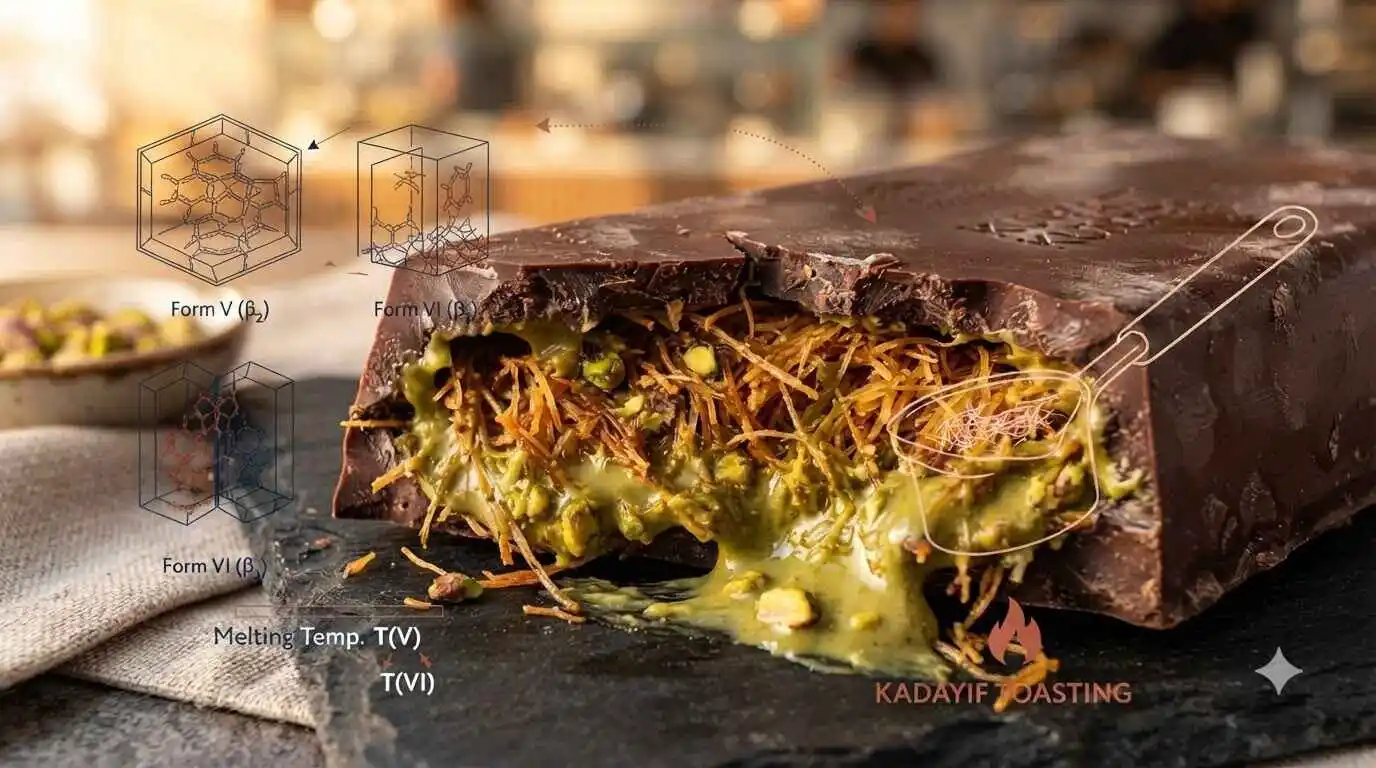
Getting a chocolate bar to snap cleanly rather than crumble or melt too quickly depends on a process called tempering, which controls the crystalline structure of the cocoa butter within the chocolate. Cocoa butter can form six distinct types of crystals, and only one of them, known as Form V, produces the glossy finish, firm snap, and resistance to melting at room temperature that a well-made chocolate bar needs. Untempered chocolate sets with an unstable mix of crystal types, resulting in a dull, streaky surface and a soft, waxy texture that melts too easily and lacks the audible snap central to the Dubai bar’s appeal.
Achieving proper temper at home typically involves carefully heating chocolate to melt all existing crystal structures, cooling it to encourage Form V crystals to form, then gently rewarming it slightly to melt out any less stable crystal types while preserving the desirable ones. This is genuinely one of the more technically demanding steps in recreating the bar, and it is the single step most home attempts skip or rush, which is why so many home versions look correct in a photo but fail to deliver the same firm, glossy snap as the original.
Why Toasting the Kunafa Actually Matters
The crunch inside the bar depends heavily on properly toasting the shredded kunafa pastry in butter before it goes anywhere near the pistachio filling. Raw or undertoasted kunafa contains too much residual moisture and will turn soft and chewy rather than crisp once combined with the pistachio-tahini filling and sealed inside chocolate, since the filling itself contains enough fat and moisture to soften an inadequately dried pastry strand over time.
Toasting drives off that residual moisture while triggering the Maillard reaction, the same browning chemistry responsible for toasted bread and seared meat, which develops a deeper, nuttier flavor in the pastry strands alongside the structural crispness. Toasting the kunafa until it reaches a deep golden color, rather than stopping at a pale, barely-browned stage, is one of the more reliable ways to distinguish an excellent home recreation from a merely adequate one.
The Pistachio and Tahini Pairing, Explained
Pistachio and tahini might seem like an unusual pairing to anyone unfamiliar with Middle Eastern dessert traditions, but the combination works for concrete flavor-chemistry reasons. Tahini, made from ground sesame seeds, contributes a rich, slightly bitter, deeply nutty backbone and a notably smooth, pourable texture due to its high fat content, while pistachio paste delivers a sweeter, greener, more delicate nut flavor along with its distinctive color. Combined, the bitterness of tahini balances and deepens what would otherwise be a one-dimensionally sweet pistachio flavor, producing a more complex, savory-leaning filling than pistachio alone would achieve.
The fat content in both ingredients also plays a functional, not just flavor-based, role: it is what gives the filling its smooth, spreadable consistency at room temperature and helps it bind the toasted kunafa strands together into a cohesive layer rather than a loose, crumbly mixture that would be difficult to enclose neatly inside a chocolate shell.
Where Home Recreations Usually Go Wrong
The most common failure point in home versions is skipping or rushing the chocolate tempering step entirely, resulting in bars that taste correct but look streaky and lack the satisfying snap of the original. A close second is under toasting the kunafa, either from impatience or uncertainty about how dark the pastry should actually get before it is properly crisp, leaving the finished bar soft and gummy inside rather than crunchy.
A third common mistake is using an unbalanced ratio of tahini to pistachio paste, either producing a filling that tastes overwhelmingly of sesame rather than pistachio, or one that is so sweet and one-dimensional it lacks the depth the original balances so carefully. Getting the filling ratio right, along with fully cooling the toasted kunafa before folding it into the filling to avoid melting the fats prematurely, are both small details that meaningfully affect the final result.
What the Nutrition Actually Looks Like
Despite its viral appeal, a Dubai chocolate bar is, nutritionally speaking, exactly what it looks like: a dense, high-fat, high-sugar dessert, not meaningfully different in overall nutritional profile from other filled chocolate bars, aside from a somewhat higher fat content driven by the tahini and pistachio paste. A typical serving delivers a substantial amount of saturated fat and added sugar, and nothing about the trend’s viral popularity changes the basic nutritional reality of a chocolate bar built around nut butter and sugar.
This is worth stating plainly because viral food trends are sometimes marketed with implied health halos simply for containing ingredients like pistachios or tahini, which do have genuine nutritional benefits in their whole, unprocessed forms, but that benefit is substantially diluted once blended into a dessert filling loaded with added sugar and paired with a full milk chocolate shell. It remains, and is reasonably marketed as, an indulgence rather than a health food.
How the Commercial Market Responded
The scale of demand for the original Fix Dessert Chocolatier bars quickly outpaced what a single small business could realistically supply, which opened the door for a wave of commercial copycat versions from established chocolate brands, specialty grocery chains, and countless smaller chocolatiers eager to capture some of the trend’s momentum. Several major retailers introduced their own pistachio-kunafa chocolate bars within months of the original video’s peak virality, a notably fast commercial response time that reflects how quickly modern food trends can move from a single viral clip to shelf-stable retail products.
This rapid commercialization is itself a useful case study in how contemporary food trends propagate: a genuinely scarce, hard-to-obtain original product generates enough attention and demand that the broader market, rather than waiting for the original producer to scale up, moves quickly to create accessible alternatives, often at a lower price point and with far greater availability than the product that originally sparked the trend.
A Trend With Real Culinary Roots
It is worth situating the Dubai chocolate bar within a broader, longer-running trend of fusion desserts that repurpose a traditional regional ingredient or technique inside an unfamiliar, globally recognizable format. Matcha, originally a centuries-old Japanese tea preparation, followed a similar arc when it was folded into lattes, croissants, and Western-style desserts over the past decade, eventually becoming a mainstream flavor largely disconnected from its original ceremonial context. Kunafa’s journey into a chocolate bar shell follows a comparable pattern: a traditional technique or ingredient, re contextualized inside a format built for rapid global distribution and social media share ability.
This pattern is worth understanding both because it explains part of why the trend spread so quickly, an already-familiar chocolate bar format made the unfamiliar pistachio-kunafa combination feel approachable rather than intimidating, and because it points toward where the next viral fusion dessert is likely to come from: an existing traditional technique, reframed inside a globally recognizable, highly shareable format.
Storage and Practical Tips for Home Bakers
Properly tempered chocolate bars should be stored in a cool, dry place, ideally between 60 and 68 degrees Fahrenheit, and away from direct sunlight or strong odors, since chocolate readily absorbs surrounding smells. Refrigeration is generally discouraged for finished bars unless the climate is particularly warm, since condensation forming on the chocolate surface as it comes back to room temperature can create a dulling effect called sugar bloom, distinct from but related to the streaking that results from poor tempering in the first place.
For anyone attempting this at home for the first time, making a smaller test batch before committing to a full recipe is a reasonable way to dial in tempering technique and kunafa toasting time without wasting a large quantity of chocolate and pistachio paste, both of which are relatively expensive ingredients that make repeated full-batch experimentation costly.
Recipe Card
| SERVINGS
8 bars |
PREP TIME
35 min |
CHILL/COOK
10 min + chill |
Ingredients
| Ingredient | Amount |
| Milk or dark chocolate, chopped | 400 g |
| Kunafa (shredded phyllo) pastry, chopped | 150 g |
| Unsalted butter | 60 g |
| Pistachio paste | 180 g |
| Tahini | 40 g |
| Powdered sugar | 2 tbsp |
| Pinch of salt | 1 pinch |
| Green food coloring (optional) | a few drops |
Method
- Chop the kunafa pastry into short strands and toast in butter over medium heat, stirring constantly, until deep golden brown and fully crisp, about 8 to 10 minutes. Spread on a tray and let cool completely.
- In a bowl, combine pistachio paste, tahini, powdered sugar, and a pinch of salt. Mix until smooth, then fold in the cooled toasted kunafa until evenly coated. Add food coloring here if using.
- Temper the chocolate: melt two-thirds of it gently over a double boiler to 45°C, remove from heat and stir in the remaining chopped chocolate until melted and the mixture cools to about 28°C, then gently rewarm to 31-32°C.
- Pour a thin layer of tempered chocolate into silicone chocolate bar molds, tilting to coat the sides evenly. Chill for 5 minutes until set.
- Fill each mold with the pistachio-kunafa mixture, pressing gently and leaving space at the top for a chocolate seal.
- Pour the remaining tempered chocolate over the filling to seal each bar completely, scraping off excess from the top with a bench scraper.
- Refrigerate for 20 to 30 minutes until fully set, then unmold. Store in a cool, dry place away from direct sunlight.
Frequently Asked Questions
| Question | Answer |
| What is a Dubai chocolate bar? | It is a chocolate bar filled with pistachio cream and crunchy toasted kunafa pastry, made famous by Fix Dessert Chocolatier. |
| What is kunafa? | Kunafa is a shredded, phyllo-like pastry traditionally used in Middle Eastern desserts. |
| Why did the Dubai chocolate bar go viral? | A viral video combined with genuine product scarcity created massive online attention and demand. |
| What makes the filling taste unique? | The combination of pistachio paste and tahini creates a balanced, nutty, slightly bitter flavor. |
| Why is chocolate tempering important? | Tempering creates stable cocoa butter crystals that give chocolate its snap, gloss, and shelf stability. |
| What happens if chocolate is not tempered properly? | It sets with a dull, streaky appearance and a soft, less structured texture. |
| Why must kunafa be toasted before use? | Toasting removes moisture and develops flavor, ensuring the pastry stays crunchy inside the filling. |
| Can I use white chocolate instead of milk chocolate? | Yes, though the flavor balance changes since white chocolate is sweeter and lacks cocoa solids. |
| Is tahini necessary in the recipe? | It adds depth and balances the sweetness of the pistachio paste, though it can be reduced to taste. |
| How long do homemade Dubai chocolate bars last? | Properly stored in a cool, dry place, they typically last one to two weeks. |
| Should the bars be refrigerated? | Refrigeration is generally unnecessary unless the room is warm, since it can cause sugar bloom. |
| What is sugar bloom? | It is a dulling, whitish film on chocolate caused by moisture or improper storage temperature changes. |
| Can I substitute kunafa with something else? | Crushed phyllo dough or shredded wheat cereal can approximate the texture, though flavor will differ slightly. |
| Is the Dubai chocolate bar healthy? | No, it is a high-fat, high-sugar dessert despite containing pistachio and tahini. |
| Why do commercial versions vary so much in taste? | Ratios of pistachio, tahini, and chocolate type differ significantly between brands and recipes. |
| What temperature should tempered chocolate reach? | Milk chocolate is typically tempered to around 31 to 32 degrees Celsius after cooling. |
| Can I make this recipe without a candy thermometer? | It is possible but significantly harder to achieve consistent, reliable tempering results. |
| Why does my filling taste too sweet? | An imbalanced ratio of pistachio paste to tahini can result in an overly sweet, one-dimensional filling. |
| What molds work best for these bars? | Silicone chocolate bar molds work well for easy release and clean edges. |
| Can I use store-bought pistachio paste? | Yes, store-bought paste works well and saves significant preparation time. |
| Why did commercial brands create copycat versions so quickly? | High demand and limited original supply created a strong incentive for rapid market response. |
| Is Fix Dessert Chocolatier the original creator of kunafa desserts? | No, kunafa is a centuries-old traditional pastry; the brand popularized this specific chocolate bar format. |
| What gives the filling its green color? | Natural pistachio paste provides a pale green hue, sometimes enhanced with food coloring. |
| Can this recipe be made dairy-free? | Yes, using dairy-free chocolate and butter substitutes can adapt the recipe accordingly. |
| Why is my chocolate shell too thin or fragile? | Insufficiently coating the mold walls during the initial pour can result in a fragile shell. |
| How many bars does this recipe yield? | This recipe yields approximately eight standard-sized chocolate bars. |
| What is the Maillard reaction in this context? | It is the browning chemistry responsible for the deep flavor developed while toasting the kunafa. |
| Can I freeze these chocolate bars? | Freezing is possible but may affect texture and increase the risk of sugar bloom upon thawing. |
| Why is scarcity important to the trend’s popularity? | Genuine limited supply created urgency and media attention beyond typical viral food content. |
| What is the biggest mistake people make recreating this at home? | Skipping proper chocolate tempering is the most common reason home versions fall short. |
Disclaimer: This content offers general health and nutrition information. It is not intended as medical advice, diagnosis, or treatment. Individual dietary needs vary. Please consult a qualified health professional with any questions about your personal health before implementing new meal plans or dietary changes. You are responsible for ensuring recipes are safe for your specific allergies and dietary needs.
