
Table of Contents
Your Urine Is Talking — Are You Listening? What the Color, Smell, and Composition of Your Pee Reveals About Your Health
The body’s most overlooked diagnostic tool flows out of you every single day — and most people flush it without a second glance.
Introduction
Long before blood panels, MRI machines, or genetic sequencing, physicians diagnosed disease by studying something far simpler — urine. Ancient Egyptian papyri dating back to 1500 BCE describe inspecting urine for signs of illness. Greek physicians tasted it to detect sweetness (an early, if unpleasant, test for diabetes). Medieval European doctors held flasks of urine up to sunlight, cataloguing its color, clarity, smell, and consistency in elaborate diagnostic charts called “uroscopy wheels.” For thousands of years across dozens of civilizations, urine was medicine’s most democratic diagnostic tool.
Today, the urinalysis remains one of the most frequently ordered laboratory tests in modern medicine — and for good reason. Urine is a filtered record of your body’s internal chemistry. Every substance your kidneys remove from your bloodstream — waste products, excess minerals, metabolic byproducts, hormones, proteins, glucose, bacteria, and more — leaves a chemical signature in your urine. When something goes wrong anywhere in the body, that signature often changes before you feel a single symptom.
This blog post takes you on a deep, science-grounded journey through the art and science of urinary diagnosis. We will explore what urine actually is, what its color, odor, clarity, and composition can reveal about your health, which diseases announce themselves through urine changes, and when those changes should send you straight to a doctor. By the end, you will look at that morning trip to the bathroom in an entirely different way.

What Is Urine, Really?
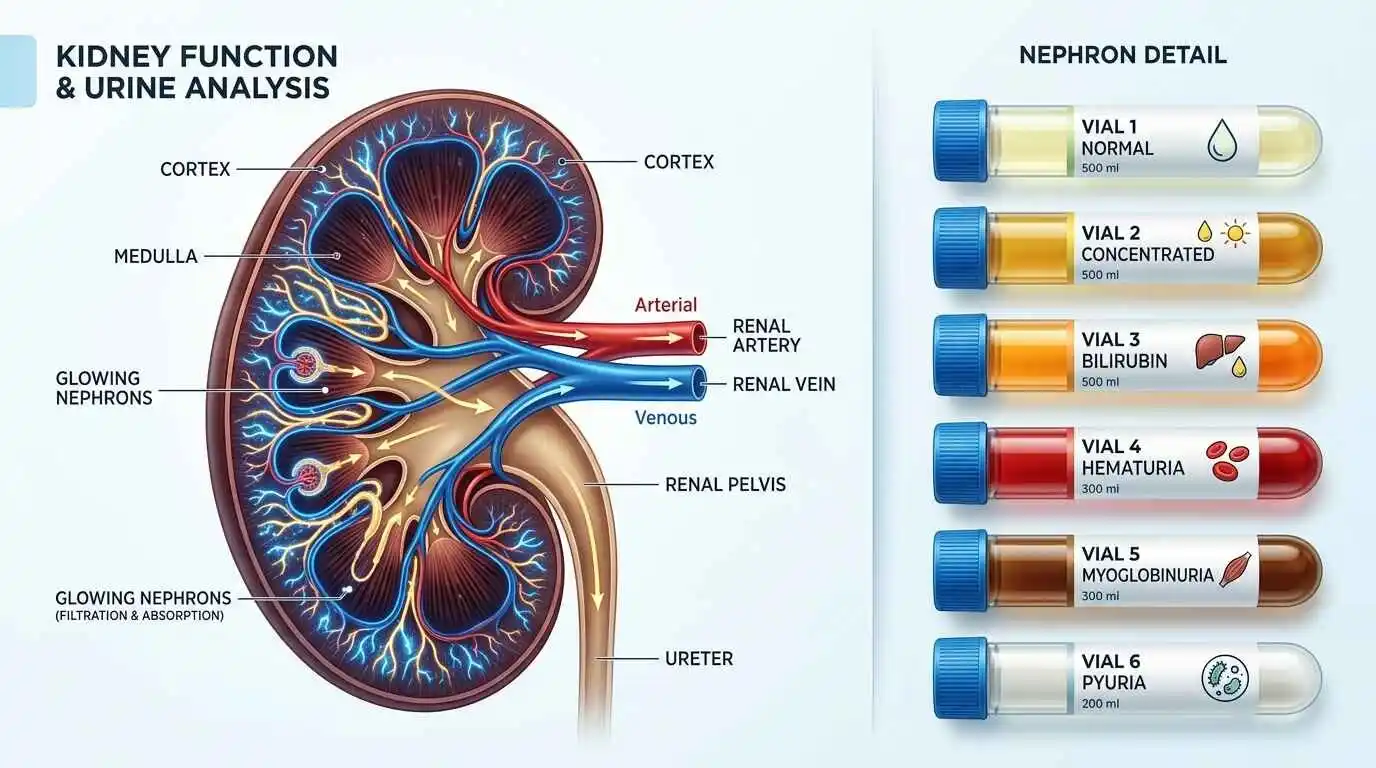
Urine is not simply “liquid waste.” It is a precisely regulated biological fluid produced by the kidneys through an intricate filtration process involving approximately one million tiny filtration units called nephrons in each kidney. Every 24 hours, your kidneys filter roughly 180 liters (about 47 gallons) of blood plasma — and concentrate it into just 1 to 2 liters of urine for excretion.
Healthy urine is approximately 95% water. The remaining 5% is a sophisticated chemical cocktail: urea (the primary nitrogenous waste product of protein metabolism), creatinine (a byproduct of muscle metabolism), uric acid (from purine breakdown), various electrolytes (sodium, potassium, chloride, phosphate, sulfate), hormones and hormone metabolites, vitamins, and trace amounts of enzymes. The kidney’s genius lies in its ability to fine-tune this composition in real time — excreting more sodium when dietary intake is high, conserving water when you are dehydrated, eliminating waste metabolites from drugs or toxins, and maintaining the blood’s delicate pH balance.
When the kidney, liver, bladder, urinary tract, or any organ system whose waste products pass through the kidneys is malfunctioning, the composition of urine shifts — often dramatically. Those shifts are the language in which the urinary diagnosis is built.
Part 1: What Urine Color Reveals
The single most immediately observable characteristic of urine is its color. Normal urine ranges from pale yellow to amber, a pigmentation caused primarily by urochrome (also called urobilin), a byproduct of hemoglobin breakdown. The intensity of the color is directly related to concentration — more concentrated urine is darker; more dilute urine is lighter. But when urine strays from the yellow spectrum, it is often communicating something important.
Colorless or Very Pale Yellow
Nearly clear urine suggests overhydration or excessive fluid intake. While hydration is generally healthy, extremely dilute urine can also indicate diabetes insipidus — a condition in which the body cannot concentrate urine due to dysfunction of antidiuretic hormone (ADH) — or the effect of diuretic medications. In isolation, pale urine is rarely concerning, but in the context of frequent urination, extreme thirst, and large volumes, it warrants investigation.
Dark Yellow to Amber
Deep yellow or amber urine is almost always a sign of dehydration. When fluid intake is insufficient, the kidneys conserve water by producing more concentrated urine. This is the body’s normal response to mild dehydration, and it resolves with adequate fluid intake. Persistent dark urine despite normal hydration can indicate liver disease — when the liver is damaged, it processes bilirubin less efficiently, allowing it to spill into the urine.
Orange
Orange urine can indicate several conditions. Severe dehydration is the most benign. More seriously, it can reflect liver or bile duct problems — when bile cannot flow properly (a condition called cholestasis), bilirubin accumulates in the bloodstream and is excreted in urine, turning it orange or tea-colored. Certain medications — rifampin (an antibiotic), phenazopyridine (a urinary analgesic), and high-dose vitamin B2 (riboflavin) — also produce vivid orange urine.
Pink or Red
Red or pink urine is one of the most alarming color changes and demands prompt medical attention. The most common cause is hematuria — the presence of red blood cells in urine. Hematuria can indicate urinary tract infections (UTIs), kidney stones, bladder or kidney cancer, glomerulonephritis (inflammation of the kidney’s filtering units), prostate problems in men, or significant physical trauma. Not all red urine is blood — eating large quantities of beets, blackberries, or rhubarb can produce harmless pink or red pigmentation. Myoglobinuria, the excretion of muscle protein following severe muscle breakdown (rhabdomyolysis), also produces red-brown urine and is a medical emergency due to its potential to cause acute kidney failure.
Brown or Cola-Colored
Brown urine is a significant clinical finding. It strongly suggests myoglobinuria (rhabdomyolysis), severe liver disease, acute glomerulonephritis, or the accumulation of bile pigments in obstructive jaundice. Certain medications and toxins (including some antimalarial drugs and industrial chemicals) also produce brown urine. Cola-colored urine following strenuous exercise — particularly long-distance running or heavy weightlifting — can signal rhabdomyolysis and should prompt immediate evaluation.
Blue or Green
Blue or green urine is rare and is almost exclusively caused by medications — particularly propofol (an anesthetic), methylene blue (used as a dye and treatment), amitriptyline (an antidepressant), and some multivitamins. Pseudomonas aeruginosa bacterial infection can occasionally produce greenish urine due to pyocyanin pigment. A rare inherited metabolic disorder called blue diaper syndrome causes blue urine in infants due to abnormal tryptophan metabolism. Green urine can also appear in severe cases of hypercalcemia after treatment with certain infusions.
Cloudy or Foamy
Cloudy urine suggests the presence of pus (pyuria), bacteria, mucus, or crystals — typically indicating a urinary tract infection or kidney infection. Persistently foamy urine is a more specific and serious finding: the foam is caused by proteinuria (excess protein in urine), which indicates that the kidney’s filtration barrier is damaged. Nephrotic syndrome, diabetic nephropathy, glomerulonephritis, and early-stage kidney disease are all associated with significant proteinuria. Occasional foaming after forceful urination is normal, but persistent, thick foam warrants a urine protein test.
Part 2: What Urine Odor Reveals
Healthy urine has a mild, slightly ammonia-like odor that intensifies when concentrated or left standing (as bacteria convert urea to ammonia). Significant deviations from this baseline odor are diagnostically meaningful.
Sweet or fruity-smelling urine is one of the most important and actionable odor findings in medicine. It indicates the presence of ketones in the urine — a sign of diabetic ketoacidosis (DKA), a life-threatening complication of uncontrolled type 1 diabetes in which the body breaks down fat for fuel at an unsustainable rate, producing acidic ketone bodies. Sweet-smelling urine can also appear during prolonged fasting, ketogenic dieting, or starvation, when ketosis occurs in a non-pathological context.
Maple syrup-scented urine — exactly as sweet and distinctive as it sounds — is the hallmark of Maple Syrup Urine Disease (MSUD), a rare but serious inherited metabolic disorder in which the body cannot break down certain amino acids (leucine, isoleucine, and valine). If untreated, MSUD causes severe brain damage and is fatal. It is one of the conditions screened for in newborn metabolic panels.
Musty or mousy-smelling urine is associated with phenylketonuria (PKU), another inherited amino acid disorder in which phenylalanine accumulates to toxic levels. PKU is also screened at birth and is manageable with strict dietary control.
Foul, fish-like odor can indicate trimethylaminuria (fish odor syndrome), a metabolic disorder in which trimethylamine accumulates and is excreted in urine, sweat, and breath. Bacterial infections of the urinary tract also produce foul-smelling urine as bacteria metabolize urea and other urinary components. Asparagus consumption produces a well-known sulfurous odor in urine shortly after eating — caused by asparagusic acid metabolites — though not everyone can smell it, suggesting a genetic variation in the olfactory receptor responsible for detecting these compounds.
Ammonia-heavy odor in urine that has just been produced (rather than left standing) typically reflects either severe dehydration or liver disease, as the liver’s capacity to convert ammonia to urea becomes compromised.
Part 3: What Urinalysis Laboratory Tests Reveal
Beyond what can be observed with the eye or nose, modern urinalysis provides an extraordinary window into body chemistry.
The pH of normal urine ranges from 4.5 to 8.0. Persistently acidic urine (low pH) is associated with high-protein diets, uncontrolled diabetes, respiratory or metabolic acidosis, and gout. Persistently alkaline urine (high pH) suggests urinary tract infections with urease-producing bacteria, kidney tubular acidosis, or vegetarian diets high in fruits and vegetables.
Specific gravity measures urine concentration. Values between 1.005 and 1.030 are normal. Low specific gravity indicates diabetes insipidus or overhydration. High specific gravity indicates dehydration, adrenal insufficiency, or conditions that cause fluid retention.
Glucose in urine (glucosuria) is a critically important finding. Normally, healthy kidneys reabsorb all filtered glucose back into the bloodstream. Glucose appears in urine only when blood glucose levels exceed the kidney’s reabsorption threshold — typically around 180 mg/dL. Glucosuria is a hallmark of uncontrolled diabetes mellitus and was historically how the disease was first identified. It can also appear in pregnancy (gestational glucosuria due to a lower reabsorption threshold) and in a rare genetic condition called renal glycosuria.
Protein in urine (proteinuria) is one of the most diagnostically significant urinalysis findings. Healthy kidneys retain proteins in the blood. Proteinuria indicates damage to the glomerular filtration barrier and is associated with diabetic kidney disease, hypertensive nephropathy, lupus nephritis, preeclampsia in pregnancy, and primary kidney diseases like IgA nephropathy and focal segmental glomerulosclerosis (FSGS). The presence of albumin specifically (microalbuminuria) is the earliest detectable marker of diabetic kidney disease — often appearing years before any other clinical sign.
Ketones in urine (ketonuria) reflect fat metabolism and appear in diabetic ketoacidosis, prolonged fasting, alcoholic ketoacidosis, and ketogenic dietary states. Ketonuria in a type 1 diabetic who is not eating is a medical emergency.
Bilirubin and urobilinogen in urine provide information about liver function and red blood cell breakdown. Elevated bilirubin in urine appears in hepatitis, cirrhosis, and biliary obstruction. Elevated urobilinogen suggests hemolytic anemia (excessive red cell breakdown) or liver disease.
Nitrites and leukocyte esterase are the two key markers for urinary tract infection on a dipstick test. Nitrites are produced by gram-negative bacteria converting urinary nitrates. Leukocyte esterase indicates the presence of white blood cells (neutrophils), which are recruited to the urinary tract in response to infection. Together, these findings are highly sensitive for bacterial UTI.
Red blood cells (hematuria) visible on microscopy — even when urine appears normal in color — can be an early sign of bladder cancer, kidney cancer, glomerulonephritis, or urolithiasis. Microscopic hematuria should never be dismissed, particularly in adults over 35 years of age, as it can be the only early symptom of urological malignancy.
Casts — cylindrical structures formed in kidney tubules and shed into urine — are among the most specialized microscopic findings in nephrology. Red cell casts are virtually pathognomonic of glomerulonephritis. White cell casts indicate pyelonephritis (kidney infection) or interstitial nephritis. Fatty casts appear in nephrotic syndrome. Granular casts suggest advanced kidney disease. The presence and type of urinary casts can pinpoint the location and nature of kidney pathology with remarkable precision.
Part 4: Urine and Systemic Disease — The Bigger Picture
The diagnostic power of urine analysis extends far beyond the kidney and urinary tract. Urine is a window into systemic health.
Pregnancy is one of the most famous examples: human chorionic gonadotropin (hCG), produced by the developing placenta, is detectable in urine from as early as 10 days after conception — the basis of home pregnancy tests. Similarly, ovulation predictor kits detect the luteinizing hormone (LH) surge in urine that precedes ovulation.
Hormonal disorders are frequently investigated through urine. Cushing’s syndrome (excess cortisol) is diagnosed in part through a 24-hour urine cortisol collection. Pheochromocytoma (an adrenal tumor that secretes catecholamines) is screened with urine metanephrines. Carcinoid tumors are detected by urinary 5-hydroxyindoleacetic acid (5-HIAA). These are not simple dipstick tests but specialized collections that have become essential in endocrinology.
Drug testing exploits the kidney’s role in excreting drug metabolites. Urine drug screens detect metabolites of opioids, amphetamines, cannabis, cocaine, benzodiazepines, and more, often for days to weeks after the substance was consumed.
Heavy metal toxicity — from lead, mercury, arsenic, or cadmium — is confirmed through urine heavy metal panels, as these elements are excreted renally. Similarly, porphyrias (metabolic disorders of heme synthesis) are diagnosed by measuring urinary porphyrins and their precursors, which accumulate and discolor urine to shades of red, brown, or purple.
Conclusion
Urine is not waste — it is data. Every sample tells a story about hydration status, kidney function, metabolic health, hormonal balance, and the presence or absence of infection, malignancy, or systemic disease. From the color it presents to the microscopic casts it contains, urine carries diagnostic information that spans millennia of medical discovery and continues to power cutting-edge diagnostics today.
The next time you notice an unusual color, a strange odor, unusual foam, or a change in volume or frequency, resist the instinct to dismiss it. Your kidneys are among the most sophisticated filtration systems in the natural world, and the fluid they produce is a continuous, real-time health report. Knowing how to read it — even partially — could be one of the most important things you do for your health.
When in doubt, see a healthcare provider and request a urinalysis. It remains one of the cheapest, fastest, and most informative tests in all of medicine. The answers may surprise you.
FAQs
- What does the color of urine normally look like?
Healthy urine ranges from pale yellow to amber, depending on hydration level. The yellow pigment is produced by urochrome, a byproduct of hemoglobin breakdown. Pale yellow and well-diluted urine generally indicates good hydration.
- What does dark yellow or brown urine mean?
Dark yellow urine usually signals dehydration — the kidneys are conserving water. Brown or cola-colored urine is more serious and can indicate rhabdomyolysis, severe liver disease, glomerulonephritis, or medication effects. It warrants medical evaluation.
- Is it normal for urine to smell strong?
Concentrated urine, particularly in the morning or after sweating, normally has a stronger ammonia-like smell. Persistently foul, sweet, fruity, or fishy odors are abnormal and can indicate infections, metabolic disorders, or uncontrolled diabetes.
- Why does my urine smell sweet or fruity?
Sweet or fruity-smelling urine indicates the presence of ketones, typically from diabetic ketoacidosis (DKA), prolonged fasting, or a ketogenic diet. In a diabetic patient, this is a medical emergency requiring immediate attention.
- What causes foamy urine?
Occasional foaming is normal from forceful urination. Persistent, thick foam indicates proteinuria — excess protein leaking through damaged kidney filters. This is associated with diabetic nephropathy, nephrotic syndrome, and glomerulonephritis.
- What does blood in urine (hematuria) mean?
Blood in urine can range from harmless (intense exercise, minor trauma) to serious (kidney stones, UTI, bladder or kidney cancer, glomerulonephritis). Visible blood or persistent microscopic hematuria always warrants medical investigation.
- Can urine diagnose diabetes?
Yes. Glucose in urine (glucosuria) is a classic early indicator of uncontrolled diabetes mellitus. Ketones in urine indicate diabetic ketoacidosis. Home dipstick tests and laboratory urinalysis can detect both. However, formal blood glucose testing is required for diagnosis.
- What causes orange urine?
Orange urine can result from severe dehydration, liver or bile duct disease (from excess bilirubin), or medications including rifampin, phenazopyridine, and high-dose riboflavin (vitamin B2).
- What is a urinalysis, and what does it test for?
A urinalysis is a standard laboratory examination of a urine sample. It typically includes visual inspection (color, clarity), chemical dipstick testing (pH, protein, glucose, ketones, blood, bilirubin, leukocyte esterase, nitrites), and microscopic examination (cells, casts, crystals, bacteria).
- What does protein in urine indicate?
Proteinuria indicates damage to the kidney’s glomerular filtration barrier. It is associated with diabetic kidney disease, hypertensive nephropathy, lupus nephritis, preeclampsia, and primary kidney disorders. Microalbuminuria is the earliest detectable sign of diabetic kidney damage.
- Why does my urine smell like ammonia?
Ammonia-smelling urine is most often caused by dehydration or holding urine for extended periods. It can also reflect liver disease (impaired ammonia-to-urea conversion) or a urinary tract infection with certain bacteria.
- What do urinary casts indicate?
Urinary casts are cylindrical structures formed in the kidney’s tubules. Different types indicate different conditions: red cell casts suggest glomerulonephritis, white cell casts indicate kidney infection or nephritis, granular casts suggest progressive kidney disease, and fatty casts appear in nephrotic syndrome.
- What causes cloudy urine?
Cloudy urine is typically caused by urinary tract infection (pus, bacteria, white blood cells), kidney stones (crystals), or excess protein. It can also result temporarily from concentrated urine with high mineral content (phosphaturia or uraturia).
- What is a urinary tract infection (UTI)?
A UTI is a bacterial infection of the urethra, bladder, or kidneys. Classic symptoms include painful urination, frequent urges, cloudy or foul-smelling urine, and sometimes blood in urine. Urinalysis typically shows nitrites, leukocyte esterase, and white blood cells.
- Can urine detect kidney disease early?
Yes. Microalbuminuria (tiny amounts of albumin in urine) can detect early diabetic kidney disease years before other symptoms appear. Microscopic hematuria and proteinuria are also early markers of various kidney diseases detectable by routine urinalysis.
- What causes blue or green urine?
Blue or green urine is rare and almost always medication-related — propofol, methylene blue, amitriptyline, and some multivitamins are common causes. Pseudomonas aeruginosa infection and a rare condition called blue diaper syndrome can also produce this unusual color.
- What does the pH of urine tell us?
Urine pH reflects the body’s acid-base balance and dietary patterns. Acidic urine (low pH) appears with high-protein diets, diabetes, and acidosis. Alkaline urine (high pH) appears with vegetarian diets, certain bacterial infections, and renal tubular acidosis.
- Is it normal to have ketones in urine?
Small amounts of ketones can appear during fasting, low-carbohydrate dieting, or intense exercise. Significant ketonuria in a diabetic patient indicates ketoacidosis — a medical emergency. Persistent ketonuria outside of these contexts should be evaluated by a physician.
- What does bilirubin in urine mean?
Bilirubin should not normally appear in urine. Its presence indicates that the liver is failing to process or excrete it properly, as seen in hepatitis, cirrhosis, or bile duct obstruction. It typically causes orange or brown discoloration of urine.
- How does urine change during pregnancy?
Pregnancy introduces several urinalysis changes. Human chorionic gonadotropin (hCG) is detectable in urine from early pregnancy. Glucosuria is more common in pregnancy. Proteinuria in the third trimester, especially with high blood pressure, suggests preeclampsia — a serious obstetric emergency.
- What is maple syrup urine disease?
Maple Syrup Urine Disease (MSUD) is a rare inherited metabolic disorder in which branched-chain amino acids (leucine, isoleucine, valine) cannot be metabolized. The urine has a distinctive maple syrup or burnt sugar odor. It is screened for at birth and requires strict dietary management.
- What is specific gravity in a urine test?
Specific gravity measures how concentrated or dilute the urine is. Normal ranges from 1.005 to 1.030. Low values suggest overhydration or diabetes insipidus; high values suggest dehydration or conditions that reduce urine output. It reflects the kidney’s concentrating ability.
- Can dehydration be detected through urine alone? Y
- The simplest way to gauge hydration is urine color — pale yellow indicates good hydration, while dark yellow to amber signals dehydration. High specific gravity and elevated creatinine concentration in urinalysis also confirm dehydration.
- What are kidney stones, and how do they appear in urine?
Kidney stones are crystallized mineral deposits that form in the kidneys. They appear in urine as crystals on microscopy and can cause hematuria (blood), pain, and cloudy urine. Common types include calcium oxalate, uric acid, struvite, and cystine crystals.
- What is rhabdomyolysis, and how does it affect urine?
Rhabdomyolysis is the breakdown of skeletal muscle tissue, releasing myoglobin into the bloodstream. Myoglobin is excreted by the kidneys, causing cola-colored or red-brown urine (myoglobinuria). This is a medical emergency because myoglobin can cause acute kidney injury.
- Can urine tests detect cancer?
Urine tests can detect certain cancers. Microscopic hematuria is a key early symptom of bladder and kidney cancer. Urine cytology (examining cells shed into urine) can detect bladder cancer cells. Elevated urinary 5-HIAA detects carcinoid tumors. Research is advancing into urine-based biomarker tests for prostate and other cancers.
- What causes frequent urination?
Frequent urination (polyuria) can indicate diabetes mellitus, diabetes insipidus, urinary tract infection, overactive bladder syndrome, prostate enlargement in men, or excessive fluid intake. It can also be a side effect of diuretic medications or caffeine.
- How does glomerulonephritis affect urine?
Glomerulonephritis is inflammation of the kidney’s filtering units. It characteristically produces hematuria (red blood cells in urine), proteinuria, red cell casts on microscopy, and sometimes cola-colored urine. It can be caused by autoimmune diseases, infections, and other systemic conditions.
- Can urine odor indicate what food I have eaten?
Absolutely. Asparagus produces a sulfurous odor within 15–30 minutes of consumption due to asparagusic acid metabolites. Coffee, garlic, onions, and certain spices also alter urine odor temporarily. These dietary odor changes are harmless and transient.
- When should I see a doctor about changes in my urine?
You should seek medical evaluation promptly if you notice: blood or pink/red discoloration in your urine, persistent foamy urine, significant pain during urination, strong or foul persistent odor, extremely dark urine without dehydration, unusually large or small urine volumes, or urine color changes that cannot be explained by diet or medication. Many serious conditions are highly treatable when caught early.
⚕️Medical Disclaimer:
The information provided on this website is for general educational and informational purposes only and is not intended as a substitute for professional medical advice, diagnosis, or treatment. Always seek the advice of your physician or other qualified health provider with any questions you may have regarding a medical condition. Never disregard professional medical advice or delay in seeking it because of something you have read on this website.
