
Table of Contents
The Desert’s Watchtower: Unlocking the Secrets, Survival, and Society of the Meerkat
The Kalahari Desert is a land of extremes. It is a vast, arid expanse where the sun scorches the earth by day, temperatures plummet to freezing by night, and the barren red sands offer little mercy to those who call it home. Yet, if you stand quietly at the break of dawn near a cluster of sandy mounds, you might witness one of the most remarkable spectacles in the natural world. The earth begins to shift. Small, dark heads pop up from the subterranean darkness, blinking against the early light. Then, like a fuzzy, hyperactive battalion, dozens of slender creatures emerge, standing tall on their hind legs, noses twitching, eyes scanning the horizon. These are the meerkats, and they are far more than just the cute, quirky animals popularized by television commercials and memes. They are highly intelligent, fiercely cooperative, and ruthlessly efficient survivors.
To truly understand the meerkat is to look past the endearing exterior and dive deep into a complex world of underground architecture, matriarchal dictatorships, venomous dietary habits, and a sophisticated communication network that rivals some human societies. This is the complete story of the meerkat, from the anatomy that allows it to thrive in a harsh wasteland to the intricate social bonds that keep it alive.
The Mongoose Connection: Taxonomy and Evolutionary Roots
Before we can understand the meerkat’s unique adaptations, we must first establish its place in the animal kingdom. Scientifically known as Suricata suricatta, the meerkat is a small carnivoran belonging to the family Herpestidae—the mongooses. Despite their shared name and general body shape, meerkats are not closely related to felines or canines. Instead, they are part of a superfamily called Feliformia, which means they are actually more closely related to cats, hyenas, and civets than they are to dogs or bears.
The meerkat is the only member of the genus Suricata, distinguishing it significantly from its mongoose cousins. While other mongooses are often solitary or live in loose, temporary pairs, the meerkat evolved a strictly social, cooperative breeding structure. This evolutionary pivot toward intense sociality is believed to have been driven by the harsh realities of their environment. In a landscape where predators are abundant and food is scattered, surviving alone is nearly impossible. By banding together, meerkats gained the ability to post sentinels, babysit young, and defend territory collectively.

Fossil records and genetic studies suggest that the Herpestidae family originated in Asia, eventually migrating into Africa. The meerkat’s ancestors adapted specifically to the open, arid savannas and deserts of Southern Africa, shedding the arboreal (tree-climbing) tendencies of some of their tropical relatives in favor of a strictly terrestrial, burrowing lifestyle.
Anatomy of a Desert Survivor
Every physical feature of a meerkat is a masterclass in evolutionary adaptation, fine-tuned over millions of years to conquer the challenges of the desert.
The Coat and Camouflage A meerkat’s fur is not merely for show; it is a specialized suit of armor against the elements. Their coat is typically a light, peppered grey-brown with faint, horizontal stripes across their backs. This coloration provides perfect camouflage against the khaki, scrub-covered sands of the Kalahari and Namib deserts. Surprisingly, the meerkat’s belly is completely devoid of fat and has very thin fur. When they need to absorb the heat of the morning sun after a freezing desert night, they will stand upright and expose their bellies to the rays, acting almost like solar panels to quickly warm their core temperature.
The Built-In Sunglasses Perhaps the most iconic feature of the meerkat is the dark patches of fur around its eyes. While they look like a thief’s mask, these patches serve a vital biological function: they act as built-in sunglasses. Just like the black greasepaint worn by baseball players, the dark fur absorbs the intense, blinding glare of the desert sun, reducing glare and allowing the meerkat to spot aerial predators like eagles and hawks from incredible distances.
Digging Machines: A meerkat’s forelimbs are disproportionately strong compared to the rest of its body. They possess long, robust, non-retractable claws that curve downward. These claws are not meant for climbing or killing large prey; they are specialized excavating tools. A meerkat can move its own body weight in sand in just a few seconds. They use their claws to dig out scorpions, beetles, and lizards, and more importantly, to construct the massive underground tunnel systems that serve as their homes.
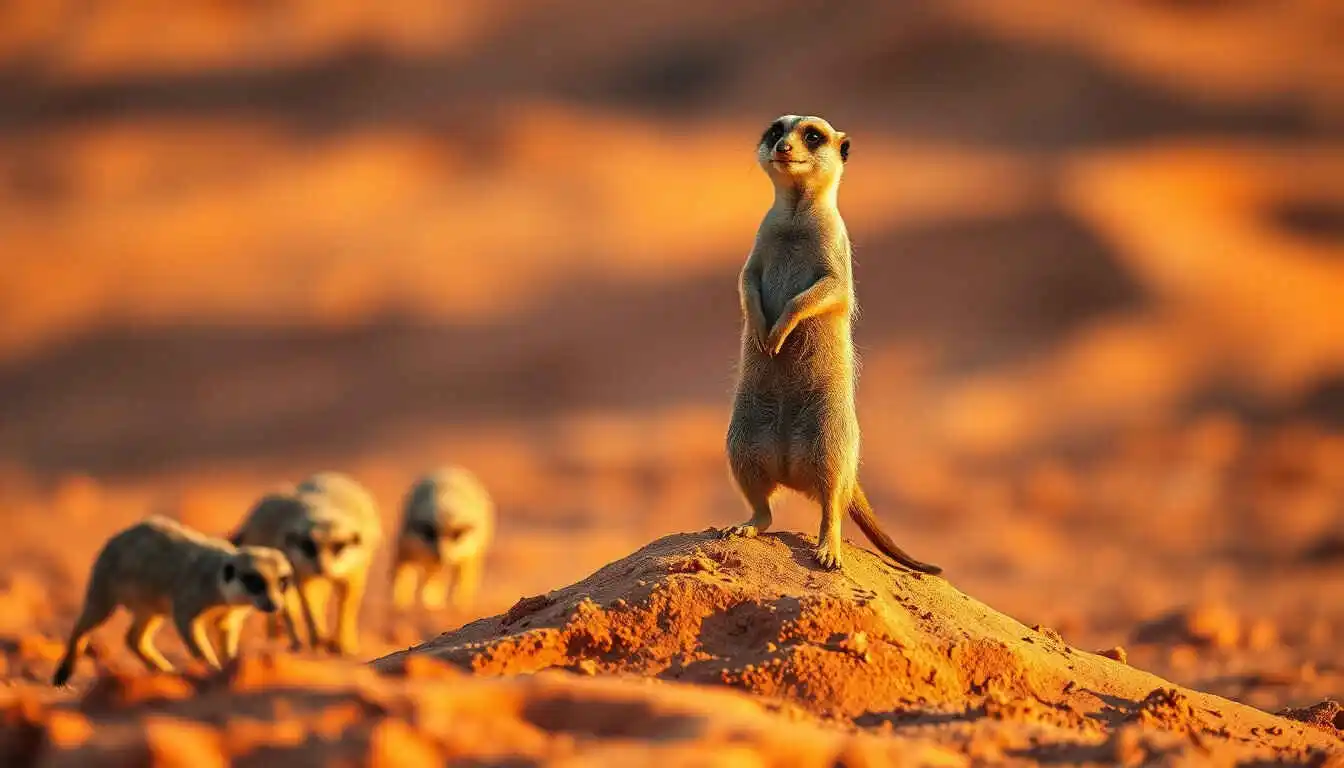
The Tail as a Tripod When a meerkat stands upright on its two hind legs to act as a sentry, it utilizes its tail as a stabilizing tripod. The tail is long, slender, and gradually tapers to a dark tip with a black or reddish-brown tuft at the end. By stiffening the tail and planting it firmly on the ground behind them, meerkats can maintain perfect balance for extended periods, even while twisting their torsos to get a 360-degree view of the surroundings.
Architects of the Underworld: Burrow Systems
Meerkats are fossorial animals, meaning they spend a significant portion of their lives underground. Their burrow systems, often called warrens or bolt-holes, are feats of engineering that are essential for their survival.
A single meerkat mob’s territory can contain upwards of 50 to 100 different burrow entrances, spread out over several kilometers. These are not just simple holes in the ground; they are complex, multi-chambered networks that can extend up to 1.5 meters (5 feet) below the surface. The tunnels wind and turn, featuring dead ends designed to confuse predators that might manage to dig their way in, and specific chambers designated for sleeping, birthing, and sheltering from extreme weather.
The thermal regulation provided by these burrows is critical. In the Kalahari, summer daytime temperatures can exceed 40°C (104°F), while winter nights can drop well below freezing. Just a few feet underground, the temperature remains remarkably stable and moderate, protecting the mob from heatstroke and hypothermia. Furthermore, when the rare desert rains do come, the deep burrows provide a dry refuge against flash floods.
Because the desert sand is inherently unstable, these burrows require constant maintenance. Every day, the meerkats will spend time digging out collapsed tunnels, expanding chambers for growing pups, and occasionally digging entirely new bolt-holes while out foraging, ensuring they are never too far from a safe escape route.
The Menu of the Desert: Diet and Foraging
Meerkats are opportunistic, primarily insectivorous carnivores. They will eat almost anything they can overpower and fit in their mouths, but their diet is heavily skewed toward invertebrates. Beetles, caterpillars, spiders, and centipedes make up the bulk of their daily intake. However, their most famous and most dangerous dietary choice is the scorpion.
Dancing with Death: Eating Scorpions. The Kalahari is home to some of the most venomous scorpions in the world, including the thick-tailed scorpion (Parabuthus transvaalicus), whose sting can be fatal to a human and easily kill a small meerkat. Yet, meerkats devour them with alarming nonchalance.
When a meerkat uncovers a scorpion, a rapid, highly choreographed sequence ensues. The meerkat will quickly dart in and bite off the scorpion’s stinger (telson) and venom glands with its sharp teeth. It then aggressively rubs the scorpion in the sand to remove any remaining residual venom before swallowing the carcass whole. This behavior is not entirely instinctive; young pups must learn the specific technique of disarming a scorpion. Elders will often catch a scorpion, disable it, and give it to a pup to practice on, ensuring the next generation knows how to handle the desert’s deadliest prey.
Beyond Bugs When insects are scarce, meerkats will diversify their menu. They are adept at hunting small lizards, geckos, and snakes. They will raid the nests of ground-dwelling birds for eggs or chicks, and they are known to consume small rodents, amphibians, and even certain toxic millipedes, which they roll in the sand to excrete a toxic fluid before eating. Very rarely, if food is exceptionally scarce, they may consume roots and tubers, but their digestive system is fundamentally built for meat.
Meerkats have a remarkably high metabolic rate, which means they must forage constantly. A mob will spend several hours every morning and afternoon digging and foraging, moving as a cohesive unit across the territory, constantly communicating to keep track of each other’s positions.
The Mob: Social Structure and Matriarchy
The most fascinating aspect of meerkat biology is their social structure. Meerkats live in groups known as mobs, gangs, or clans, typically consisting of 20 to 50 individuals, though super-groups of over 80 have been documented. Unlike wolf packs or lion prides, where a dominant male leads, meerkat society is strictly matriarchal. The dominant female is the absolute ruler of the mob.
The Despot and the Dominant Male. The alpha female is the largest, most aggressive member of the group. She holds the exclusive right to breed. If any subordinate female becomes pregnant, the alpha female will usually evict her from the group, or worse, kill and eat the subordinate’s pups. This brutal behavior ensures that the alpha’s offspring receive 100% of the mob’s resources and attention, maximizing the survival of her genetic lineage.
The alpha male is her mate, but his status is secondary. He maintains his position by defending the territory against rival mobs and standing guard, but if he fails in his duties or shows weakness, the alpha female will readily drive him out and mate with a roaming male from another group.
The Subordinates The rest of the mob is made up of subordinate adults, usually the offspring of previous alpha litters. These subordinates are not mere freeloaders; their existence is entirely tied to cooperative labor. They act as sentries, babysitters, and foragers. In return for their service, they receive the protection of the group and the benefit of living in a defended territory with established burrows. Subordinates are generally not permitted to breed, but in highly unusual circumstances, such as the sudden death of the alpha female, a subordinate may ascend the ranks and take over the throne.
Babysitters of the Kalahari: Cooperative Breeding
Meerkats are the quintessential example of cooperative breeders. When the alpha female gives birth—usually to a litter of two to five pups—the entire mob mobilizes to ensure their survival.
For the first three to four weeks of their lives, the pups are entirely confined to the burrow, completely blind and helpless. During this time, they cannot thermoregulate their own bodies. If the mother leaves to forage, subordinate adults—both male and female—will stay behind in the burrow to act as babysitters. These babysitters will forgo their own meals to keep the pups warm, often sacrificing their own physical condition for the good of the alpha’s litter.
Once the pups are old enough to emerge from the burrow, the babysitting duties shift to escorting. For the next several weeks, the pups are too small and slow to keep up with the foraging mob. A rotating squad of adults will stay behind with the pups, acting as guards and tutors. They will bring small, dead scorpions or beetles to the pups, gradually introducing them to live prey as they grow. This intensive, communal investment in the young is incredibly rare in the mammalian world and is the primary reason meerkat mobs are so successful.
The Language of the Mob: Communication and Intelligence
To coordinate a group of 30 individuals across a vast, open desert, meerkats require a complex communication system. They possess one of the most sophisticated vocal repertoires of any carnivore, with scientists identifying over 30 distinct vocalizations that serve specific purposes.
The Sentinel’s Watchman’s Song When a meerkat takes up the role of sentinel—standing on a termite mound or high rock to watch for predators—it emits a continuous, low-pitched, rhythmic sound known as the “watchman’s song.” This sound acts as an all-clear signal to the foraging mob below, essentially saying, “I am watching, the sky is clear, keep digging.” The foraging meerkats can hear this sound from dozens of meters away and will not raise their heads from the sand as long as the song continues.
Urgent Alarm Calls If the sentinel spots a predator, the watchman’s song stops abruptly, replaced by one of several distinct alarm calls, each specific to the type of threat and the urgency level.
- Aerial Predators (Eagles/Hawks): A sharp, high-pitched bark. This causes the mob to instantly drop flat onto the ground or sprint for the nearest bolt-hole, as an aerial attack is fast and requires immediate cover.
- Terrestrial Predators (Jackals/Big Cats): A deeper, harsher bark. The mob will typically bunch together, face the threat, and back away slowly toward a burrow.
- Snakes: A specific, clucking alarm call. Because snakes are relatively slow, the mob will often mob the snake, harassing it and trying to drive it away rather than immediately fleeing.
Social Chatter Beyond alarms, meerkats have specific calls for reunions (when separated individuals find each other), aggressive growls for territorial disputes, and soft “close calls” used to maintain contact while foraging in tall grass. Remarkably, research has shown that meerkat calls can convey not just the type of predator, but the level of danger (e.g., a bird flying far away vs. a bird diving directly at them), and in some cases, the identity of the individual calling.
They also communicate heavily through scent. Meerkats have anal and subcaudal scent glands that they use to mark territory boundaries and identify members of their own mob. When two mobs meet at a border, it often results in aggressive posturing, scent-marking, and violent chases.
The Harsh Reality: Threats, Predators, and Mortality
Despite their cooperative brilliance, the life of a meerkat is brutally short and fraught with danger. In the wild, the average lifespan of a meerkat is only about 5 to 7 years, with many dying long before that. The mortality rate for pups in their first year can exceed 50%.
The Assassins from Above. The greatest threat to a meerkat is the air force. Martial eagles, tawny eagles, and pale chanting goshawks are the apex predators of the Kalahari skies. These birds have incredible eyesight and can spot a meerkat from hundreds of feet in the air. A single martial eagle can easily carry away an adult meerkat, and they frequently target foraging mobs, causing panic and chaos.
Ground Predators On the ground, meerkats face threats from black-backed jackals, bat-eared foxes, and occasionally cheetahs or leopards. However, their most terrifying ground enemy is the cape cobra. Cobras are highly venomous and can easily enter meerkat burrows. When a cobra is discovered, the mob will form a tight circle around it, puffing up their fur to look larger, hissing aggressively, and taking turns darting in to bite the snake’s tail. While meerkats are highly resistant to certain venoms, a cobra bite is still frequently fatal.
The Invisible Killer: Drought. While predators are dramatic, the silent killer of the meerkat is the environment. Extended droughts in Southern Africa can decimate meerkat populations. When the ground becomes too hard to dig, insects and scorpions burrow deep and become inaccessible. The meerkats’ high metabolism works against them; they cannot simply store fat and wait out a famine. During severe droughts, mobs will weaken, pups will starve, and the entire social structure can collapse, forcing survivors to disperse and find new groups.
Dispersal: Leaving the Mob
For subordinate meerkats, life in the mob is a trade-off. They are safe and fed, but they are genetically dead ends as long as the alpha female is in power. To pass on their own genes, subordinates—usually young males, but occasionally females—must leave their birth mob in a process called dispersal.
Dispersal is incredibly dangerous. A lone meerkat outside of its mob is highly vulnerable to predators. Furthermore, neighboring meerkat mobs are intensely territorial. A dispersing individual attempting to join a new group faces aggressive rejection and can be severely injured or killed by the resident mob.
If a dispersing male is lucky, he may find a group where the alpha male has recently died or been overthrown, and he can integrate himself as the new dominant male. Females rarely join existing mobs; instead, they often team up with dispersing males from other groups to form entirely new mobs from scratch—a monumental task that requires finding unclaimed territory, digging a complex burrow system, and surviving long enough to establish a foothold in the harsh desert.
Meerkats and Humans: Culture and Conservation
Humans have had a long, complex relationship with meerkats. Indigenous San peoples of the Kalahari have historically viewed meerkats with a mix of reverence and practicality. Some traditions hold that meerkats are the protectors of the desert, and it was considered bad luck to harm them. Practically, however, the San sometimes utilized abandoned meerkat burrows to find water in emergencies, as the deep tunnels could sometimes reach damp soil.
In modern times, the meerkat has achieved global pop-culture superstardom. From the animated meerkat Timon in Disney’s The Lion King to the viral “Compare the Meerkat” advertising campaign in the UK, the meerkat’s upright posture and seemingly expressive faces have made them internet darlings. The landmark documentary series Meerkat Manor, which followed the daily lives of a wild mob called the Whiskers, revolutionized wildlife filmmaking by giving individual meerkats names and portraying their lives with the drama of a soap opera, deeply connecting the public to the emotional lives of these animals.
Conservation Status: Fortunately, the meerkat is currently listed as “Least Concern” on the IUCN Red List of Threatened Species. They are incredibly abundant across their range in South Africa, Namibia, Botswana, and Angola. Their ability to reproduce quickly when conditions are good, combined with their adaptability to different arid environments, has insulated them from the population crashes seen in other African carnivores.
However, “Least Concern” does not mean “no concern.” Climate change poses a long-term, existential threat. As global temperatures rise, the deserts of Southern Africa are expected to become hotter and drier. Increased frequency and severity of droughts could eventually outpace the meerkat’s incredible adaptive capabilities. Furthermore, while they are not heavily poached, they can fall victim to indiscriminate predator control methods used by farmers, such as poison baits left out for jackals or caracals.
Ecotourism has become a vital tool in meerkat conservation. In places like the Tswalu Kalahari Reserve in South Africa, wild meerkats have been carefully habituated to human presence. Tourists can sit quietly with a mob as they forage, stand guard, and interact. This generates crucial revenue for reserve management and local communities, providing a direct financial incentive to protect the desert ecosystem. Importantly, when done correctly, this habituation does not alter the meerkats’ natural behaviors or make them dependent on humans; it simply removes their natural fear of our species, allowing for a breathtaking window into their world.
Conclusion: The Heartbeat of the Desert
The meerkat is a profound contradiction. It is incredibly small, yet it dominates the vast, unforgiving landscapes of the Kalahari. It looks soft and comical, yet it survives by hunting highly venomous scorpions and battling deadly snakes. It lives in a seemingly peaceful, democratic society, yet that society is ruled by an iron-fisted matriarch willing to kill her own kind to maintain power.
But above all, the meerkat is a testament to the power of unity. In a world where isolation often means death, the meerkat has evolved to intertwine its fate completely with the lives of those around it. The sentinel standing tall on the termite mound is not just watching for eagles; it is fulfilling an ancient, unspoken contract with the foragers below. The babysitter skipping a meal to warm a shivering pup is not acting out of human-like altruism, but executing a biological imperative that ensures the survival of the mob.
When you watch a meerkat mob emerge from the red earth in the early morning light, you are not just looking at a group of cute animals. You are witnessing one of nature’s most successful, tightly knit societies. They are the watchtowers of the desert, standing tall against the odds, reminding us that in the harshest environments on Earth, survival is rarely a solo endeavor. It is a shared burden, a collective triumph, and a beautiful, endless echo of cooperation in the dust.
FAQs
- What is the scientific name of the meerkat?
Suricata suricatta.
- Are meerkats more closely related to dogs or cats?
Despite looking similar to dogs or ferrets, they belong to the Feliformia superfamily, making them more closely related to cats, hyenas, and civets.
- Why do meerkats have dark patches of fur around their eyes?
They act as built-in sunglasses, absorbing the intense glare of the desert sun and helping them spot aerial predators.
- How do meerkats warm themselves up after a freezing desert night?
They stand upright and expose their thin-furred bellies to the morning sun, using their bodies almost like solar panels to absorb heat.
- What is the biological function of a meerkat’s tail when it stands upright?
It acts as a stabilizing tripod, allowing them to balance perfectly on their hind legs for extended periods.
- How do meerkats use their claws in their daily lives?
They have long, non-retractable claws used as specialized excavating tools for digging out prey, maintaining burrows, and moving sand.
- How deep do meerkat burrow systems typically extend into the ground?
They can extend up to 1.5 meters (5 feet) below the surface.
- Why do meerkat tunnels feature dead ends and sharp turns?
To confuse and trap predators that might manage to dig their way into the tunnel system.
- Are meerkats herbivores, carnivores, or omnivores?
They are primarily insectivorous carnivores, though they will occasionally eat roots/tubers in extreme scarcity.
- How are meerkats able to eat highly venomous scorpions without dying?
They quickly bite off the scorpion’s stinger and venom glands, then aggressively rub the scorpion in the sand to remove any leftover venom before eating it.
- Do meerkat pups instinctively know how to disarm a scorpion?
No, they must learn the technique. Elders will catch a scorpion, disable it, and give it to the pups to practice on.
- What is a group of meerkats commonly called?
A mob, gang, or clan.
- What type of social structure do meerkat mobs operate under?
A strict matriarchy ruled by a dominant female, with cooperative breeding and labor among subordinate members.
- Who holds the ultimate power and breeding rights in a meerkat mob?
The alpha female.
- What happens if a subordinate female meerkat becomes pregnant?
The alpha female will usually evict her from the group, or kill and eat the subordinate’s pups to ensure only her own lineage survives.
- What does “cooperative breeding” mean in the context of meerkats?
The entire mob works together to protect, feed, babysit, and tutor the alpha female’s pups, rather than the mother raising them alone.
- Do subordinate meerkats sacrifice their own meals to help raise pups?
Yes, babysitters will forgo their own foraging to stay in the burrow and keep the pups warm and protected.
- How many distinct vocalizations have scientists identified in meerkats?
Over 30 distinct vocalizations.
- What is the “watchman’s song,” and what does it signify?
It is a continuous, low-pitched, rhythmic sound made by a sentinel meerkat, signaling to the foraging mob that the sky is clear and it is safe to keep digging.
- Do meerkats have different alarm calls for different types of predators?
Yes, they have specific calls for aerial threats (sharp, high-pitched barks), terrestrial threats (deeper, harsher barks), and snakes (specific clucking sounds).
- What is the primary aerial predator that meerkats fear the most?
The martial eagle, which is large enough to carry away an adult meerkat.
- How does a meerkat mob typically respond to a ground threat like a cape cobra?
Instead of fleeing, they will form a tight circle, puff up their fur to look larger, hiss aggressively, and take turns darting in to harass the snake.
- What is the average lifespan of a meerkat in the wild?
Only about 5 to 7 years.
- Why is drought considered the “invisible killer” of meerkats?
Droughts harden the ground, making insects and scorpions burrow deep and become inaccessible, leading to starvation because meerkats cannot store fat.
- What is “dispersal” and why do young meerkats do it?
Dispersal is when subordinate meerkats (usually males) leave their birth mob to find a new group where they can become dominant and breed.
- Why is leaving the safety of the birth mob so dangerous for dispersing meerkats?
Lone meerkats are highly vulnerable to predators and face violent, potentially fatal rejection from neighboring territorial mobs.
- What is the current IUCN conservation status of the meerkat?
Least Concern, as they are abundant across their range.
- How could climate change potentially threaten meerkat populations in the future?
Increased frequency and severity of droughts could outpace the meerkat’s incredible adaptive capabilities.
- Why can’t meerkats simply store body fat to survive long droughts?
They have a remarkably high metabolic rate that requires them to forage and eat constantly.
- What famous wildlife documentary series helped turn meerkats into global pop-culture icons?
Meerkat Manor, which followed the daily lives of a wild mob called the Whiskers with the drama of a soap opera.
Disclaimer: The content on this blog is for informational purposes only. The author’s opinions are personal and not endorsed. Efforts are made to provide accurate information, but completeness, accuracy, or reliability are not guaranteed. The author is not liable for any loss or damage resulting from the use of this blog. It is recommended to use the information on this blog at your own discretion.
