
Table of Contents
THE ARCHITECTURE OF GLORY | Football Series
When Football Broke Free: The Total Revolution That Rewired the Beautiful Game
How Johan Cruyff, Rinus Michels, and the 1974 Dutch Oranje Destroyed Every Rule We Thought We Knew
The Game Before the Revolution
To understand Total Football, you must first understand what came before it — and why that world was suffocating the sport. In the decades leading up to the 1974 FIFA World Cup in West Germany, football operated on a theology of fixed positions. A Centre-back stayed at the back. A winger hugged his touchline. A number nine lived inside the penalty box. Coaches drilled positional obedience into their players the way military sergeants trained recruits: deviation was failure, creativity was insubordination, and spatial freedom was a luxury no serious team could afford. The game was organized, predictable, and, in its own way, efficient — but it was also growing rigid. Fans could set their watches by the patterns on the pitch.
This was the world into which Rinus Michels — the meticulous, iron-willed Dutch coach nicknamed ‘The General’ — decided to drop a tactical bomb. What emerged from Ajax Amsterdam in the late 1960s and fully detonated at the 1974 World Cup was a philosophy so radical that it didn’t just offer an alternative; it offered an entirely different conception of what football could be.
Rinus Michels and the Ajax Laboratory
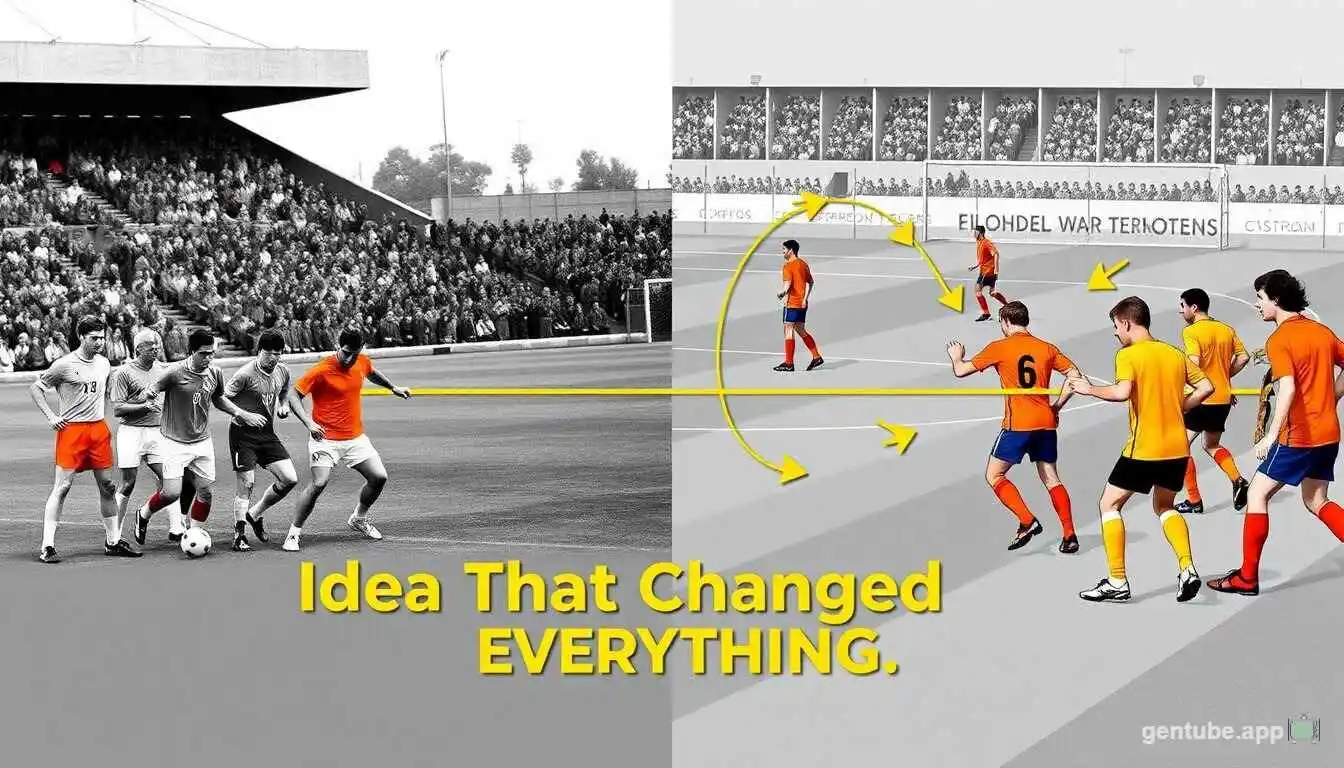
Rinus Michels became head coach of Ajax Amsterdam in 1965 and immediately began dismantling the orthodoxy. His core insight was deceptively simple: if every outfield player could play every position, the opposition could never prepare for you. There would be no Centre-back to mark, no winger to track, no playmaker to neutralize. The team would become a shapeshifting organism, collapsing space when defending and explosively expanding it when attacking — always in fluid, coordinated unison. He called it Totaalvoetbal. The world would eventually call it Total Football.
The philosophy rested on three foundational pillars. First, positional interchangeability: any outfield player could seamlessly take over any position at any given moment without the team losing structural integrity. Second, spatial dominance: the team would compress space to suffocate opponents when defending and stretch the pitch to its maximum dimensions when attacking. Third, pressing as offense: rather than waiting to win the ball, players would aggressively win it back immediately in dangerous zones, treating every turnover as a counter-attack waiting to happen. These ideas required extraordinary athleticism, football intelligence, and trust — and Michels had the perfect laboratory to develop them.

Ajax won three consecutive European Cups from 1971 to 1973, announcing the philosophy’s arrival on the grandest stage. But the 1974 World Cup would take it further — offering it to the entire planet, in the most pressurized arena in sport, and nearly winning everything.
Johan Cruyff: The Human Algorithm
No discussion of Total Football is complete without confronting the impossible centrality of Johan Cruyff. He was not merely the star player of this movement — he was its living, breathing proof of concept. Cruyff wore the number 14 jersey at a World Cup where convention demanded numbers 1 through 11 map directly to positions. His number alone was a statement of intent.
On the pitch, Cruyff was omnipresent in the most literal sense. He would drop into midfield to receive the ball, drift wide to create overloads, appear suddenly in the penalty area to finish — and then, in the same movement, track back to win possession 60 meters from goal. Defending players assigned to mark him faced an existential crisis: if they followed him everywhere, they abandoned their positional duties; if they stayed in position, Cruyff simply moved into space, and the ball followed.
The famous Cruyff Turn — a piece of skill so revolutionary that it now bears his name permanently — perfectly symbolized his relationship with the game. A skill that involved not doing what every defender anticipated, instead reversing direction in a single fluid motion to escape and advance. His entire career was essentially that turn expressed over ninety minutes, across every match, for over two decades.
The 1974 World Cup: A Tournament That Changed Everything
The Netherlands arrived at the 1974 World Cup in West Germany as the embodiment of everything Michels had built. Their squad read like a who’s-who of revolutionary footballers: Johan Cruyff, Johan Neeskens, Ruud Krol, Rob Rensenbrink, Johnny Rep. Collectively, they played with a synchronized intelligence that left opponents disoriented — not because they were individually faster or stronger, but because they were collectively smarter.
In the group stages, the Dutch dismantled Uruguay 2-0, took apart East Germany, and neutralized Sweden. They were fluid, unpredictable, and perpetually in motion. Neeskens operated as the engine in midfield — pressing, tackling, recycling — while Cruyff ghosted between lines and Krol drove forward from left-back in the manner that would one day be called an inverted fullback, decades before the term existed.
In the semi-final against Brazil, the Netherlands produced perhaps the most complete performance in World Cup history to that point — a controlled, intelligent 2-0 dismantling of the reigning champions that served notice: the game had permanently changed. Brazil’s samba rhythms, built on individual brilliance, had no answer for a system that suffocated space collectively.
The final against West Germany ended in heartbreak — a 2-1 defeat after Neeskens had opened the scoring from the penalty spot in the very first minute, before the German hosts had even touched the ball. West Germany equalized through Paul Breitner and won it through Gerd Müller’s clinical finish. The Dutch wept. Football’s purists wept with them. The most beautiful team in the tournament had not won.
Why Losing the Final Doesn’t Diminish the Legacy
Paradoxically, the Netherlands’ failure to win the 1974 World Cup may have amplified their tactical legacy rather than diminished it. By not winning, they became eternal romantic heroes — the greatest team never to win the World Cup, whose influence on the game outlasted any medal. Every generation of football analyst, coach, and fan who has since wrestled with questions of pressing, positional play, and spatial domination has returned to West Germany 1974 as the wellspring.
Michels himself returned to manage the Dutch national team in 1988, winning the European Championship with Ruud Gullit, Marco van Basten, and Frank Rijkaard — a vindication so complete it felt scripted. His philosophical descendants would go on to manage FC Barcelona (Johan Cruyff himself, then Pep Guardiola), Borussia Dortmund, Liverpool, and virtually every club that now trades in high-pressing, position-fluid football.
The Philosophical Afterlife of Total Football
Total Football was not a tactic you could simply copy and paste onto a new squad. It was an entire educational system — a way of teaching football from childhood that required players who had grown up thinking spatially, not positionally. It required footballers who could look up before they received the ball, process the entire pitch, and already know where they were going. This is why its truest successors emerged from Ajax’s youth academy — the famous De Toekomst — and from La Masia, Barcelona’s academy, where Johan Cruyff imported the philosophy wholesale when he became coach there in 1988.
The Barcelona teams of the 1990s — winning four La Liga titles and a European Cup in 1992 — were direct philosophical children of Total Football. The tiki-taka revolution of the 2000s and 2010s was its grandchild. Jürgen Klopp’s gegenpressing at Dortmund and Liverpool was its feral, high-octane nephew. Pep Guardiola’s obsessive positional play at Barcelona, Bayern Munich, and Manchester City — with its carefully engineered pressing traps and positional rotations — is its most technically refined descendant.
In 2024, fifty years after West Germany, virtually every top club in the world trains some version of positional pressing, spatial awareness, and rotational roles. The players wear different numbers on their backs, but they play the game that Rinus Michels and Johan Cruyff invented in a small Amsterdam training ground half a century ago.
What Total Football Taught Us About the Game
Beyond tactics, Total Football offered something rarer: a philosophy of football as collective intelligence. It argued — and proved — those eleven interconnected minds, trained to read and respond to the same spatial patterns, would always outthink eleven individuals locked into rigid roles. It was football as a neural network, decades before that term entered the cultural vocabulary.
It also democratized brilliance. In a Total Football system, there are no passengers. There are no right-backs who hide for ninety minutes and hoof the ball long. Every player must be technically capable, physically dynamic, and tactically intelligent. This raised the baseline standard for professional footballers globally — because coaches everywhere, seeing what was possible, began demanding more.
The 1974 Netherlands team did not win the World Cup. But they won something larger: they won the argument about what football should be. And fifty years on, the game is still being played by their rules.
Frequently Asked Questions
| # | Question | Answer |
| 1 | What is Total Football? | Total Football is a tactical system developed by Rinus Michels at Ajax Amsterdam in which every outfield player can seamlessly play in any position, creating a fluid, unpredictable system that collectively dominates space. |
| 2 | Who invented Total Football? | Rinus Michels is credited as the architect. Johan Cruyff was its most famous practitioner and later its most influential evangelist as a coach. |
| 3 | When did Total Football debut on the world stage? | It debuted at the 1974 FIFA World Cup in West Germany, where the Netherlands captivated the world before narrowly losing the final 2-1 to the host nation. |
| 4 | Why is Total Football considered revolutionary? | It shattered the idea that players must stay in fixed positions, introducing fluid interchangeability, spatial domination, and aggressive pressing as coordinated team tactics. |
| 5 | Did the Netherlands win the 1974 World Cup? | No. Despite being widely considered the best team, they lost the final 2-1 to West Germany, with Gerd Müller scoring the decisive goal. |
| 6 | What position did Johan Cruyff play? | Cruyff nominally played as a forward, but his role was deliberately undefined — he dropped into midfield, drifted wide, and appeared in any zone where he could influence the game. |
| 7 | What does ‘pressing’ mean in football tactics? | Pressing means aggressively challenging opponents for the ball immediately after losing possession, rather than retreating into a defensive shape — a cornerstone of Total Football. |
| 8 | What clubs later adopted Total Football principles? | Ajax, Barcelona (under Cruyff’s management and later Guardiola), Borussia Dortmund, Liverpool, and Manchester City are the most prominent philosophical successors. |
| 9 | Who was Rinus Michels? | Rinus Michels was a Dutch football manager, known as ‘The General,’ who developed Total Football at Ajax and led the Netherlands to the 1988 European Championship title. |
| 10 | What is the Cruyff Turn? | A skill move invented by Johan Cruyff in which a player feigns to pass or cross, then drags the ball behind the standing leg to change direction — iconic for its surprise and elegance. |
| 11 | What was special about the 1974 Netherlands squad? | It combined extraordinary individual talent — Cruyff, Neeskens, Krol, Rep, Rensenbrink — with collective tactical intelligence that the world had never previously seen organized as a team system. |
| 12 | How did Total Football influence Pep Guardiola? | Guardiola played under Johan Cruyff at Barcelona, absorbing Total Football’s positional principles directly. He later developed and refined these into his own positional-play philosophy as a manager. |
| 13 | Why did the Netherlands lose the 1974 final? | West Germany combined Gerd Müller’s clinical finishing with exceptional defensive organization. The Dutch also reportedly relaxed after their early penalty, allowing Germany to control the tempo. |
| 14 | What is ‘pressing as offense’? | The idea that winning the ball high up the pitch through immediate pressing creates scoring opportunities — making pressing a proactive offensive weapon, not just a defensive act. |
| 15 | What is positional interchangeability? | The ability of all outfield players to interchange positions fluidly during a match without the team losing shape or tactical coherence. |
| 16 | How did Total Football influence Barcelona’s tiki-taka? | Johan Cruyff introduced Total Football principles to Barcelona when he became coach in 1988, establishing La Masia’s curriculum. Tiki-taka emerged from this educational foundation decades later. |
| 17 | What does ‘spatial domination’ mean in football? | Compressing space collectively when defending to suffocate opponents, while stretching the pitch to maximum width and depth when attacking to create openings. |
| 18 | Why did Ajax win three consecutive European Cups? | Michels’s positional system and exceptional players like Cruyff created a team that was tactically superior to anything Europe had seen — unpredictable, cohesive, and relentlessly intelligent. |
| 19 | Who was Johan Neeskens? | Johan Neeskens was the tireless Dutch midfielder who provided the engine for the 1974 Netherlands team — pressing, tackling, and supporting both defense and attack with equal dynamism. |
| 20 | Did Total Football require special players? | Yes. It required players with exceptional technical skill, football intelligence, high athletic capacity, and the ability to read space instantaneously — a combination extremely rare in any era. |
| 21 | What is gegenpressing, and how does it relate to Total Football? | Gegenpressing, popularized by Jurgen Klopp, means counter-pressing immediately after losing the ball. It is a direct, high-intensity evolution of Total Football’s pressing philosophy. |
| 22 | How did Total Football change defenders’ roles? | Defenders became active participants in build-up play and even attacking phases — a radical departure from the defensive-only role they previously occupied. |
| 23 | What is De Toekomst? | De Toekomst (‘The Future’) is Ajax’s renowned youth academy, where Total Football principles are taught from a very young age as the foundational approach to the game. |
| 24 | What tactical system did West Germany use in the 1974 final? | West Germany played a robust, disciplined 4-3-3 with strong defensive organization, clinical finishing from Gerd Müller, and the tactical flexibility of Franz Beckenbauer at sweeper-libero. |
| 25 | Is Total Football still used today? | Elements of Total Football — pressing, positional fluidity, spatial organization — form the backbone of most modern high-level football. Few teams execute the full pure version, but its DNA is everywhere. |
| 26 | What number jersey did Johan Cruyff wear at the 1974 World Cup? | Cruyff wore the number 14 — an unconventional choice at a time when numbers were supposed to map directly to specific positions. |
| 27 | What was the score when the Netherlands played Brazil in 1974? | The Netherlands beat Brazil 2-0 in a decisive second-round group stage match, in what many observers consider one of the finest performances in World Cup history. |
| 28 | What legacy did Rinus Michels leave behind? | Michels left a complete coaching philosophy — positional pressing football — that transformed football globally. He was named FIFA’s Coach of the Century in 1999. |
| 29 | Why was 1974 the right time for Total Football to emerge? | Football globally was ready for disruption after decades of rigid systems. Television was spreading the game widely, audiences were sophisticated, and the athleticism and education of Dutch players were uniquely aligned with the demands of the system. |
| 30 | Could a Total Football team win the World Cup today? | The principles already underpin most elite teams. A ‘pure’ Total Football team using 1974 personnel would struggle athletically today, but the philosophy expressed through modern athletic standards — as Guardiola’s teams demonstrate — remains supremely competitive. |
Disclaimer: The content on this blog is for informational purposes only. The author’s opinions are personal and not endorsed. Efforts are made to provide accurate information, but completeness, accuracy, or reliability are not guaranteed. The author is not liable for any loss or damage resulting from the use of this blog. It is recommended to use the information on this blog at your own discretion.
