
Table of Contents
THE ARCHITECTURE OF GLORY | Foot ball series
The Iron Curtain of Italy: How Catenaccio and Cold Discipline Conquered the World in 1982
When Organized Defensive Chaos, Tactical Cunning, and Paolo Rossi’s Resurrection Silenced the Romantics
The Reputation That Preceded Them
Few football nations have ever arrived at a World Cup with lower expectations and higher eventual glory than Italy at España 1982. The Azzurri entered the tournament under a cloud so dark it bordered on scandal. Several of their key players — including Paolo Rossi, the striker who would become the tournament’s legendary figure — were returning from serving bans related to a match-fixing investigation known as the Totonero scandal. Rossi himself had been suspended for two years and had played only a handful of matches before the World Cup. Journalists wrote him off. Pundits predicted elimination. The Italian public was ambivalent.
Italy’s group stage performances did nothing to improve the mood. They drew all three group games — against Poland, Peru, and Cameroon — scoring just two goals. They qualified for the second round purely on goal difference. The press was savage. The public was impatient. Coach Enzo Bearzot famously enforced a media blackout — refusing to allow his players to speak to journalists — in response to the relentless criticism. It was a siege mentality that would prove accidentally brilliant.
Catenaccio: The Lock That Italy Built
To understand Italy’s 1982 triumph, you must understand catenaccio — a word that translates, appropriately enough, as ‘door bolt.’ Developed initially by Swiss coach Karl Rappan in the 1930s and refined by Italian coaches through the 1950s and 1960s, catenaccio was a defensive system built around a libero — a sweeper — who played behind the defensive line to cover any mistakes. The back line would be disciplined and compact, organized to deny space between the lines, forcing opponents wide and backwards. Attacking threats were channeled into predictable areas and neutralized collectively.
In its purest form, catenaccio was not merely a defensive formation — it was a philosophy of risk management. The system accepted that conceding possession was acceptable, that pressure was acceptable, that playing deep was acceptable, so long as the goal remained inviolable. The reward for this defensive solidity was the counter-attack: explosive, sudden, lethal — using the space the opponent left behind when they committed forward in search of a breakthrough.

Critics found it cynical, even ugly. The Italian game, particularly in the Serie A of the 1970s and early 1980s, had earned a reputation for low-scoring affairs and deliberate time-wasting. But practitioners of catenaccio saw it differently: as chess played at top speed, where patience was a weapon and the single moment of attacking brilliance was worth a hundred fruitless possessions. Italy’s 1982 squad would take this philosophy to its most thrilling extreme.
Enzo Bearzot: The Stubborn Genius
Enzo Bearzot became Italy’s national team coach in 1975 and spent years quietly building something the world didn’t fully recognize until it was too late. He was not a flamboyant tactician. He did not give dramatic pre-match speeches or develop revolutionary systems that upended conventional thinking. Instead, Bearzot was a builder of solidarity — a man who understood that football at the highest level is won in the spaces between tactical systems, in the trust players have in each other and the clarity of their collective purpose.
His core tactical structure in 1982 was a 4-4-2 that, in defensive phases, could compress into a narrow 4-5-1. The full-backs — Claudio Gentile and Antonio Cabrini — were instructed to defend deep and push forward selectively. The midfield was organized around Marco Tardelli and Bruno Conti, whose energy and reading of the game allowed Italy to press compactly and transition quickly. At the back, Gaetano Scirea operated as the libero — cultured, intelligent, never panicking — sweeping up whatever leaked through.
The key tactical instrument, however, was not the system itself but the timing of the Italian counter-attack. Bearzot had drilled into his players the art of the moment — recognizing exactly when a defensive line had been broken, when the opponent was stretched, when a single sharp burst of quality would punish seven minutes of patient defensive suffering. It was this timing, combined with Paolo Rossi’s incandescent rediscovery of form, that would define the tournament.
Paolo Rossi: The Dead Man Who Came Alive
If catenaccio was Italy’s method, Paolo Rossi was their miracle. The striker — nicknamed Pablito — had returned from a two-year ban with, as the consensus held, legs that had forgotten what top-level football felt like. He played three group games and scored zero goals. He was invisible in the fog of collective Italian mediocrity. Bearzot faced enormous pressure to drop him. He refused.
Then came Argentina in the second round — the defending champions, led by Diego Maradona. Italy needed a win. What they produced was one of the great exhibitions of intelligent, structured counter-attacking football in World Cup history, with Rossi scoring twice in a 2-1 victory that announced his extraordinary return. The goal instinct — timing the run, arriving at the perfect moment, finishing with cold precision — had never left him. The match had simply been waiting for him to remember it.
Against Brazil in the next match — in what most observers consider the greatest match in World Cup history — Rossi produced a performance of almost supernatural concentration. Brazil had Zico, Socrates, Falcao, Eder — a team of such individual brilliance that they made Argentina look ordinary. They had won the style vote before a ball was kicked. Then, inside an unforgettable 25-minute spell, Paolo Rossi scored a hat-trick. Italy won 3-2. Romantics wept. Tacticians quietly began rewriting their notes.
The Brazil Game: Tactical Poetry in Counter
Italy versus Brazil on July 5, 1982, in Barcelona’s Sarria stadium, is worth examining in specific tactical detail because it perfectly illustrates catenaccio’s philosophical genius. Brazil controlled 60 percent of possession. They created more chances. They were, for large stretches, the better football team by most romantic metrics. They lost 3-2 and were eliminated.
How? Because Italy’s defensive organization was so disciplined that Brazil’s moments of individual brilliance — Socrates’ vision, Zico’s passing range, Eder’s thunderous shooting — were channeled into slightly sub-optimal positions. And because the Italian counter-attack, triggered in moments of Brazil’s highest forward commitment, was executed with the surgical precision of a team that had rehearsed these exact transitions thousands of times. Each Italian goal came from Brazil overextending — the ball turning over in midfield, space appearing behind the Brazilian line, and Rossi arriving a half-second before any defender could react.
It was not, as critics suggested, a triumph of ugly football over beautiful football. It was a triumph of collective tactical intelligence over individual brilliance. The irony was that Brazil’s individual genius, unstructured by collective defensive discipline, made them vulnerable to exactly the kind of organized patience Italy had built their system around.
The Final, the Trophy, and the Vindication
Italy’s passage to the final included a tight semifinal victory over Poland — Rossi scoring twice again — before meeting West Germany in Madrid’s Bernabeu on July 11. The final was won 3-1, with Rossi opening the scoring, Marco Tardelli producing one of the most celebrated goal-celebrations in football history — sprinting with arms wide and tears in his eyes — and Alessandro Altobelli completing the rout before Paul Breitner pulled one back.
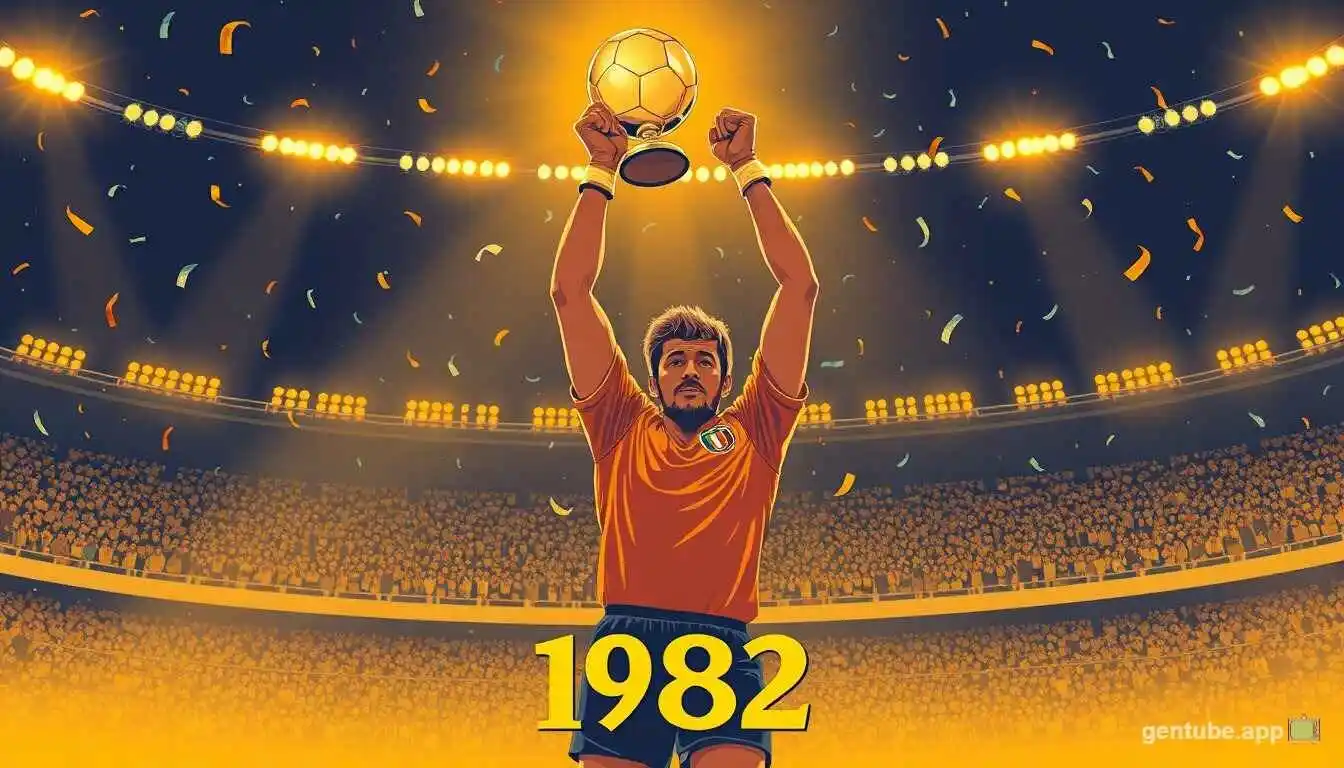
Dino Zoff, the 40-year-old goalkeeper and captain, lifted the World Cup. Bearzot — the stubborn, patient, loyal architect — stood on the pitch in a daze of vindicated stubbornness. Rossi was awarded the Golden Boot as top scorer with six goals and the Golden Ball as player of the tournament. From zero goals in three games to tournament top scorer in three weeks: a narrative so dramatic it could only have emerged from the specific pressure of a World Cup.
Catenaccio’s Enduring Influence
The 1982 Italy victory did not kill catenaccio. If anything, it refined its reputation — demonstrating that defensive solidity combined with lethal, precisely-timed counter-attacking football could overcome teams of vastly superior individual talent. The tactical principle — defend deep, deny space between the lines, absorb pressure, and explode on the transition — became the template for underdog teams worldwide.
Every counter-attacking system developed in the decades since owes a philosophical debt to the Italian defensive tradition: Jose Mourinho’s Inter Milan of 2010 (which won the Champions League with explicitly catenaccio-influenced tactics), Diego Simeone’s Atletico Madrid, Leicester City’s stunning 2016 Premier League title, and Greece’s astonishing Euro 2004 victory. The lock, it turns out, is very hard to pick.
FAQs
| # | Question | Answer |
| 1 | What is catenaccio? | Catenaccio is an Italian defensive football system centered on a libero (sweeper) playing behind the defensive line, with the team compressing space collectively and exploiting counter-attacks. |
| 2 | Who invented catenaccio? | Swiss coach Karl Rappan developed early versions in the 1930s, but Italian coaches — most notably Helenio Herrera and Nereo Rocco — refined it into the system associated with Italian football. |
| 3 | How did Italy perform in the 1982 World Cup group stage? | Italy drew all three group games and barely qualified for the second round on goal difference — creating enormous public and media pressure on coach Enzo Bearzot. |
| 4 | Who was Paolo Rossi? | Paolo Rossi was Italy’s striker who returned from a two-year match-fixing ban to score six goals and win the Golden Boot and Golden Ball at the 1982 World Cup. |
| 5 | Why was Italy versus Brazil in 1982 considered the greatest World Cup match? | It combined extraordinary individual brilliance from Brazil (Zico, Socrates, Falcao) with extraordinary collective tactical intelligence from Italy, producing a thrilling 3-2 result that perfectly illustrated the tension between style and system. |
| 6 | Who was Enzo Bearzot? | Enzo Bearzot was Italy’s national team coach who built the 1982 World Cup-winning squad, famous for his loyalty to players under pressure and his media blackout during the tournament. |
| 7 | What is a libero in football? | A libero is a sweeper who plays behind the main defensive line with the freedom to read the game and cover defensive errors — the structural heart of catenaccio. |
| 8 | What was the Totonero scandal? | The Totonero scandal was an Italian match-fixing investigation in 1980 that resulted in bans for several Serie A players, including Paolo Rossi, who received a two-year suspension. |
| 9 | How did Italy win the 1982 World Cup final? | Italy defeated West Germany 3-1 in Madrid, with goals from Paolo Rossi, Marco Tardelli, and Alessandro Altobelli. Dino Zoff captained the team at age 40. |
| 10 | Who was Gaetano Scirea? | Gaetano Scirea was Italy’s libero in 1982 — a cultured, calm sweeper considered one of the finest defenders in football history, renowned for his reading of the game. |
| 11 | What was Marco Tardelli’s goal celebration famous for? | Tardelli’s wild, tearful sprint with arms outstretched after scoring in the 1982 final became one of football’s most iconic images — an expression of pure, overwhelming joy. |
| 12 | What formation did Italy use in the 1982 World Cup? | Italy primarily used a 4-4-2 that compressed into a 4-5-1 defensively, built around organized pressing, compact defensive blocks, and clinical counter-attacks. |
| 13 | How old was Dino Zoff when he won the 1982 World Cup? | Dino Zoff was 40 years old — making him the oldest player ever to lift the FIFA World Cup trophy as captain. |
| 14 | What does ‘counter-attack’ mean in football? | A counter-attack is a quick, direct offensive transition made immediately after winning the ball, exploiting the space left by an opposition that has committed many players forward. |
| 15 | Who was Diego Maradona’s role in the 1982 World Cup? | Maradona played for Argentina but was eliminated in the second round by Italy — he was sent off against Brazil and did not replicate his 1986 brilliance in 1982. |
| 16 | Did Brazil deserve to win the 1982 World Cup? | Brazil had arguably the most talented squad but their lack of defensive organization made them vulnerable — the tournament illustrated that talent without defensive discipline cannot guarantee success. |
| 17 | What is the difference between catenaccio and a modern low block? | Catenaccio includes a libero sweeper role and specific spatial compressing principles, while a modern low block simply refers to defending deep with two compact banks of four without the classic sweeper role. |
| 18 | Who was Jose Mourinho’s 2010 Champions League triumph inspired by? | Mourinho’s Inter Milan victory in 2010 drew heavily on Italian defensive tradition, including catenaccio-influenced principles of compactness, organized pressing, and lethal transitions. |
| 19 | What is the significance of Italy’s media blackout in 1982? | Bearzot imposed the blackout after the Italian press was viciously critical of the team’s group stage performances. It created internal unity and psychological protection for players. |
| 20 | How did Claudio Gentile defend Diego Maradona in 1982? | Gentile man-marked Maradona with relentless physical pressure — a controversial approach that largely eliminated Maradona’s influence but prompted significant debate about the ethics of aggressive man-marking. |
| 21 | Can catenaccio work against modern pressing teams? | A well-organized low defensive block can still frustrate high-pressing teams — as Leicester City (2016), Greece (Euro 2004), and Atletico Madrid have repeatedly demonstrated in modern football. |
| 22 | What was the tactical difference between Italy and Brazil in 1982? | Brazil prioritized individual brilliance and possession with limited defensive structure; Italy prioritized collective defensive discipline, and the precision counter-attack — Italy’s philosophy was better suited to tournament football. |
| 23 | Why did Italy only draw their group games in 1982? | Italy played cautiously in the group stage, prioritizing defensive solidity and avoiding mistakes while managing key players’ fitness — a calculated strategy that left them flat in attack. |
| 24 | Who was Bruno Conti? | Bruno Conti was Italy’s right winger in 1982 — a skillful, energetic player who provided creative threat in transition and a defensive work rate essential to Italy’s system. |
| 25 | How many goals did Paolo Rossi score in the 1982 World Cup? | Rossi scored six goals — including a hat-trick against Brazil, two against Poland, and one in the final — making him the tournament top scorer. |
| 26 | What is the historical relevance of the 1982 World Cup for Italian football? | It was Italy’s third World Cup title (after 1934 and 1938) and represented the definitive global validation of the catenaccio philosophy under its most pressurized conditions. |
| 27 | Did Catenaccio influence modern football outside Italy? | Deeply — its principles appear in Diego Simeone’s Atletico Madrid, Mourinho’s Inter, Bielsa-influenced counter-pressing, and any system that prioritizes defensive shape and transition speed. |
| 28 | Who was Zico, and why was Brazil’s 1982 team so celebrated? | Zico was Brazil’s creative playmaker — a midfield genius supported by Socrates, Falcao, and Eder. Their 1982 team is considered among the most gifted in World Cup history, despite not winning. |
| 29 | What was the weather like during the 1982 World Cup final? | The final in Madrid was played in intense summer heat — one of the factors that rewarded Italy’s disciplined fitness management over Brazil’s more energy-intensive attacking style. |
| 30 | What tactical lesson does the 1982 World Cup teach modern coaches? | That individual talent, without collective defensive discipline and the ability to execute on transition, is insufficient at the tournament level — structure and organization consistently trump brilliance in knockout football. |
Disclaimer: The content on this blog is for informational purposes only. The author’s opinions are personal and not endorsed. Efforts are made to provide accurate information, but completeness, accuracy, or reliability are not guaranteed. The author is not liable for any loss or damage resulting from the use of this blog. It is recommended to use the information on this blog at your own discretion.
