
Table of Contents
Bigger, Bolder, Busier — Decoding the Mind-Bending Logistics of Football’s 48-Team Mega-Tournament
The 48-Team Era: Football’s New Frontier- Foot ball Series
Focus: How the 48-team tournament actually works — groups, the Round of 32, grueling travel, and the mechanics behind football’s biggest ever format change
Introduction: The Tournament That Changed Everything
For 28 consecutive years, the 32-team World Cup format defined international football’s grandest stage. Eight groups of four nations, 64 matches, six wins required to become champion — it was elegant in its simplicity and revered for the intensity it produced. Then, in January 2017, FIFA’s Council voted to shatter that template forever. Beginning with the 2026 tournament, co-hosted across the United States, Canada, and Mexico, the World Cup expanded to 48 nations. Not 33. Not 36. Not 40. Forty-eight — a 50 percent increase in participants that reshaped every element of the tournament’s structure, schedule, logistics, and competitive dynamics.
The announcement detonated a debate that continues to this day, but before we argue about whether this expansion was wise or reckless, we must first understand what it actually means in practical terms. How do 48 teams fit into a coherent tournament bracket? How does a host arrangement spanning three countries and sixteen cities function? What does the newly invented Round of 32 mean for teams, players, and fans? And how has the group-stage format been redesigned to accommodate half again as many nations while still producing a workable, fair competition?
This post strips away the politics and the passion to answer those fundamental structural questions. Whether you are a tactical deep-thinker, a casual supporter, or someone trying to explain the new format to a bewildered friend before the opening match, this is your complete guide to decoding the 48-team mega-tournament from the inside out.
From 8 Groups to 12: The Expanded Group Stage
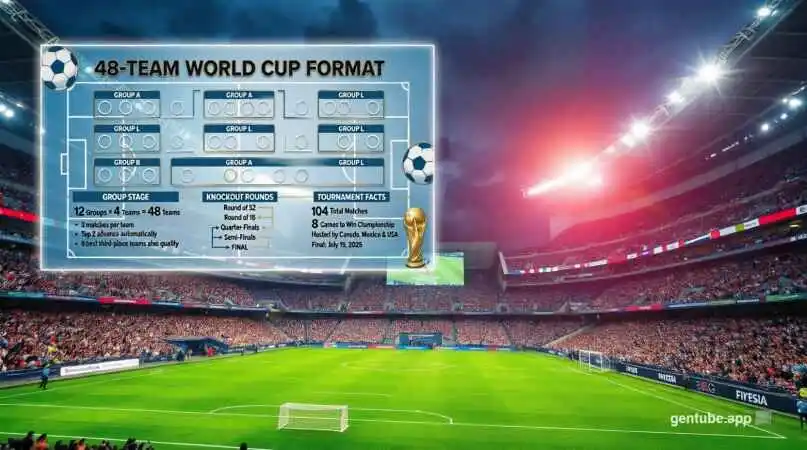
The most visible change in the 48-team format is the transformation of the group stage. Where the 32-team World Cup fielded eight groups of four teams, the new structure comprises twelve groups of four teams. On the surface, this seems like simple arithmetic — four more groups to house the sixteen additional nations. But the downstream effects of this change ripple through every subsequent stage of the tournament, altering how teams approach individual matches, how managers plan their squads, and how fans follow the competition.

Within each of the twelve groups, the top two finishers advance automatically to the knockout phase. This mirrors the old format’s structure — the two best teams in any given group progress. What changes dramatically is the third-place clause. In a 32-team, eight-group tournament, third-placed teams were simply eliminated. In the 48-team format, the eight best third-placed finishers from across all twelve groups also advance, producing 32 teams for the knockout rounds — ironically, the exact same number as the entire previous World Cup field.
This structural irony has not been lost on commentators. The 48-team World Cup essentially runs a preliminary tournament to produce a 32-team bracket before the real competition begins. Critics see this as evidence that FIFA has over-engineered a format that already worked. Supporters counter that the preliminary phase still has enormous meaning for the 48 participating nations and the billions of fans who follow them, even if the elite teams ultimately compete in a familiar knockout structure.
The ‘Best Third-Placed Teams’ Mechanism: Brilliant or Broken?
Borrowing directly from UEFA’s model for the European Championship, the ‘best third-placed teams’ mechanism is arguably the most technically complex element of the new format. Eight spots in the Round of 32 are reserved for the third-placed finishers who, across all twelve groups, accumulated the best records. FIFA ranks these teams using a cascade of criteria: first by points, then by goal difference, then by goals scored, then by disciplinary record, and finally by FIFA World Ranking if every other measure remains tied.
The fundamental challenge with this system is that it attempts to create a fair comparison between teams whose group-stage experiences were not equivalent. A third-placed team in a group containing three former World Champions will face a vastly different set of challenges than a third-placed team in a group featuring one established power and two debutant nations. Mathematically, the comparison is defensible; intuitively, it often feels unjust. A team that finished third in the toughest conceivable group may be statistically inferior on paper to a team that accumulated comfortable victories in a weaker group — yet both compete for the same advancement spots.
This tension is not hypothetical. UEFA experienced comparable controversies during European Championships that used the same format. The system also creates peculiar late-match scenarios where teams and fans must simultaneously monitor results across multiple groups, calculating whether a loss by a certain margin still produces advancement through the third-place route. This is simultaneously thrilling and exhausting — a microcosm of the broader debate about whether complexity enhances or degrades the spectator experience.
The Round of 32: Football’s Brand-New Stage
No structural addition to the 48-team World Cup is more significant or more debated than the Round of 32. This entirely new knockout stage does not exist in any previous World Cup format and represents a fundamental extension of the tournament’s competitive architecture. The 32 teams that emerge from the group phase — 24 group winners and runners-up, plus 8 best third-placed teams — contest 16 single-elimination matches to determine the sixteen sides that reach the traditional Round of 16.
What this means in practice is that the path to World Cup glory now requires seven consecutive victories, not six. The additional match may appear marginal, but its implications are substantial. Professional footballers playing at a World Cup are typically at the tail end of a club season that began eleven months earlier. Their physical condition, injury history, and mental fatigue are all critical factors. Adding a seventh compulsory match — played in what may be extreme weather conditions across a vast geographical hosting footprint — places additional strain on player welfare that physiologists, team doctors, and players’ unions have consistently flagged as a serious concern.
Tactically, the Round of 32 also recalibrates how managers approach the group stage. Under the 32-team format, a manager could field rotated squads in meaningless dead-rubber third group matches, preserving key players for the knockout rounds. Under the 48-team system, the stakes of third-place finishes — and therefore every group match — are heightened. A single poor result can drop a team into the third-place comparative ranking system, creating anxiety and tactical caution throughout the entire group phase.
The Tri-Nation Hosting Colossus: Distances, Borders, and Logistics
While the structural changes to the tournament bracket are significant, the logistical challenges of the 2026 World Cup’s tri-nation hosting arrangement may prove even more consequential in practice. The United States, Canada, and Mexico jointly host the tournament across sixteen cities spanning a geographical footprint that dwarfs any previous World Cup. From Vancouver in the northwest to Miami in the southeast, from Guadalajara in Mexico to Toronto in Canada, the tournament’s venues cover distances measured in thousands of kilometres.
For participating teams, this means navigating not just long domestic flights but international border crossings between sovereign nations, each with its own visa requirements, customs procedures, and security arrangements. A team based in one of the three Canadian host cities could face a transcontinental journey of 5,000 kilometres to reach a Mexican venue for a Round of 32 fixture. Managing player acclimatisation, training facility standards, accommodation quality, and staff logistics across three different countries represents an unprecedented operational challenge for national football associations, many of which are already stretched by the demands of a lengthy tournament.
For fans, the situation is even more challenging. The traditional World Cup experience — flying to a host nation, establishing a base, and following a team through the tournament — becomes enormously more expensive and complex when that team may play group matches in one country and knockout fixtures in another. Visa arrangements between Mexico and the United States, in particular, have historically been complicated for fans from certain nations. The cost of flights within and between the three host countries can easily exceed the cost of accommodation and match tickets combined, creating financial barriers that cut directly against FIFA’s stated goal of a globally accessible tournament.
Stadium Infrastructure: 104 Matches Across Sixteen Iconic Venues
Running 104 matches across sixteen venues — compared to 64 matches in the previous format — demands stadium infrastructure of the highest order. The 2026 World Cup venues represent some of the most iconic sporting arenas in North America, including MetLife Stadium in New Jersey, which serves as the tournament’s centrepiece Final venue with a capacity exceeding 82,000. AT&T Stadium in Arlington, Texas; Levi’s Stadium in the San Francisco Bay Area; the Rose Bowl in Los Angeles; and Estadio Azteca in Mexico City — a venue with perhaps the most storied history in global football — all form part of the extraordinary venue network.
The scheduling complexity of 104 matches across sixteen venues in three countries and multiple time zones is staggering. FIFA’s scheduling team must balance travel minimisation for participating teams against broadcast window maximisation for global audiences. A match played at 3:00 PM local time in Los Angeles kicks off at midnight in Central Europe and at 6:00 AM in Southeast Asia. Across a 32-day tournament, these broadcast conflicts require constant compromise, producing a schedule that satisfies no single stakeholder group entirely but attempts to serve the broadest possible global audience.
Beyond scheduling, the transformation of American football stadiums — most of which have artificial turf surfaces — for FIFA-standard football pitches has been a significant infrastructure challenge. Natural grass surfaces are mandatory for World Cup matches under FIFA regulations, requiring the installation of temporary natural turf systems that can withstand the playing demands of high-intensity international football while meeting the very different requirements of the venues’ NFL tenant clubs.
Player Welfare: The Hidden Crisis in Football’s Grand Expansion
Behind the spectacle of flags, anthems, and historic moments, a serious welfare concern underlies the expanded format. Elite footballers competing at the 2026 World Cup will arrive having completed a club season that, for players at European powerhouses, includes not only their domestic league but the expanded UEFA Champions League — itself recently enlarged from 32 to 36 clubs — plus domestic cup competitions and potential FIFA Club World Cup participation. The cumulative match burden on the game’s top players has reached levels that sports scientists describe as physiologically unsustainable.
FIFPRO, the global footballers’ union, has been vocal and persistent in its criticism of the expanded playing calendar, of which the 48-team World Cup is a central element. Their research consistently identifies injury risk elevation, mental health deterioration, and career longevity reduction as direct consequences of fixture accumulation at the top level. The additional Round of 32 match compounds these concerns, as does the travel demands of a tri-nation hosting model that may require teams to cover extraordinary distances between fixtures with minimal recovery time.
FIFA has responded by introducing enhanced medical monitoring protocols and recovery requirements within tournament regulations, but critics argue these measures are insufficient given the structural pressures of the format. The tension between the commercial imperatives that drive expansion — more matches mean more revenue — and the human welfare of the athletes who make those matches possible represents perhaps the most uncomfortable dimension of the 48-team tournament debate.
What the Format Means for Fans in 2026 and Beyond
For the billions of football supporters around the world, the 48-team format delivers a mixed package. On the positive side, the tournament runs for a longer period — approximately 39 days compared to 32 — providing more opportunities to experience World Cup football. With 48 nations competing, there is a dramatically higher probability that any given fan’s national team is present, particularly for supporters from Africa, Asia, and the Americas who historically faced punishing qualifying routes. The emotional and cultural weight of a first World Cup appearance for a nation cannot be overstated; those stories are part of what makes the tournament special.
On the negative side, the sheer volume of matches — 104 in total — means that the World Cup is no longer an event that even the most devoted fan can follow comprehensively. The group stage alone produces 48 matches across twelve simultaneous groups, requiring a level of simultaneous broadcasting and viewer attention that strains even the most sophisticated multi-screen setup. The signal-to-noise ratio of must-watch football decreases as the total volume of matches increases, a reality that broadcasters, streaming platforms, and fans will all navigate differently.
Ultimately, the 48-team format is not a fixed destination but the opening move in a new era of World Cup football. Its mechanics, as explored in this post, represent FIFA’s most ambitious structural intervention in the tournament’s history. Whether those mechanics produce the compelling, inclusive, globally celebrated football spectacle that FIFA envisions — or an overcrowded, logistically strained, commercially driven shadow of the tournament’s former self — is a question that only the matches themselves can answer.
FAQs
Q01. Why did FIFA choose 48 as the new team number rather than 40 or 64?
Forty-eight was selected as a mathematically workable number that could be divided into twelve groups of four while also reflecting the commercial and political desire to give each of FIFA’s six confederations meaningful additional representation. It was also the number that FIFA’s internal modelling suggested would maximise revenue and participation without producing an unmanageable bracket structure.
Q02. When was the 48-team format officially ratified?
FIFA’s Council formally ratified the expansion to 48 teams in January 2017, with the decision taking effect from the 2026 World Cup. The 2018 and 2022 tournaments were the final editions of the 32-team format.
Q03. How many total matches are played in the 48-team World Cup?
The 48-team format produces 104 matches in total — 48 in the group stage, 16 in the Round of 32, 8 in the Round of 16, 4 in the quarter-finals, 2 semi-finals, a third-place play-off, and the Final.
Q04. How does the group stage work exactly in the 48-team format?
Twelve groups of four teams each are formed. Within each group, all four teams play each other once (six matches per group). The top two finishers from each group advance automatically, while the eight best third-placed teams from across all twelve groups also qualify for the Round of 32.
Q05. What happens to the 4 worst third-placed teams?
The four third-placed teams with the weakest records across all twelve groups are eliminated at the end of the group stage. Only the top eight third-placed finishers advance to the Round of 32.
Q06. How is the ‘best third-placed team’ ranking calculated?
FIFA ranks all 12 third-placed finishers first by points accumulated, then by goal difference, then by total goals scored, then by disciplinary record (yellow and red cards), and finally by FIFA World Ranking if all other criteria remain equal.
Q07. Is it theoretically possible to advance with just one point from the group stage?
Yes, in extreme circumstances. If enough groups produce three teams on one point each and the tiebreakers favour a specific team, advancement on one point is mathematically possible, though vanishingly unlikely in competitive international football at World Cup level.
Q08. How many wins are needed to win the 48-team World Cup?
Seven consecutive wins are required to lift the trophy — one more than the six wins needed in the 32-team format, due to the addition of the Round of 32 knockout stage.
Q09. What is the Round of 32 and why does it not exist in the previous format?
The Round of 32 is the first knockout stage of the 48-team World Cup, involving all 32 teams that qualified from the group phase. It did not exist in the 32-team format because the tournament moved directly from the group stage to the Round of 16 with only 16 advancing teams.
Q10. Which countries are hosting the 2026 World Cup and which cities?
The 2026 World Cup is co-hosted by the United States (11 venues including New York/New Jersey, Los Angeles, Dallas, Miami, Seattle, San Francisco Bay Area, Kansas City, Atlanta, Philadelphia, Houston, and Boston), Canada (Toronto, Vancouver, and Montreal), and Mexico (Mexico City and Guadalajara).
Q11. Why are some NFL stadiums used for World Cup football matches?
American football stadiums have the required large capacities and meet FIFA’s commercial and infrastructure standards. They require temporary natural grass installations because FIFA mandates real turf surfaces for World Cup matches. Several US host stadiums have undergone significant pitch preparation programmes to meet FIFA regulations.
Q12. How long does the 48-team World Cup last from first match to Final?
The expanded tournament runs for approximately 39 days from opening match to Final, compared to roughly 32 days for the 32-team format, to accommodate the additional Round of 32 stage and the increased total match count.
Q13. Will players face significantly more physical stress in the 48-team format?
Yes. The additional Round of 32 match, combined with the potential for long-distance travel between venues in three different countries, increases the physical and logistical burden on players. FIFPRO has formally raised player welfare concerns about the cumulative demands of the expanded format.
Q14. Does the 48-team format increase the risk of dead-rubber group matches?
Theoretically, yes — a team that wins its first two group matches secures qualification regardless of the third game result, reducing competitive incentive in that match. However, the stakes of third-place finishes (which still matter for advancement) provide some additional competitive pressure that the old format lacked.
Q15. How does the seeding system work in the 48-team group draw?
FIFA uses a seeding system based on the FIFA World Ranking at a designated cutoff date to distribute teams into pots for the group draw. Pot 1 typically contains the highest-ranked teams, including the hosts, and seedings are designed to prevent the strongest nations from meeting in the group stage.
Q16. Can two teams from the same confederation be placed in the same group?
FIFA’s draw regulations generally prevent two teams from the same confederation from being placed in the same group, with the exception that UEFA teams (given their large numbers) may share groups with one other UEFA member.
Q17. How does the 48-team format affect broadcasters and television schedules?
Broadcasters face a significantly increased match volume of 104 games, requiring substantially more airtime, production resources, and commentary teams. Scheduling matches across three time zones in three countries also creates broadcast window conflicts that require complex rights negotiations and programming decisions.
Q18. What are the accommodation challenges for fans following their team?
Fans face the possibility of their team playing group matches in one country and knockout fixtures in another, potentially requiring multiple flights, different visa arrangements for each host country, and accommodation in cities hundreds or thousands of kilometres apart.
Q19. Has any previous World Cup used a group-stage format with third-placed team advancement?
Yes. The 1986, 1990, and 1994 World Cups used 24-team formats that included best third-placed team advancement mechanisms before the expansion to 32 teams in 1998. UEFA’s European Championship has also used similar mechanisms in multiple editions.
Q20. How does FIFA handle the scheduling of 48 group-stage matches to minimise conflict?
FIFA uses computer modelling to create scheduling matrices that minimise travel distances for teams between group matches while maximising global broadcast windows. The final group stage schedule is typically released several months before the tournament begins.
Q21. Are there any rule changes to the actual football competition in the 48-team format?
The Laws of the Game remain unchanged — the expansion is purely structural and logistical. Match duration, rules about goals, offside, VAR implementation, and other in-play regulations continue to operate under standard FIFA rules.
Q22. Will there be a third-place play-off in the 48-team World Cup?
Yes. The third-place play-off between the two losing semi-finalists is retained in the 48-team format, as it has been in every World Cup since 1930 (with the exception of 1950, which used a final round-robin format).
Q23. How does weather and climate affect tournament planning across three host countries?
The June-July tournament window presents varied climatic conditions across the sixteen venues — from the summer heat of Miami and Dallas to the milder conditions in Vancouver and Seattle. FIFA and host authorities have worked extensively on stadium cooling, scheduling, and player welfare measures to manage extreme heat risks.
Q24. What is the financial impact of the 48-team format on FIFA?
FIFA projects the 2026 World Cup to be the most commercially successful in history, with the expanded match count increasing broadcasting rights values, sponsorship opportunities, and ticketing revenues significantly. Revenue projections have exceeded $10 billion for the 2026 cycle, substantially above the 2022 Qatar tournament.
Q25. Can a host nation be eliminated in the group stage of the 48-team World Cup?
Yes. Host nations receive automatic qualification berths but must still compete in the group stage on equal terms with all other participants. A host nation that finishes third in its group and fails to qualify among the eight best third-placed teams would be eliminated.
Q26. How are the Round of 32 match pairings determined after the group stage?
The Round of 32 bracket is pre-determined based on group positions. FIFA publishes the potential bracket structure before the tournament, allowing fans and teams to understand which group winners face which runners-up and third-placed teams, though the specific matchups depend on group results.
Q27. What impact does the expanded format have on grass pitch quality throughout the tournament?
Playing 104 matches on natural grass surfaces over 39 days places significant stress on pitch quality, particularly in shared or high-use venues. FIFA mandates pitch maintenance standards and has approved pitch replacement protocols for some venues to ensure playing surfaces remain at an acceptable standard throughout the tournament.
Q28. How do teams manage their squad rotation strategy in the 48-team format?
The additional match in the Round of 32 incentivises managers to carry larger and deeper squads, making the most of FIFA’s permitted squad size. Rotation becomes more important than ever, as teams must manage player fitness across potentially seven matches over 39 days, plus travel between multiple cities.
Q29. Is there a risk that the 48-team format produces fewer memorable World Cup moments?
Some analysts argue that the dilution of tension in the group stage — with more teams qualifying and fewer catastrophic eliminations — may reduce the frequency of historic ‘shock’ moments. Others contend that the larger field creates more opportunities for upsets and debut tournament performances that become iconic. The evidence from the 2026 tournament itself will ultimately settle this debate.
Q30. Could FIFA expand the World Cup beyond 48 teams in the future?
While no formal proposal exists, FIFA President Gianni Infantino has not ruled out future expansion. A 64-team format has been discussed in football media circles, though the logistical, competitive, and welfare challenges of such a size increase would be enormous. The 48-team format will likely be assessed over multiple tournaments before any further expansion is seriously considered.
Disclaimer: The content on this blog is for informational purposes only. The author’s opinions are personal and not endorsed. Efforts are made to provide accurate information, but completeness, accuracy, or reliability are not guaranteed. The author is not liable for any loss or damage resulting from the use of this blog. It is recommended to use the information on this blog at your own discretion.
