
Table of Contents
FEATHERS, FORKED TAILS & FEARLESS HEARTS:The Complete Guide to India’s Four Most Spectacular Drongo BirdsBlack Drongo • Ashy Drongo • Hair-crested Drongo • Greater Racket-tailed Drongo |
Introduction: Why Drongos Rule the Sky
There is a moment every birder in India knows. You are watching a row of sparrows on a telegraph wire when a coal-black silhouette lands among them with the authority of a monarch. The sparrows shuffle aside. The newcomer cocks its head, flicks a perfectly forked tail, and launches itself at a passing hawk three times its size — driving the raptor into an embarrassed retreat. That bird is the drongo.
Drongos belong to the family Dicruridae, a compact clan of aerial hunters scattered across Africa, Asia, and Australasia. India is extraordinarily rich in drongo diversity, hosting species that range from the farm-field boldness of the Black Drongo to the forest-canopy sorcery of the Greater Racket-tailed Drongo. Each species has carved a distinct ecological niche, armed itself with specific anatomical tools, and evolved a personality so vivid that traditional communities across the subcontinent have woven them into folklore, agriculture, and medicine.
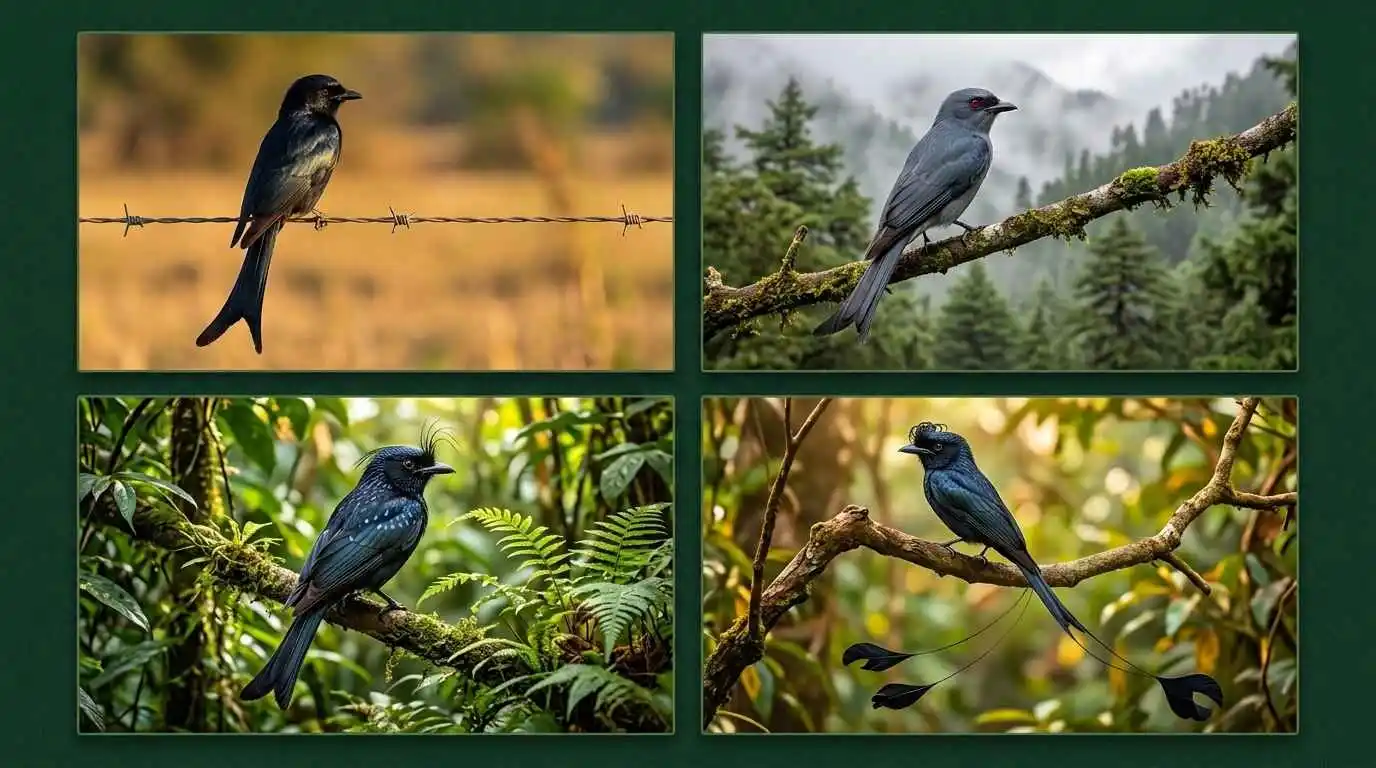
This guide takes you deep into the lives of four of India’s most remarkable drongos: the ubiquitous Black Drongo (Dicrurus macrocercus), the elegant migrant Ashy Drongo (Dicrurus leucophaeus), the crested forest aristocrat Hair-crested Drongo (Dicrurus hottentottus), and the showstopping illusionist Greater Racket-tailed Drongo (Dicrurus paradiseus). By the time you reach the last page, you will understand why ornithologists, farmers, wildlife photographers, and forest-dwellers alike hold these birds in such high regard — and why the drongo, in all its forms, is among the most compelling birds on Earth.
1. Black Drongo (Dicrurus macrocercus) — The King Crow of the Open Country
Identity and Distribution
The Black Drongo is arguably India’s most recognised drongo and one of its most familiar birds full stop. Measuring approximately 28 centimetres from bill-tip to tail-fork, this compact, all-black bird with a deeply forked tail sits conspicuously on telephone wires, fence posts, and the bare upper branches of roadside trees from Kashmir to Kanyakumari, from Mumbai to Manipur. Its range extends well beyond India — it breeds across a vast corridor stretching from Iran and the Arabian Peninsula through South Asia into southern China, Taiwan, and parts of Southeast Asia.

Described by ornithologists Brian Hodgson in 1836, its binomial Dicrurus macrocercus comes from the Greek dikros (forked) and oura (tail) combined with macros (long) and kerkos (tail) — effectively the ‘long, forked-tailed one.’ The species is further divided into several subspecies, with the nominate macrocercus dominating the Indian subcontinent.
Appearance and Field Marks
In the field, the Black Drongo is unmistakable: a compact silhouette of glossy blue-black, offset by a vivid red or orange-red iris and a stout, slightly hooked bill. The tail is deeply forked into two stiff, upward-curling outer rectrices — a shape that gives the bird extraordinary aerial control. Juveniles are duller, with white-tipped underpart feathers that could lead to brief confusion, but the distinctive tail and posture usually clarify the identification within moments.
The Black Drongo is also noticeably vocal, producing a combination of harsh calls, sharp metallic chips, and surprisingly melodious warbling sequences, occasionally interspersed with mimicry of other species.
Behaviour and Ecology
The Black Drongo is an aerial insectivore of the first order. It hunts from a prominent exposed perch — a wire, a post, a bare twig — and launches sorties of extraordinary agility, snapping flying insects with audible bill-clicks. Beetles, grasshoppers, flying ants, bees, wasps, and dragonflies all feature on the menu. It also follows tractors and ploughs, exploiting the insects churned up by tillage, and associates closely with grazing cattle, picking off insects disturbed by hooves — a behaviour ecologists term ‘commensalism.’
The bird’s most celebrated character trait is its aggression. The ‘King Crow,’ as rural India knows it, will fearlessly mob eagles, harriers, crows, and kites with a ferocity disproportionate to its size. This anti-predator behaviour also benefits other ground-nesting birds nearby, who take advantage of the drongo’s vigilance — making the Black Drongo a keystone species in open-country bird communities. The Hindi term ‘kotwal’ — meaning police officer or town watch — is another popular folk name that encapsulates this sentinel role perfectly.
Breeding and Nesting
Breeding season runs from April through July across most of the subcontinent, peaking before the full onset of the monsoon. The nest is a neat, deep cup of grass, plant fibres, and spider silk, typically suspended from the forking of a horizontal branch, often at the outer canopy edge. Clutches of three to four eggs are common; both parents incubate and are ferociously protective, driving off any intruder that ventures too close. The eggs are pale pink or cream with reddish speckles, and incubation lasts approximately 14 days.
2. Ashy Drongo (Dicrurus leucophaeus) — The Elegant Grey Wanderer
Identity and Distribution
If the Black Drongo is the bold farmhand of Indian bird life, the Ashy Drongo is its sophisticated, well-travelled cousin. Slightly longer than the Black Drongo at around 29 centimetres, the Ashy Drongo is cloaked in a distinctive slate-grey plumage that gives it an almost monochrome, old-world elegance. First described by Nicholas Vieillot in 1817, its species name leucophaeus comes from the Greek leukos (white) and phaios (dusky) — a poetic reference to its pale-grey colouration.
This species is a confirmed long-distance migrant across much of its range, with several distinct subspecies making seasonal journeys of thousands of kilometres. Breeding populations in the Himalayas, southern China, and parts of Southeast Asia descend to lowland India, Sri Lanka, and the Malay Peninsula during the winter months. The subspecies leucophaeus, which breeds in the eastern Himalayas and China, is the most widespread winter visitor to peninsular India.
Appearance and Field Marks
The Ashy Drongo’s slate-grey plumage is its defining characteristic — clean, unstreaked, and unlike any other drongo in its range. The underparts are slightly paler, and the face shows a dark grey mask around the eye, which itself gleams a vivid orange-red or blood-red depending on the subspecies and light conditions. The tail is noticeably forked but less deeply so than the Black Drongo. The bill is robust and slightly hooked, well-suited to the precision aerial hunting that defines all drongos.
Different subspecies show subtle plumage variations: some have whitish patches on the face, others are darker overall, and a few show fine pale scaling on the underparts. Birders visiting India in winter along the Western Ghats, the Nilgiris, or central Indian forests may encounter several subspecies in the same location during peak migration.
Behaviour and Ecology
Like all drongos, the Ashy Drongo is an accomplished aerial insectivore, launching precision sorties from exposed mid-canopy perches in its preferred forest-edge or open-woodland habitats. In winter quarters, it favours deciduous and mixed forests, forest clearings, wooded gardens, and fruiting trees where insects congregate. It is less inclined toward the open agricultural landscapes that the Black Drongo dominates, preferring instead the transitional zones where woodland meets grassland or riverine scrub.
The Ashy Drongo is a vocal and confident bird. Its call is a metallic, churring series punctuated by loud, clean notes, and in its winter range it will often join mixed-species foraging flocks, moving through the canopy with babblers, minivets, and flycatchers. Like other drongos, it will mob raptors and maintain small feeding territories with characteristic boldness.
Migration Ecology
The migratory behaviour of the Ashy Drongo is one of the most fascinating aspects of its natural history. Subspecies from the Himalayas begin moving south and southeast in September and October, with peak arrivals in peninsular India occurring through November. Return movements in March and April carry birds back to breeding altitudes, where they nest in mid-montane forests and secondary growth. The fact that multiple subspecies winter together in India makes the Ashy Drongo a prized subject for birders with a taste for subspecific identification challenges.
3. Hair-crested Drongo (Dicrurus hottentottus) — The Forest Aristocrat
Identity and Distribution
Step into a tall, moist broadleaved forest in Northeast India, the Western Ghats, or Odisha’s hill forests in the right season, and you may encounter a drongo that stops you in your tracks — not for its colour or tail shape, but for a detail so unusual it seems almost decorative: a cascade of fine, wispy, hair-like feathers that protrude from the forecrown like an avant-garde headpiece. This is the Hair-crested Drongo (Dicrurus hottentottus), and its name is entirely warranted.
First formally described by Carl Linnaeus in 1766 — the species epithet hottentottus is an archaic reference to the Khoikhoi people of southern Africa, reflecting the confused geographic attribution common in early taxonomic history — this drongo has a wide but patchy distribution across South and Southeast Asia. In India it is found in the northeastern hill forests, the Western Ghats, and pockets of suitable evergreen habitat in Odisha and the Eastern Ghats.
Appearance and Field Marks
The Hair-crested Drongo is a noticeably robust drongo — heavier and more powerful than the Black or Ashy Drongo, at around 32 centimetres in length. Its plumage is a rich, glossy black with a characteristic blue-green or purple iridescence visible in good light, and the breast and flanks are studded with small, lens-shaped pale spangles that catch the light and give the bird a jewelled appearance. The tail is moderately forked with a subtle upward curl at the tips.
But the defining feature — and the reason no one ever forgets their first encounter with this bird — is the crest. From the base of the bill, a series of long, thin, decomposed feathers protrude forward and upward, giving the head a distinctive ‘brush cut’ or feathery corona effect. In strong sidelighting these crest feathers appear almost translucent, lending the bird an otherworldly, sculptural quality.
Behaviour and Ecology
The Hair-crested Drongo is a forest specialist, inhabiting the mid-to-upper storeys of evergreen and semi-evergreen forests. It hunts insects aerially but is also a flower visitor, and in flowering seasons it is frequently observed feeding on nectar from large-flowered trees — particularly Erythrina (coral tree) and Bombax (silk cotton) — functioning as a pollinator in the process. This floral association links the Hair-crested Drongo to broader forest ecosystem services beyond simple insect predation.
It is among the most accomplished mimics in the drongo family. Individuals have been recorded incorporating the calls of drongocuckoos, woodpeckers, babblers, laughingthrushes, and raptors into complex song sequences. These vocalizations are so convincing that experienced birders are routinely deceived. The mimicry appears to serve both territorial functions and, potentially, the recruitment of mixed-species foraging associations.
Subspecific Diversity
The Hair-crested Drongo is one of the most taxonomically complex drongos, with more than a dozen subspecies recognised across its range. Some authorities have argued for splitting certain forms into distinct species. In India, the subspecies found in the northeast differ subtly in crest development, gloss intensity, and body size from those of the Western Ghats and Sri Lanka, making it a rewarding subject for birders interested in subspecific variation and avian systematics.
4. Greater Racket-tailed Drongo (Dicrurus paradiseus) — The Forest Illusionist
Identity and Distribution
If any bird deserves a standing ovation simply for existing, it is the Greater Racket-tailed Drongo (Dicrurus paradiseus). This extraordinary species is not merely a drongo — it is a biological tour de force, combining architectural excess in its tail design with cognitive sophistication in its vocal behaviour that rivals some of the most intelligent birds on Earth. The species name paradiseus — ‘of paradise’ — says everything about how early European naturalists received their first sight of this bird.
The Greater Racket-tailed Drongo inhabits the forests of South and Southeast Asia, from the Himalayan foothills of northeast India and Uttarakhand through the Western Ghats, Sri Lanka, and across the Malay Peninsula, Borneo, and parts of the Philippines. In India it is most reliably encountered in the tall moist deciduous and evergreen forests of the Western Ghats, the northeast, and the Andaman Islands.
Appearance and Field Marks
At roughly 32 centimetres in body length, the Greater Racket-tailed Drongo would already be an impressive bird — glossy blue-black, with a small, compact crest at the forehead, a robust bill, and deep red eyes. But then come the tail feathers, and everything else becomes secondary. The two outermost tail feathers are massively elongated, stripped of their vanes along most of their length to form bare, wire-like shafts that extend far beyond the body, each terminating in a twisted, paddle-shaped ‘racket’ of intact vane. These rackets can extend 25 to 30 centimetres beyond the tail’s natural length, and in flight they spiral, tumble, and pendulum in ways that are almost impossible to describe without actually watching them.
The effect in the field is arresting. A Greater Racket-tailed Drongo in flight appears to have two black butterflies attached to its tail, moving independently as the bird manoeuvres through the canopy. On a still perch, the rackets hang below like twin pendulums, swaying gently in forest air. It is among the most dramatic structural adaptations in any bird species outside of a bird of paradise.
Vocal Intelligence and Mimicry
What truly elevates the Greater Racket-tailed Drongo from spectacular to extraordinary is its vocal life. This species is among the most accomplished bird mimics in the world, regularly reproducing the calls of 15 to 40 or more species within a single extended song sequence. Hawk-eagles, hornbills, laughingthrushes, flycatchers, bulbuls, woodpeckers — all are reproduced with uncanny precision, often looped in a continuous medley delivered from a high forest perch.
This mimicry is not merely incidental. Research by ornithologist Srinivasan Karthik and others has documented that Greater Racket-tailed Drongos use specific mimicked alarm calls to scatter mixed-species foraging flocks — then swoop in to steal food items dropped or abandoned by the panicked birds. This ‘false alarm’ behaviour, a form of deceptive kleptoparasitism, requires the drongo to recognise which alarm call will trigger which species’ flight response, implying a level of cognitive modelling of other species’ behaviour that is remarkable in a non-primate animal.
Role in Mixed-Species Flocks
The Greater Racket-tailed Drongo is also the keystone species of mixed-species forest flocks across South and Southeast Asia. These flocks — assemblages of 10 to 40 or more different bird species moving through the forest together — coalesce around drongos. The drongo provides two services: its sharp alarm calls warn the flock of raptors and other threats, and its aggressive mobbing behaviour drives predators away. In return, the drongo benefits from the insects flushed by the movement of the flock through the understory. It is a mutualistic relationship of extraordinary sophistication, and when the drongo is absent, flock size and cohesion drops significantly.
Conservation and Habitat
The Greater Racket-tailed Drongo is currently classified as Least Concern by the IUCN, but it is a forest-interior specialist, and the accelerating loss of tall, mature forest across the Western Ghats, northeast India, and Southeast Asia poses a long-term concern. In forest fragments smaller than a critical threshold, drongo populations cannot sustain themselves, and the collapse of mixed-species flocks follows — with cascading consequences for many other insectivorous birds.
5. Comparing the Four: A Field Guide Summary
Though all four species share the drongo blueprint — insectivorous, aerial, aggressive, and forked-tailed — they have evolved along strikingly different trajectories dictated by habitat, diet, and ecology.
The Black Drongo is the generalist: perfectly adapted to open country, agricultural land, and human-modified landscapes. Its evolutionary success in the Anthropocene is evidenced by its extraordinary range and population density — it is one of the commonest birds on the Indian subcontinent. Conversely, the Greater Racket-tailed Drongo is the forest specialist, whose survival is inextricably tied to the integrity of tall, mature forest ecosystems. Its spectacular morphology and cognitive sophistication are products of forest living, where competition is intense and ecological niches are narrow.
The Ashy Drongo occupies the middle ground — adaptable enough to use forest edge and open woodland, migratory enough to exploit seasonal insect abundances across vast geographic ranges, and variable enough in its subspecific diversity to occupy a wide range of ecological contexts. The Hair-crested Drongo, meanwhile, is the forest polymath: partly insectivore, partly nectarivore, partly avian sound engineer — a bird that has turned the forest into both its larder and its concert hall.
What unites all four is the drongo disposition: bold, intelligent, combative when necessary, ecologically important, and visually compelling. Whether you are watching a Black Drongo mob a Brahminy Kite over a Bihar paddy field, following an Ashy Drongo through a Nilgiri shola, tracking the crest plumes of a Hair-crested Drongo in a Coorg coffee estate, or listening to a Greater Racket-tailed Drongo conduct its symphonic mimicry concert in a Wayanad forest at dawn — you are in the presence of a bird that repays attention in full.
6. Where and How to Watch Drongos in India
India offers extraordinary drongo-watching opportunities across a wide range of habitats and seasons. The Black Drongo can be found virtually everywhere — sit by any agricultural field, roadside, or river bank and one will appear within minutes. Dawn and dusk are particularly rewarding, when insects are active and drongos are at their most energetic.
For the Ashy Drongo, plan visits to the Western Ghats between October and March, when wintering birds are present in deciduous and shola forests. Key locations include Valparai, Thattekad Bird Sanctuary in Kerala, Nagarhole, and Anamalai Tiger Reserve. Early morning walks along forest roads and edges are most productive.
The Hair-crested Drongo requires forest habitat with tall trees. In the northeast, Eaglenest Wildlife Sanctuary in Arunachal Pradesh and the forests of Nagaland are prime locations. In the south, the Anamalai Hills, Silent Valley National Park, and the Kudremukh range offer good chances. Look for it in the mid-canopy and listen for its elaborate mimicry songs.
The Greater Racket-tailed Drongo is best sought in the tall evergreen forests of the Western Ghats and northeast India. Kaziranga’s forest fringes, the forests of Uttarakhand’s Corbett landscape, and the deep western slopes of the Ghats from Coorg to the Nilgiris are all productive. Join a mixed-species flock at forest edges in the early morning and follow it — the Racket-tailed Drongo will almost certainly be at or near the core of that flock.
7. Conservation Status and Threats
All four species currently carry an IUCN status of Least Concern, but this designation masks significant variation in their vulnerabilities. The Black Drongo thrives in human-modified landscapes and is, if anything, expanding its range as agriculture spreads. The Ashy Drongo faces threats primarily from habitat changes at its breeding grounds in the Himalayan foothills and China, where forest conversion and pesticide use reduce insect availability.
The Hair-crested Drongo and, particularly, the Greater Racket-tailed Drongo are more sensitive to habitat quality. Both are forest-interior species that require large tracts of mature, structurally complex forest. Fragmentation is their primary threat: as forests are broken into smaller patches, mixed-species flocks lose cohesion, foraging efficiency drops, breeding success declines, and local populations eventually collapse. The greater the area of forest lost, the more disproportionate the impact on these species.
For birdwatchers, photographers, and naturalists, supporting forest conservation organisations, practicing ethical wildlife photography (no playback in sensitive areas, no nest disturbance), and advocating for the expansion of protected area coverage in the Western Ghats and northeast India are all meaningful ways to contribute to the long-term survival of these magnificent birds.
Conclusion: The Drongo’s Lesson
The four drongos explored in this guide — the Black, the Ashy, the Hair-crested, and the Greater Racket-tailed — are not simply birds. They are ecological narratives written in feather and behaviour, each one a story about how evolution solves the problem of survival in a particular corner of the natural world. The Black Drongo tells us about resilience and opportunism. The Ashy Drongo speaks of long journeys and seasonal abundance. The Hair-crested Drongo reveals how forest complexity generates biological elaboration. And the Greater Racket-tailed Drongo shows us something rarer still: that cognition, creativity, and even a kind of social cunning can evolve in creatures with brains the size of a walnut.
In a world where biodiversity is contracting at a rate unprecedented in human history, the drongos remind us of what we stand to lose: not just species, but entire systems of ecological intelligence, accumulated across millions of years of evolution, that no human institution will ever be able to recreate. To watch a drongo is to receive a lesson in what the living world is capable of. To protect its habitat is to give the world permission to keep teaching us.
Frequently Asked Questions — India’s Drongo Birds
| # | Question | Answer |
| 1 | What is a Drongo? | Drongos are perching birds of the family Dicruridae, known for their aerial agility, glossy plumage, and bold, opportunistic behaviour. |
| 2 | How many species of Drongo exist worldwide? | About 30 species are recognised globally, with India hosting at least six species year-round or seasonally. |
| 3 | Why do Drongos have forked tails? | The forked tail improves aerodynamic manoeuvrability, helping them execute sharp turns while catching insects in mid-flight. |
| 4 | What does the Black Drongo eat? | It primarily eats flying insects — beetles, grasshoppers, bees, dragonflies — and occasionally small lizards or nectar. |
| 5 | Is the Black Drongo found only in India? | No. It ranges from Iran across South and Southeast Asia, reaching Indonesia and parts of East Asia. |
| 6 | Why is the Black Drongo called ‘King Crow’? | Because of its fearless habit of dive-bombing crows, eagles, and hawks many times its own size to defend territory or nests. |
| 7 | What is unique about the Ashy Drongo’s appearance? | Its ashy-grey plumage, slightly forked tail, and prominent red eye set it apart from the more common Black Drongo. |
| 8 | Is the Ashy Drongo migratory? | Yes. Several subspecies are long-distance migrants, moving between breeding grounds in the Himalayas or China and wintering lowlands. |
| 9 | What does ‘Ashy’ refer to in Ashy Drongo? | It refers to the slate-grey or ash-coloured plumage that covers the entire body, contrasting with the jet-black of other drongos. |
| 10 | What makes the Hair-crested Drongo special? | Its distinctive wispy, hair-like crest feathers projecting from the forehead give it a theatrical, almost aristocratic appearance. |
| 11 | Where is the Hair-crested Drongo found? | It inhabits broadleaved, evergreen, and semi-evergreen forests of Northeast India, Southeast Asia, and parts of South China. |
| 12 | Does the Hair-crested Drongo mimic other birds? | Yes. It is an excellent mimic, incorporating calls of other species into its complex, melodious song repertoire. |
| 13 | Which Drongo has the most spectacular tail? | The Greater Racket-tailed Drongo, whose two elongated outer tail feathers end in bare shafts tipped with twisted, paddle-like rackets. |
| 14 | Why does the Greater Racket-tailed Drongo mimic? | Mimicry is used to recruit mixed-species foraging flocks, trigger alarm responses, and possibly to impress mates. |
| 15 | How long are the tail rackets of the Greater Racket-tailed Drongo? | The bare wire-like shafts can extend 25–30 cm beyond the body, making the total bird nearly twice the length it would otherwise appear. |
| 16 | Are Drongos aggressive? | Absolutely. All four species will mob raptors, drive off crows, and defend feeding territories or nests with remarkable boldness. |
| 17 | Do Drongos follow large animals? | Yes, especially the Black and Racket-tailed Drongos follow cattle, elephants, or other animals to snap up insects flushed by their movement. |
| 18 | What is ‘false alarm calling’ in Drongos? | Greater Racket-tailed Drongos sometimes mimic predator alarm calls of other species to scatter a foraging flock and steal their food — a form of deceptive kleptoparasitism. |
| 19 | Do Drongos build elaborate nests? | They build small, cup-shaped nests suspended from forked branches, often near active wasp nests for protection against predators. |
| 20 | When do Drongos breed? | Most Indian Drongo species breed between March and July, coinciding with the pre-monsoon period when insect availability peaks. |
| 21 | Can Drongos harm humans? | No. They pose no danger to humans, though they may swoop at people who approach their nests too closely during the breeding season. |
| 22 | Why do Drongos perch high on exposed branches? | High, exposed perches provide wide visibility to spot flying insects and also to watch for approaching predators. |
| 23 | Are Drongos endangered? | The four species covered here are currently of Least Concern on the IUCN Red List, though habitat loss is a growing concern. |
| 24 | What is the lifespan of a Drongo? | Wild Drongos typically live 5–10 years, though data from banding studies suggest some individuals exceed this in suitable habitats. |
| 25 | Do Drongos sing at night? | Certain Drongo species, including the Greater Racket-tailed Drongo, are known to call at night, especially during the breeding season near forest edges. |
| 26 | How do I identify a Black Drongo in the field? | Look for an all-black bird slightly larger than a myna, with a distinctly forked tail, red eye, and a habit of perching on wires or bare branches. |
| 27 | What role do Drongos play in the ecosystem? | They are important insect regulators, reducing pest populations around agricultural fields, and they serve as sentinel species that alert other animals to danger. |
| 28 | Is the Drongo a sacred or cultural bird in any tradition? | In some Indigenous Northeast Indian traditions and in Sri Lankan folklore, Drongos are associated with boldness and good fortune. |
| 29 | Can Drongos be kept as pets? | In most countries including India, keeping wild birds as pets is illegal under wildlife protection laws. Drongos should be enjoyed in their natural habitat. |
| 30 | How can I attract Drongos to my garden? | Plant tall native trees, reduce pesticide use to sustain insect populations, and maintain open perching spots — Drongos will follow the insects. |
Disclaimer: The content on this blog is for informational purposes only. The author’s opinions are personal and not endorsed. Efforts are made to provide accurate information, but completeness, accuracy, or reliability are not guaranteed. The author is not liable for any loss or damage resulting from the use of this blog. It is recommended to use the information on this blog at your own discretion.
