
Table of Contents
The Secret Life of Octopuses: Three Hearts, Blue Blood, and Alien Intelligence
No animal on Earth challenges our assumptions about intelligence quite like the octopus, a creature so biologically unlike us that scientists sometimes describe encountering one as the closest thing to meeting alien intelligence.
A Mind That Evolved on a Completely Different Path
Octopuses represent one of the most striking examples of convergent intelligence in the animal kingdom, having evolved complex problem-solving abilities and behavioral flexibility along a completely separate evolutionary branch from vertebrates, with the last common ancestor between octopuses and humans dating back roughly 500 to 700 million years, long before anything resembling a brain as vertebrates understand it had even evolved. This means octopus intelligence developed entirely independently from the intelligence found in mammals and birds, making it one of the closest things science has to studying genuinely alien cognition without leaving the planet.
This independent evolutionary path is precisely why researchers studying octopus cognition often describe the experience as uniquely disorienting compared to studying intelligence in more closely related animals, since an octopus solving a puzzle or displaying apparent curiosity is not doing so using anything resembling the neural architecture that produces those same behaviors in a dog, a crow, or a human, a genuinely different kind of mind arriving at recognizably similar outcomes through an entirely separate biological route. Understanding exactly how strange octopus biology really is, from its circulatory system to its distributed nervous system, is what makes this convergent intelligence so genuinely remarkable.
Three Hearts and a Genuinely Unusual Circulatory System
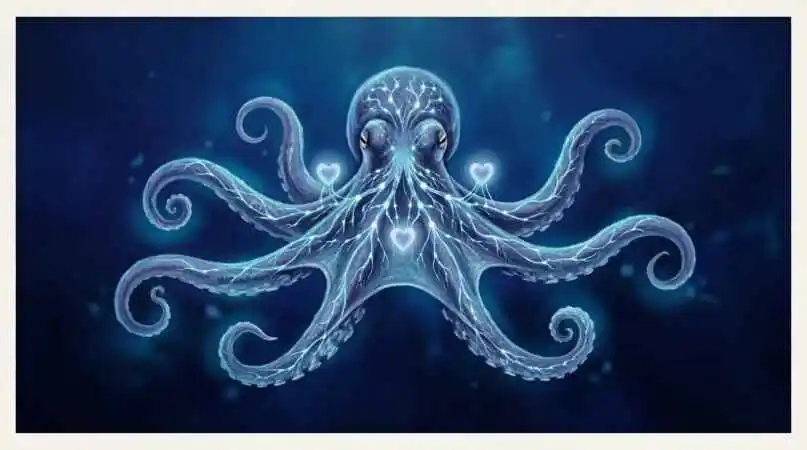
An octopus has three hearts, each serving a distinct function within its circulatory system. Two smaller hearts, called branchial hearts, are dedicated specifically to pumping blood through each of the octopus’s two gills, while a third, larger systemic heart pumps oxygenated blood to the rest of the body. This three-heart arrangement reflects the specific demands of the octopus’s circulatory system, which requires considerably more pumping power than a typical vertebrate circulatory system to move blood efficiently through its unusual, decentralized body structure.

Adding to this circulatory peculiarity, the octopus’s systemic heart actually stops beating when the animal swims, which is part of why octopuses tend to prefer crawling along the ocean floor to swimming whenever possible, since swimming is metabolically costlier and places the animal in a temporarily compromised circulatory state until the systemic heart resumes beating once swimming stops.
Why Octopus Blood Is Blue Instead of Red
Octopus blood appears blue rather than red because it relies on a copper-based protein called hemocyanin to transport oxygen through the bloodstream, rather than the iron-based hemoglobin found in vertebrate blood. When hemocyanin binds with oxygen, it produces a blue color, in contrast to the reddish color iron-based hemoglobin produces under the same oxygen-binding process, giving octopus blood its distinctive, genuinely striking blue-tinted appearance.
This copper-based oxygen transport system is actually less efficient at carrying oxygen than hemoglobin under typical conditions, but it offers a genuine advantage in cold, low-oxygen environments, including the deep, cold ocean waters many octopus species inhabit, since hemocyanin remains functional across a broader range of temperature and pressure conditions than hemoglobin does, a specific evolutionary trade-off that has served octopuses well across the wide range of ocean environments they have successfully colonized.
An octopus’s blood runs blue not by accident, but because copper, not iron, does a better job carrying oxygen through cold, deep ocean water.
A Brain Distributed Across Nine Separate Clusters
Perhaps the most genuinely alien aspect of octopus biology involves how its nervous system is organized. Rather than concentrating the majority of neurons in a single centralized brain the way vertebrates do, an octopus distributes roughly two-thirds of its approximately 500 million neurons across nine separate neural clusters, one central brain and eight additional neural clusters, one embedded within each of its eight arms, giving each arm a remarkable, semi-independent capacity to process sensory information and coordinate movement without requiring constant, direct instruction from the central brain.
This distributed neural architecture means an octopus’s arms can continue executing complex movements, including reaching, grasping, and even some exploratory behavior, for a period of time even when severed from the central body, a genuinely striking demonstration of just how much independent processing capability resides within each individual arm rather than being centrally controlled the way movement coordination works in vertebrate limbs.
How Octopuses Change Color Without Actually Seeing Color
Octopuses are renowned for their extraordinary ability to rapidly change both the color and texture of their skin, achieved through specialized skin cells called chromatophores, which contain expandable sacs of pigment that the octopus can expand or contract almost instantaneously through direct neural and muscular control, alongside additional cell types called iridophores and leucophores that reflect and scatter light to produce iridescent and white coloration effects respectively.
Remarkably, research suggests octopuses are colorblind, lacking the type of color-sensing cone cells in their eyes that would allow them to perceive color the way many other animals do, which has led researchers to a genuinely fascinating open question about how an animal without color vision achieves such precise, apparently color-matched camouflage, with leading theories suggesting octopus skin itself may contain light-sensitive proteins capable of detecting color information directly, potentially allowing the skin to sense and respond to color cues independently of what the eyes themselves can perceive, an area of active, ongoing research still working toward a fully settled answer.
Camouflage That Goes Far Beyond Simple Color Matching
Beyond color changes, octopuses can dramatically alter their skin texture, raising small bumps and ridges called papillae to mimic the rough texture of coral, rock, or algae-covered surfaces, a capability that works in combination with color and pattern changes to produce remarkably convincing camouflage against an enormous range of different ocean floor environments. Some species, including the aptly named mimic octopus, take this further still, actively imitating the appearance and movement patterns of other, more dangerous marine animals, including venomous sea snakes and lionfish, to deter potential predators.
This combination of rapid color change, texture alteration, and in some cases active behavioral mimicry represents one of the most sophisticated camouflage and defense systems documented anywhere in the animal kingdom, achieved entirely without conscious deliberation in the way a human might plan a disguise, but rather through a remarkably fast, largely automatic neural and physiological response system finely tuned by millions of years of evolutionary pressure from predation.
The Evidence for Genuine Problem-Solving Intelligence
Octopuses have demonstrated problem-solving abilities in controlled research settings that go well beyond simple, instinctive behavior. They have been documented opening jars to retrieve food, navigating mazes, learning to associate specific visual cues with rewards through observation of other octopuses, and, in one particularly well-documented and widely discussed behavior, using coconut shell halves as portable armor, carrying them for later use as a defensive shelter, a genuinely striking example of tool use, a cognitive capability once thought to be largely restricted to a small number of highly intelligent vertebrate species.
Octopuses kept in captivity have also displayed behavior researchers interpret as evidence of individual personality differences, distinct preferences, and even what some researchers cautiously describe as apparent playfulness, including documented instances of octopuses repeatedly manipulating objects like floating bottles in ways that do not appear to serve any direct survival function, behavior that, while difficult to interpret with full scientific certainty, has contributed to octopuses’ growing reputation as genuinely sophisticated cognitive creatures worth taking seriously as a subject of comparative intelligence research.
Why Octopus Intelligence Remains Genuinely Difficult to Study
Studying octopus cognition presents researchers with unusual methodological challenges specifically because so much of what has been learned about animal intelligence historically comes from studying animals more closely related to humans, primates, other mammals, and birds, whose cognitive architecture and behavioral signals researchers already have some intuitive and scientific familiarity with. Octopuses, given their vastly different nervous system organization and evolutionary history, do not necessarily display intelligence or emotional states through behaviors researchers would recognize or correctly interpret based on prior experience studying more familiar animals.
This genuine interpretive challenge has led some researchers to argue that current understanding of octopus intelligence, while already genuinely impressive based on documented behavior, likely still underestimates the full scope of their cognitive capabilities, simply because existing research methods and behavioral frameworks were largely developed around more familiar animal minds and may not fully capture or correctly interpret the full range of what an octopus’s genuinely different cognitive architecture is actually capable of expressing.
A Remarkably Short Life for Such a Sophisticated Mind
Despite their sophisticated cognitive abilities, most octopus species have strikingly short lifespans, typically living only one to two years, with some smaller species living less than a year and even the longest-lived species rarely exceeding four to five years, a genuinely surprising contrast given how much learning, memory, and problem-solving capability these animals pack into such a brief existence. This short lifespan is closely tied to octopus reproduction, since most octopus species are semelparous, meaning they reproduce only once before dying shortly afterward, with females in many species stopping feeding entirely while guarding their eggs until they hatch, ultimately dying from this prolonged self-imposed starvation shortly after the eggs finally hatch.
This combination of remarkable intelligence paired with such a brief lifespan raises genuinely interesting open questions researchers continue to actively explore, about what evolutionary pressures favored developing such sophisticated cognitive machinery in an animal that, in most cases, will never live long enough to pass learned behaviors to the next generation the way longer-lived, socially learning animals like elephants or primates typically do. Some researchers propose that octopus intelligence evolved primarily to solve immediate, individual survival challenges, hunting, predator avoidance, and shelter-finding, rather than to support the kind of long-term social learning and cultural transmission that shaped intelligence in longer-lived, more social species.
How Many Octopus Species Actually Exist
Scientists have identified somewhere between 300 and 500 distinct octopus species, though taxonomic classification in this group remains an active, evolving area of research, with new species still being formally described on a regular basis. These species inhabit an enormous range of ocean environments, from shallow tide pools and coral reefs to the deep sea, with some species adapted to extreme cold, high pressure, and near-total darkness found at significant ocean depths.
This diversity spans an equally wide range of sizes, from the tiny star-sucker pygmy octopus, which can fit comfortably on a fingertip, to the giant Pacific octopus, which can grow to a considerable arm span and represents one of the largest and most intelligent octopus species specifically studied in dedicated cognition research, illustrating just how much genuine biological and behavioral diversity exists within a single broader animal group most people picture as a single, uniform kind of creature.
The Regenerative Abilities Hiding in Those Arms
Beyond their semi-independent processing capability, octopus arms possess a genuinely remarkable capacity for regeneration, with an octopus able to fully regrow an arm lost to injury or predator attack over a period of weeks to months, restoring not just the outer tissue but the full complement of suckers, chromatophores, and neural tissue that made the original arm so functionally sophisticated. This regenerative capacity has drawn significant interest from regenerative medicine researchers studying tissue regrowth mechanisms, given how considerably more limited human regenerative capability is by comparison.
Researchers studying octopus arm regeneration have identified specific genetic and cellular signaling pathways involved in the process, hoping that a more detailed understanding of how an octopus achieves such complete, functional limb regrowth might eventually offer useful insights applicable to human tissue regeneration research, even though the vast evolutionary distance between octopuses and humans means any such insights would need substantial additional research before suggesting genuinely direct medical application.
Why Octopuses Matter Beyond Scientific Curiosity
Beyond their inherent scientific fascination, octopuses have become genuinely significant subjects in broader discussions about animal cognition, consciousness, and, increasingly, animal welfare policy, with several countries and jurisdictions having extended specific legal protections to octopuses and other cephalopods in recognition of mounting scientific evidence supporting their capacity to experience pain and demonstrate genuinely sophisticated cognitive processing, a policy shift that would have seemed considerably less scientifically justified before the substantial body of octopus cognition research accumulated over recent decades.
This growing recognition reflects a broader, ongoing shift in how science approaches questions of animal intelligence and consciousness generally, moving away from assuming sophisticated cognition requires close evolutionary relatedness to humans, and toward a more genuinely open, comparative approach willing to seriously investigate intelligence wherever it appears, even when it arrives through as radically different a biological pathway as the octopus’s uniquely distributed, alien nervous system represents. Few animals make a stronger case that intelligence is not a single evolutionary story but something life has independently discovered more than once, through entirely different means.
Frequently Asked Questions
| Question | Answer |
| How many hearts does an octopus have? | An octopus has three hearts: two branchial hearts for the gills and one systemic heart for the body. |
| Why is octopus blood blue? | It uses copper-based hemocyanin instead of iron-based hemoglobin to transport oxygen. |
| Does the octopus heart stop when it swims? | Yes, the systemic heart stops beating during swimming, making crawling less metabolically costly. |
| How many neurons does an octopus have? | An octopus has approximately 500 million neurons, most distributed outside the central brain. |
| Do octopus arms have their own brains? | Each arm contains a neural cluster that allows semi-independent processing and movement. |
| Can a severed octopus arm still move? | Yes, it can continue some movement temporarily due to its distributed nervous system. |
| How do octopuses change color? | Specialized skin cells called chromatophores expand and contract to alter color rapidly. |
| Are octopuses colorblind? | Research suggests they lack color-sensing cone cells, despite their color-changing abilities. |
| How might colorblind octopuses match colors so precisely? | Some researchers believe their skin may contain light-sensitive proteins that detect color directly. |
| What are papillae in octopus skin? | They are small bumps the octopus can raise to mimic textured surfaces for camouflage. |
| What is the mimic octopus known for? | It imitates the appearance and movement of other dangerous marine animals to deter predators. |
| Do octopuses use tools? | Yes, some have been documented carrying coconut shells for later use as shelter. |
| Can octopuses solve puzzles? | Yes, they have demonstrated abilities like opening jars and navigating mazes in research settings. |
| Do octopuses have individual personalities? | Some research suggests behavioral differences that may indicate individual personality traits. |
| How long do octopuses typically live? | Most species live only one to two years, with few living beyond four to five years. |
| Why do octopuses have such short lifespans? | Most species reproduce only once and die shortly after eggs hatch. |
| What does semelparous mean? | It describes an organism that reproduces only once before dying. |
| Why do female octopuses stop eating while guarding eggs? | They dedicate all their energy to protecting eggs until hatching, leading to eventual starvation. |
| How many octopus species exist? | Scientists have identified between roughly 300 and 500 distinct species. |
| What is the smallest octopus species? | The star-sucker pygmy octopus is among the smallest, fitting on a fingertip. |
| What is the largest octopus species? | The giant Pacific octopus is among the largest and most studied species. |
| Why is octopus intelligence considered alien? | It evolved independently from vertebrate intelligence through a completely different neural structure. |
| When did octopuses and humans share a common ancestor? | Roughly 500 to 700 million years ago, before complex brains had evolved. |
| Do octopuses feel pain? | Growing scientific evidence supports their capacity to experience pain, influencing animal welfare policy. |
| Have any countries extended legal protections to octopuses? | Yes, several jurisdictions have extended specific protections to cephalopods based on cognition research. |
| Why is octopus cognition hard to study? | Their distributed nervous system differs greatly from more familiar animal cognition models. |
| Do octopuses live in social groups? | Most species are largely solitary, unlike many other intelligent animals. |
| What environments do octopuses live in? | They inhabit a wide range of ocean environments, from shallow reefs to the deep sea. |
| Why is hemocyanin useful in cold ocean water? | It remains functional across a wider range of temperature and pressure than hemoglobin. |
| What makes octopuses significant beyond scientific curiosity? | They challenge assumptions about intelligence and are reshaping animal welfare and consciousness discussions. |
Disclaimer: The content on this blog is for informational purposes only. The author’s opinions are personal and not endorsed. Efforts are made to provide accurate information, but completeness, accuracy, or reliability are not guaranteed. The author is not liable for any loss or damage resulting from the use of this blog. It is recommended to use the information on this blog at your own discretion.
