
Table of Contents
Fer-de-Lance: Inside the Legend of Latin America’s Deadliest Serpent
Why this cryptic pit viper is feared across the Americas — and what its biology actually reveals about survival, venom, and coexistence
Ask anyone who has spent time on a Central American coffee plantation, banana farm, or jungle trail to name the animal they fear most, and the answer rarely involves a jaguar or a crocodile. It is usually a snake — one so well camouflaged against dead leaves that it is often only noticed after it is too late. That snake is the fer-de-lance, and its reputation is not exaggerated folklore. It is grounded in real numbers: more snakebite injuries and fatalities across its range are attributed to this species than to any other serpent in the Americas.
Yet reducing the fer-de-lance to a simple villain misses what makes it genuinely remarkable. This is an animal shaped by millions of years of evolutionary pressure into one of the most efficient ambush predators on the planet, equipped with heat-sensing organs, a devastatingly effective venom delivery system, and reproductive strategies that keep its population thriving despite intense human pressure. Understanding the fer-de-lance is not just useful for anyone living, farming, or hiking within its range — it is also a window into how venom, camouflage, and behavior evolve together to produce a creature this successful.
This guide walks through what the fer-de-lance actually is, where it lives, how its venom works, why encounters with humans happen so often, and what modern science and conservation are learning from a species that has, for centuries, been simultaneously feared and misunderstood.

It is also a useful case study in how a single animal can occupy two seemingly contradictory roles at once: a genuine public health concern in the regions where it lives, and a biologically fascinating, ecologically important species whose venom, hunting strategy, and reproductive biology continue to inform both medicine and conservation science. Holding both of those truths at the same time, rather than reducing the fer-de-lance to a simple villain, is the goal of everything that follows.
What Exactly Is a Fer-de-Lance?
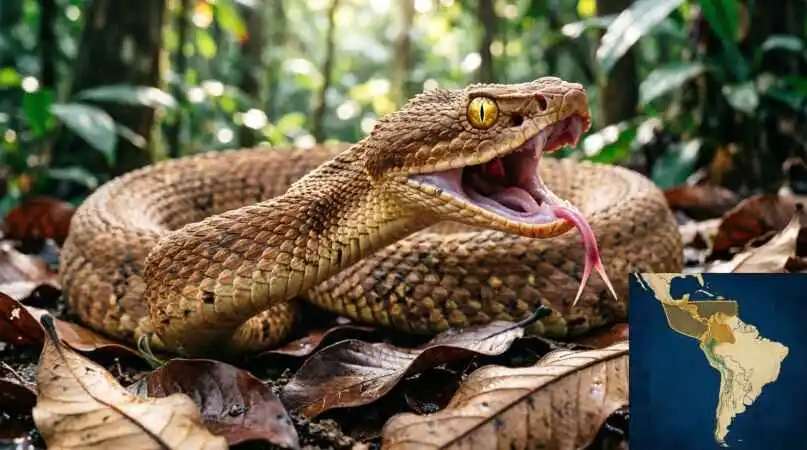
‘Fer-de-lance’ is a French term meaning ‘lance head,’ a reference to the snake’s sharply angular, spear-shaped skull. The name is applied most commonly to Bothrops asper, a large pit viper distributed from southern Mexico through Central America and into parts of Colombia, Venezuela, and Ecuador, though several closely related Bothrops species across South America share the same common name in various regions. In much of Central America, particularly Costa Rica, it is equally well known by its Spanish name, terciopelo, meaning ‘velvet,’ a nod to the smooth sheen of its scales.
Taxonomically, the fer-de-lance belongs to the family Viperidae and the subfamily Crotalinae, the pit vipers — a group that also includes rattlesnakes, cottonmouths, and copperheads found further north. What unites pit vipers is a pair of specialized heat-sensing organs, called loreal pits, located between each eye and nostril. These organs detect infrared radiation from warm-blooded prey with remarkable sensitivity, allowing the snake to strike accurately at a mouse or bird even in complete darkness, relying on thermal signature rather than sight.
Adult fer-de-lance typically measure between four and seven feet in length, though exceptionally large females — the sex tends to grow larger than males in this species — have been documented approaching eight feet. Their body is thick and muscular relative to their length, built for explosive striking power rather than speed or constriction. The head is broad and distinctly triangular, wider than the neck, a visual cue often used to distinguish venomous pit vipers from many harmless snake species with more uniform body proportions.
The common name ‘fer-de-lance’ is occasionally applied more loosely across the region to other Bothrops species as well, including Bothrops atrox in the Amazon basin and several island or regional variants, which has historically caused some confusion in both popular writing and early scientific literature. Herpetologists today generally treat these as distinct species with overlapping but not identical ranges, venom compositions, and behavioral tendencies, even though local communities often use the same general common name for any large, dangerous, triangular-headed viper they encounter.
A Master of Camouflage and Ambush
The fer-de-lance’s coloration is a masterclass in disruptive camouflage. Its base color ranges from olive-brown to gray or reddish-tan, overlaid with a series of dark, diamond or X-shaped blotches running down the back, each often edged in a lighter cream or yellow line. Against the dappled light and leaf litter of a tropical forest floor, this pattern breaks up the snake’s outline so effectively that it can be nearly invisible from just a few feet away, even to an attentive observer actively searching for it.
“Most fer-de-lance bites do not happen because the snake attacked. They happen because no one saw it there at all.”
This camouflage is not incidental; it is the foundation of the fer-de-lance’s entire hunting strategy. Unlike active foragers that pursue prey across long distances, the fer-de-lance is a classic ambush predator. It selects a promising location — often near a game trail, a fallen log, or a spot where rodents are known to pass — and remains motionless for extended periods, sometimes days, waiting for a suitable target to come within striking range. When a rodent, bird, or amphibian passes close enough, the snake strikes with extraordinary speed, injects venom, and then releases its grip, allowing the prey to flee before succumbing. The snake then tracks the dying animal by scent, a strategy that minimizes the risk of injury from a struggling, potentially dangerous prey item.
This same sit-and-wait behavior, so effective against unsuspecting rodents, is precisely why so many human bites occur without warning. A fer-de-lance resting motionless beside a farm path or a trail is not lying in ambush for a person; it typically has no interest in humans at all and will attempt to remain undetected rather than confront a creature far too large to eat. Bites almost always occur when a person accidentally steps too close, places a hand near where the snake is resting while clearing brush, or otherwise startles the animal into a defensive strike. The snake’s stillness, so useful for hunting, becomes a liability precisely because it makes accidental human contact more likely rather than less.
Juvenile fer-de-lance add another layer to this ambush strategy: a bright yellow or greenish tail tip, quite different in color from the rest of their camouflaged body, which they wiggle slowly to mimic a small worm or grub. This behavior, known as caudal luring, attracts curious frogs, lizards, or small birds close enough for the young snake to strike, compensating for its smaller size and shorter reach compared to an adult. As the snake matures, this colorful tail tip typically fades, coinciding with a dietary shift away from the smaller prey it was originally used to attract.
The Venom: Why This Bite Is Taken So Seriously
Fer-de-lance venom is primarily hemotoxic, meaning it targets blood and tissue rather than the nervous system. A bite typically causes immediate, intense pain, rapid swelling that can spread across an entire limb within hours, and extensive bruising as the venom’s components damage blood vessel walls and disrupt normal blood clotting. In more severe envenomations, victims can experience internal bleeding, blistering, and significant necrosis of muscle and skin tissue around the bite site, sometimes severe enough to require surgical debridement or, in extreme historical cases before modern treatment, amputation.
The clinical progression of a serious fer-de-lance envenomation tends to follow a recognizable pattern that emergency physicians throughout the region are trained to anticipate. Swelling typically begins within minutes and can progress up an entire limb within a few hours, often accompanied by painful, tense skin as fluid and blood accumulate in the surrounding tissue. Blood clotting abnormalities may show up as prolonged bleeding from the bite site, gums, or minor cuts, and in severe cases, laboratory testing reveals a complete failure of normal clotting function, a condition that must be corrected with antivenom rather than blood products alone, since the venom actively consumes clotting factors faster than they can be replaced.
What makes fer-de-lance bites particularly dangerous compared to many other venomous snakes is the sheer volume of venom the species is capable of delivering in a single bite. Larger individuals possess correspondingly large venom glands, and a defensive strike from an adult fer-de-lance can inject a substantial dose compared to smaller viper species. Combined with the snake’s wide distribution across densely populated agricultural regions, this volume is a major reason the species accounts for the majority of serious snakebite cases across much of its range.
Fortunately, medical response to fer-de-lance envenomation has improved enormously over the past century. Polyvalent antivenoms, developed specifically against Bothrops venom and produced by institutes across Latin America, are widely distributed in hospitals and clinics throughout the snake’s range. When administered promptly, antivenom dramatically reduces mortality and limits tissue damage. The critical variable remains time: rural clinics may be hours away from a bite location, and the interval between envenomation and treatment often determines whether a victim recovers with minimal complications or suffers lasting tissue damage. Public health programs in countries like Costa Rica and Panama have invested heavily in rural antivenom stockpiles and community education specifically because of this species’ outsized medical impact.
Interestingly, fer-de-lance venom has also become a subject of active pharmacological research. Components of pit viper venom, including those from Bothrops species, have contributed to the development of medications used to treat high blood pressure and blood clotting disorders, since certain venom proteins interact with the same physiological pathways doctors want to influence therapeutically. A creature responsible for so much fear has, paradoxically, also contributed real medical benefit through careful scientific study of the very toxins that make it dangerous.
Habitat, Range, and Daily Life
The fer-de-lance favors lowland tropical and subtropical environments, including rainforest understory, riverbanks, swampy lowlands, and — critically for human encounters — the edges of agricultural land such as banana and coffee plantations, sugarcane fields, and cattle pasture. This adaptability to human-altered landscapes is a major factor in its notoriety; unlike many snake species that retreat entirely from cleared land, the fer-de-lance often thrives at the boundary between cultivated fields and remaining forest, an edge habitat that also happens to be exactly where farm workers spend their days.
The species is largely nocturnal or crepuscular, most active during dusk, night, and early morning hours when temperatures are cooler and many of its rodent prey are also active. During the heat of the day, fer-de-lance individuals typically remain hidden under leaf litter, fallen logs, or dense vegetation, conserving energy and avoiding detection by both predators and potential prey that might otherwise be alerted by daytime movement.
Fer-de-lance are competent swimmers and are frequently found near water sources, sometimes crossing rivers or streams in search of new territory or prey. While adults are primarily terrestrial, juveniles show a greater tendency toward semi-arboreal behavior, climbing low shrubs and vegetation, in part because their diet at that life stage leans more heavily on lizards and frogs found off the ground. As they mature and shift toward a diet increasingly dominated by small mammals, adult fer-de-lance become more strictly ground-dwelling.
Like all snakes, the fer-de-lance is ectothermic, relying on its environment rather than internal metabolism to regulate body temperature, and its daily and seasonal movements are shaped heavily by this constraint. During cooler, wetter periods it may bask briefly in dappled sunlight near forest gaps to raise its body temperature enough for effective digestion, while during the hottest parts of the day it retreats into cover to avoid overheating. This close dependence on ambient temperature also means that its activity patterns, and therefore the timing of human encounters, can shift somewhat with seasonal rainfall and temperature cycles across its range.
Reproductively, the species is viviparous, meaning females give birth to fully formed live young rather than laying eggs — a trait shared by many pit vipers and one that may offer a survival advantage in variable tropical climates by allowing the mother to thermoregulate and protect developing embryos rather than leaving them exposed in an unattended nest. Litter sizes are notably large, with reports ranging from a dozen up to more than 60 offspring in a single reproductive event, a reproductive strategy that helps offset high juvenile mortality rates from predation.
Predators, Prey, and the Fer-de-Lance’s Place in the Ecosystem
Despite its fearsome reputation among humans, the fer-de-lance occupies a middle position in its ecosystem’s food web rather than sitting unchallenged at the top. Juveniles in particular face significant predation pressure from birds of prey, larger snakes, and opportunistic mammals such as coatis. Perhaps the most famous natural predator of the fer-de-lance is the mussurana, a large, non-venomous snake found throughout its range that has evolved partial immunity to pit viper venom and actively hunts and consumes fer-de-lance individuals, including full-grown adults.
As predators themselves, fer-de-lance play an important ecological role in regulating rodent populations, which in turn has meaningful downstream effects on agricultural pest control and the spread of rodent-borne disease. Farmers who understand this ecological role sometimes adopt more tolerant approaches toward the species at a distance from living and working areas, recognizing that a healthy population of natural rodent predators can reduce crop damage from mice and rats that would otherwise multiply unchecked.
This dual identity — feared threat near human dwellings, valuable pest-control agent within the broader landscape — captures much of the tension that defines how communities across Central and South America relate to the fer-de-lance. Wholesale eradication efforts, common in past decades, are increasingly recognized as ecologically counterproductive, prompting a shift toward coexistence strategies: clearing vegetation immediately around homes and paths, educating field workers on safe practices, and maintaining accessible antivenom supplies, rather than attempting to eliminate the species from a region entirely.
Research institutions across Costa Rica, Brazil, and Colombia continue to study fer-de-lance venom not only to improve antivenom production but also to catalogue the remarkable chemical diversity within it, since venom composition can vary meaningfully between populations, and even between individuals, depending on diet, geography, and age. This variability matters clinically, because it means antivenom developed against one population’s venom profile may be somewhat less effective against another, a challenge that has pushed toward the development of broader polyvalent antivenoms capable of neutralizing a wider range of Bothrops venom variants across the species’ extensive range.
Living Safely Alongside the Fer-de-Lance
For residents, farm workers, and travelers throughout the fer-de-lance’s range, a handful of practical habits meaningfully reduce the risk of a dangerous encounter. Sturdy, ankle-covering boots are the single most effective piece of protective equipment, since a large percentage of bites occur on the lower leg or foot when a person steps near a resting snake. Carrying a flashlight during dawn, dusk, or nighttime movement is equally important, given the species’ crepuscular and nocturnal activity patterns.
Avoiding blind reaches into dense leaf litter, hollow logs, or thick undergrowth — whether while gardening, harvesting, or simply clearing a path — removes another major category of accidental encounters. Because the fer-de-lance relies so heavily on camouflage and stillness rather than fleeing from perceived threats, it will often remain in place even as a person approaches, making careful visual scanning of the ground ahead a genuinely effective precaution rather than an overly cautious habit.
Should a bite occur despite these precautions, the recommended response is straightforward and worth memorizing: keep the affected person as calm and still as possible to slow venom circulation, remove rings, watches, or tight clothing near the bite site before swelling worsens, immobilize the limb in a position roughly level with the heart, and get to a medical facility capable of administering antivenom as quickly as possible. Traditional remedies such as cutting the wound, attempting to suck out venom, or applying a tight tourniquet are now firmly discouraged by medical authorities, since they tend to worsen tissue damage without meaningfully reducing venom absorption.
For hikers and ecotourists visiting fer-de-lance habitat specifically to observe wildlife, hiring knowledgeable local guides offers a significant safety advantage, since experienced guides are typically skilled at spotting camouflaged snakes well before an unguided visitor would notice them. Many national parks and reserves throughout Costa Rica, Panama, and neighboring countries incorporate fer-de-lance awareness directly into visitor briefings, reflecting just how central this species is to safe travel through the region’s lowland forests.
Conclusion: Respect, Not Just Fear
The fer-de-lance’s reputation as the Americas’ most medically significant snake is well earned, but reputation alone tells an incomplete story. Behind the fear is an animal exquisitely adapted to its environment — camouflaged to near invisibility, equipped with heat-sensing precision, and capable of reproductive output that keeps its population resilient even as human development reshapes its habitat. Its venom, a source of genuine danger to anyone caught unaware, has also become a tool in modern medicine, and its predatory role helps keep rodent populations, and the diseases they can carry, in check.
None of this erases the real risk the species poses to people who live and work within its range, and no article changes the fact that a fer-de-lance bite demands urgent medical attention rather than admiration. But understanding the biology behind the fear — why the snake is where it is, why it behaves the way it does, and why avoidance rather than eradication has become the guiding strategy — turns a one-dimensional monster of local legend into what it actually is: a remarkably successful, ecologically important predator that simply asks to be respected rather than encountered by surprise.
For anyone traveling, working, or living within the fer-de-lance’s range, that respect translates into simple, learnable habits rather than constant fear: sturdy footwear, a flashlight after dark, careful attention to leaf litter and log piles, and a clear plan for reaching medical care quickly if the worst does happen. Approached this way, the fer-de-lance becomes less an omen of danger lurking around every corner and more what it has always been — one more species, extraordinarily well adapted to its corner of the world, doing exactly what evolution built it to do.
Frequently Asked Questions
| Question | Answer |
| What is a fer-de-lance? | The fer-de-lance is the common name for several highly venomous pit viper species in the genus Bothrops, most notably Bothrops asper, found throughout Central and South America. |
| Where does the name ‘fer-de-lance’ come from? | The name is French for ‘lance head,’ referring to the snake’s sharply pointed, triangular head shape. |
| Where do fer-de-lance snakes live? | They are found from southern Mexico through Central America and into parts of northern South America, favoring lowland tropical forests, riverbanks, and agricultural areas. |
| How dangerous is a fer-de-lance bite? | A fer-de-lance bite is considered a medical emergency; it delivers a large volume of hemotoxic venom capable of causing severe tissue damage, internal bleeding, and death if untreated. |
| Is the fer-de-lance the most dangerous snake in the Americas? | It is widely regarded as responsible for more snakebite injuries and deaths than any other snake species in Central America and much of northern South America. |
| What does fer-de-lance venom do to the body? | Its venom is primarily hemotoxic, destroying tissue, disrupting blood clotting, and causing severe swelling, bruising, and potential organ damage. |
| How can you identify a fer-de-lance? | Key features include a triangular head, keeled scales, a diamond or X-shaped dorsal pattern, and heat-sensing pits between the eyes and nostrils. |
| How big do fer-de-lance snakes get? | Adults typically range from four to seven feet in length, with some large females reported to exceed eight feet. |
| What do fer-de-lance snakes eat? | They primarily prey on small mammals, birds, and amphibians, with diet shifting from ectothermic prey as juveniles to more warm-blooded prey as adults. |
| Are fer-de-lance snakes aggressive? | They are not aggressive by nature but will strike defensively when threatened, cornered, or accidentally stepped on, which contributes to their high bite rate near human settlements. |
| Why are fer-de-lance bites so common near farms? | Their preference for agricultural edges and their excellent camouflage make accidental encounters with farm and plantation workers frequent. |
| What is the first step after a fer-de-lance bite? | The person should remain calm, immobilize the affected limb, remove tight clothing or jewelry, and seek emergency medical care immediately. |
| Is there an antivenom for fer-de-lance bites? | Yes, polyvalent antivenoms effective against Bothrops species are produced and distributed throughout Latin America, and prompt treatment significantly improves outcomes. |
| Do fer-de-lance snakes lay eggs or give live birth? | Fer-de-lance snakes are viviparous, giving birth to live young, with litters sometimes numbering more than 40 offspring. |
| How many young can a fer-de-lance produce at once? | Litter sizes vary widely but can range from a dozen to over 60 live young in a single reproductive event. |
| What role do heat-sensing pits play? | The loreal pits allow the snake to detect infrared heat from warm-blooded prey, enabling accurate strikes even in total darkness. |
| Is the fer-de-lance nocturnal? | It is primarily nocturnal or crepuscular, being most active during the evening and night while resting in cover during the day. |
| What predators threaten the fer-de-lance? | Large birds of prey, mammalian predators such as coatis and other snakes, particularly the mussurana, are known predators of fer-de-lance individuals. |
| How does camouflage help the fer-de-lance hunt? | Its mottled brown, tan, and olive pattern breaks up its outline against leaf litter, allowing it to ambush prey undetected and avoid predators. |
| Are there different species called fer-de-lance? | Yes, the common name is applied to several closely related Bothrops species across different regions, with Bothrops asper being the most frequently referenced. |
| What is the difference between the fer-de-lance and the terciopelo? | Terciopelo is simply the Spanish common name widely used in Central America for the same species, Bothrops asper. |
| Can fer-de-lance snakes swim? | Yes, they are capable swimmers and are often found near rivers, streams, and flooded lowland habitats. |
| Do fer-de-lance snakes climb trees? | While primarily terrestrial, juveniles are more arboreal and may climb low vegetation, especially while hunting small prey. |
| What is the conservation status of the fer-de-lance? | The species is not currently considered globally threatened, though local populations face habitat pressure from deforestation and agricultural expansion. |
| How do fer-de-lance snakes benefit ecosystems? | As both predator and prey, they help regulate rodent populations and serve as a food source for larger predators, contributing to ecological balance. |
| What should hikers do to avoid fer-de-lance encounters? | Wearing sturdy boots, staying on cleared trails, using a flashlight at night, and avoiding reaching into dense leaf litter significantly reduce risk. |
| Why do fer-de-lance bites sometimes occur without warning? | Their exceptional camouflage and tendency to freeze rather than flee mean people often do not notice the snake until they are very close. |
| Is the fer-de-lance related to rattlesnakes? | Yes, both belong to the pit viper subfamily Crotalinae, sharing heat-sensing pits, though the fer-de-lance lacks a rattle. |
| How has the fer-de-lance influenced local culture? | It appears widely in Latin American folklore, warning signage, and regional safety education due to its medical significance and widespread presence. |
| What ongoing research focuses on the fer-de-lance? | Researchers study its venom composition for medical applications, its role in ecosystems, and its interactions with expanding human agricultural land. |
Disclaimer: The content on this blog is for informational purposes only. The author’s opinions are personal and not endorsed. Efforts are made to provide accurate information, but completeness, accuracy, or reliability are not guaranteed. The author is not liable for any loss or damage resulting from the use of this blog. It is recommended to use the information on this blog at your own discretion.
