
Table of Contents
The Childhood Illness That Announces Itself With a Slap You Never Felt
Fifth disease starts like an ordinary cold, then leaves a bright, slapped-cheek rash that alarms parents more than it should. Here is the full clinical picture of Parvovirus B19 infection, from the earliest symptoms to who actually needs to worry.
A Virus With an Oddly Specific Name
Fifth disease earned its unusual name from a nineteenth-century numbering system that classified the most common childhood rash illnesses in sequential order, and while the other four original conditions on that historical list have since been renamed or reclassified, “fifth disease” stuck as the common name for erythema infectiosum, an illness caused by Parvovirus B19. Despite the somewhat old-fashioned name, this remains one of the most common childhood viral illnesses encountered today, recognizable to most pediatricians and family doctors by its distinctive, easily identified rash pattern.
What makes fifth disease worth understanding in real detail is not that it is dangerous for most people who catch it, since the overwhelming majority of cases in healthy children resolve without any complication whatsoever, but that a small subset of specific populations, including pregnant individuals and people with certain blood disorders, face genuinely serious risk from the same infection that causes nothing more than a rash and mild discomfort in everyone else. Understanding exactly how the illness progresses, why its rash confuses so many parents, and who actually needs to worry explains both sides of this genuinely two-faced infection.
What Parvovirus B19 Actually Is
Parvovirus B19 is a small, single-stranded DNA virus that specifically targets and infects red blood cell precursors in the bone marrow, a targeting behavior that explains much of the illness’s broader clinical picture, including its potential to cause serious complications in people whose bodies already depend on an unusually high rate of red blood cell production. The virus spreads primarily through respiratory droplets, released when an infected person coughs, sneezes, or simply breathes in close proximity to others, making it readily transmissible in settings involving prolonged close contact, particularly schools and daycare centers.

Parvovirus B19 can also spread through blood, including from an infected pregnant person to their developing fetus, and through blood products in rare cases, transmission routes that carry particular clinical significance given the specific complications discussed later in this piece, even though respiratory transmission remains by far the most common way the virus spreads through a community.
The Three Stages of a Typical Infection
A typical fifth disease infection in a healthy child progresses through several recognizable stages. The illness begins with a nonspecific viral prodrome, mild fever, fatigue, a runny nose, and sometimes a mild sore throat or headache, symptoms indistinguishable from countless other common childhood respiratory viruses and generally lasting a few days before improving on their own without any specific treatment.
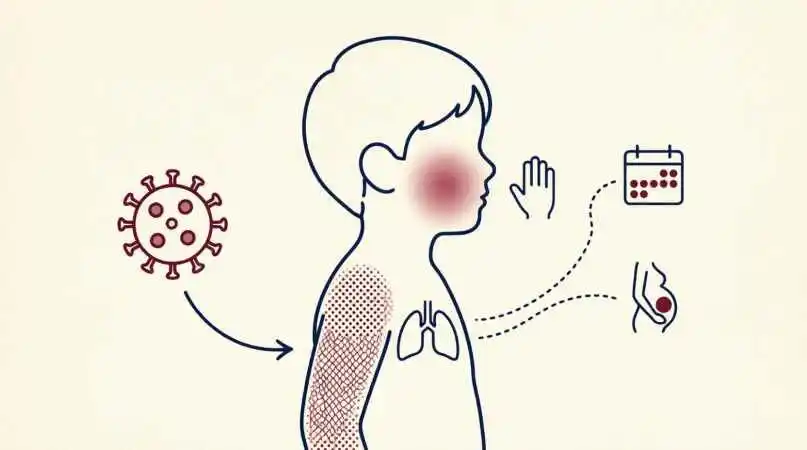
Roughly seven to ten days after this initial prodrome, once the person is actually starting to feel better, the illness’s hallmark rash appears, first as a bright, well-defined redness across both cheeks, often described as looking like the person has just been slapped, followed a day or two later by a second, lacy or net-like pinkish rash spreading across the trunk, arms, and legs, a distinctive, reticulated pattern that gives the rash its recognizable, lace-like appearance under close inspection.
By the time the classic slapped-cheek rash actually appears, the child has usually already stopped being contagious, a detail that surprises most parents seeing it for the first time.
Why the Rash Confuses So Many Parents
The slapped-cheek rash is genuinely striking in appearance, bright red, sharply defined, and often noticeably warm to the touch, which understandably alarms many parents seeing it for the first time, particularly since it can appear suddenly and dramatically compared to the mild, unremarkable symptoms that preceded it. The rash itself is not painful or itchy for most children, and its dramatic visual appearance is genuinely disproportionate to how mild the underlying illness actually is in most healthy children experiencing it.
The secondary lace-like body rash can fluctuate noticeably in visibility over the following one to three weeks, often becoming more pronounced with heat exposure, sun exposure, warm baths, physical activity, or emotional stress, a fluctuating pattern that can make the rash appear to unpredictably come and go over an extended period, sometimes prompting understandably concerned parents to seek repeated medical evaluation for what remains, in the overwhelming majority of cases, the same ordinary, resolving illness.
The Contagious Period: A Detail Worth Knowing
One of the more clinically useful and frequently surprising facts about fifth disease involves its contagious timeline: a person infected with Parvovirus B19 is most contagious during the initial prodrome phase, before the characteristic rash ever appears, and is generally considered no longer contagious by the time the classic slapped-cheek rash actually develops. This means that by the point a diagnosis is often first suspected or confirmed based on the visible rash, the child has typically already passed through their contagious window entirely.
This detail carries genuine practical significance for school and daycare exclusion policies, since many public health guidelines specifically note that children do not need to be kept home from school or daycare once the rash has appeared, a policy directly informed by this contagious-period timing, even though the visible rash itself, appearing well after the contagious window has closed, is often what first prompts concerned parents or caregivers to consider keeping a child home.
Joint Pain: The Symptom Adults Experience Very Differently
While children with fifth disease typically experience the illness as a mild respiratory prodrome followed by a rash, adults infected with Parvovirus B19 frequently experience a notably different symptom pattern centered on joint pain and swelling, called arthropathy, which can affect the hands, wrists, knees, and ankles, sometimes significantly enough to be mistaken for an entirely different condition, including early rheumatoid arthritis, before the underlying viral cause is properly identified.
This joint involvement occurs considerably more frequently in adult women than in men or children, for reasons not entirely understood, and while it typically resolves within a few weeks in most cases, it can occasionally persist for a longer period, months in some documented cases, making Parvovirus B19 infection a genuine, if underrecognized, item on the differential diagnosis list clinicians consider when evaluating adult patients presenting with new, otherwise unexplained joint pain and swelling.
Why This Virus Poses a Special Risk to Certain Blood Disorders
Because Parvovirus B19 specifically targets and temporarily halts the production of red blood cell precursors in the bone marrow, the infection poses a genuinely serious risk to people who already depend on an unusually high, continuous rate of red blood cell production to compensate for an underlying condition, most notably people with sickle cell disease, thalassemia, and other chronic hemolytic anemias, in whom the infection can trigger a sudden, severe drop in red blood cell count called an aplastic crisis.
An aplastic crisis represents a genuine medical emergency in this specific population, sometimes requiring urgent blood transfusion to manage the sudden, significant drop in red blood cell count, a stark contrast to how the same virus typically presents in an otherwise healthy child, and a major reason healthcare providers ask specifically about underlying blood disorders when evaluating a patient with confirmed or suspected Parvovirus B19 infection.
The Pregnancy Risk That Deserves Serious Attention
The other population facing genuinely serious risk from Parvovirus B19 infection is pregnant individuals, particularly during the first half of pregnancy, since the virus can cross the placenta and, in a small but clinically significant percentage of cases, cause severe fetal anemia leading to a condition called hydrops fetalis, a serious accumulation of fluid in fetal tissues that can, in the most severe cases, be fatal without appropriate monitoring and intervention.
It is important to note that the overall risk to any individual pregnancy remains relatively low even following confirmed maternal infection, and the majority of pregnancies affected by maternal Parvovirus B19 infection proceed without complication, but the genuine, serious potential severity when complications do occur is precisely why pregnant individuals exposed to a confirmed or suspected case of fifth disease, particularly through a household member or a young child in their care, should contact their obstetric provider promptly to discuss testing and appropriate monitoring, generally through specialized ultrasound surveillance for a defined period following exposure.
How Fifth Disease Is Actually Diagnosed
In most healthy children and adults, fifth disease is diagnosed clinically, based on the recognizable, classic pattern of symptoms and rash appearance, without requiring specific laboratory confirmation, since the slapped-cheek and lace-like body rash combination is distinctive enough for an experienced clinician to recognize confidently in a typical, uncomplicated presentation.
Laboratory testing, typically blood tests checking for Parvovirus B19-specific antibodies or, in certain clinical situations, direct viral DNA testing, becomes more relevant in specific circumstances where confirmation genuinely matters clinically, including pregnant individuals with a known or suspected exposure, patients with underlying blood disorders presenting with symptoms concerning for an aplastic crisis, and adults presenting with unexplained joint pain where Parvovirus B19 infection is being considered as a possible underlying cause requiring confirmation before ruling out other, potentially more serious causes of new joint symptoms.
How Fifth Disease Is Actually Treated
There is no specific antiviral treatment for Parvovirus B19 infection, and for the overwhelming majority of healthy children and adults, treatment consists entirely of supportive care: rest, adequate fluid intake, and over-the-counter fever or pain relief medication as needed for comfort, with the illness resolving entirely on its own within a matter of days to a few weeks depending on which specific symptoms, respiratory, rash, or joint-related, are most prominent in a given case.
For the specific higher-risk populations discussed earlier, people with underlying blood disorders experiencing an aplastic crisis, or pregnant individuals with evidence of significant fetal complications, treatment becomes considerably more involved and situation-specific, potentially including blood transfusion for an aplastic crisis or, in select severe fetal cases, intrauterine blood transfusion, underscoring why accurately identifying these higher-risk populations at the time of diagnosis matters so significantly for determining the appropriate level of medical attention a given case actually requires.
Can Fifth Disease Be Prevented?
There is currently no vaccine available for Parvovirus B19, meaning prevention relies primarily on standard respiratory illness precautions: regular handwashing, avoiding close contact with visibly ill individuals when reasonably possible, and covering coughs and sneezes, general measures that reduce transmission risk for many respiratory viruses simultaneously rather than being specific to Parvovirus B19 alone.
Given that infected individuals are most contagious before any recognizable rash appears, meaningful prevention within a household or school setting is genuinely difficult to achieve reliably in practice, since the illness is often already spreading before anyone realizes a specific case is fifth disease rather than an ordinary, nonspecific cold, a limitation that public health guidance around this illness generally acknowledges directly rather than promising a level of preventability the illness’s actual transmission pattern does not really support.
Why Outbreaks Cluster So Predictably in Schools
Fifth disease outbreaks follow a predictable pattern closely tied to settings involving prolonged, close indoor contact among children, most notably schools and daycare centers, where respiratory droplet transmission spreads efficiently through shared classroom air, close physical proximity during play, and frequent contact with shared surfaces. Seasonal patterns also play a role, with fifth disease activity typically increasing during late winter and spring months in many regions, a pattern broadly consistent with the seasonal transmission patterns observed across many common respiratory viruses.
Because the illness is most contagious during its nonspecific, cold-like prodrome phase, before any parent or teacher would have reason to suspect fifth disease specifically, outbreaks often become apparent only in retrospect, once several children within the same classroom or social group develop the recognizable rash within a similar timeframe, at which point the actual period of active transmission has typically already passed for most of those affected.
When to Actually Seek Medical Attention
For most healthy children and adults, fifth disease does not require urgent medical evaluation, and the classic rash, while visually alarming, generally does not by itself warrant an emergency visit. Medical attention becomes more clearly warranted for anyone with an underlying blood disorder developing symptoms of significant fatigue, pale skin, or shortness of breath during or after a suspected infection, symptoms potentially indicating an aplastic crisis requiring prompt evaluation.
Pregnant individuals with a known or strongly suspected exposure should contact their obstetric provider promptly regardless of whether they are experiencing symptoms themselves, given the specific fetal monitoring recommendations that may apply, and anyone, adult or child, with joint pain, fever, or a rash accompanied by more concerning features, including significant lethargy, difficulty breathing, or a rash that does not fit the classic, recognizable pattern described throughout this piece, should seek medical evaluation to confirm the diagnosis and rule out other, potentially more serious conditions with a similar initial presentation.
Frequently Asked Questions
| Question | Answer |
| What is fifth disease? | It is a common childhood viral illness, also called erythema infectiosum, caused by Parvovirus B19. |
| What causes fifth disease? | It is caused by Parvovirus B19, a virus that targets red blood cell precursors in the bone marrow. |
| Why is it called fifth disease? | The name comes from a historical numbering system of common childhood rash illnesses. |
| How does fifth disease spread? | Primarily through respiratory droplets, and also through blood or from mother to fetus. |
| What does the slapped-cheek rash look like? | A bright, well-defined redness across both cheeks that can look like a slap mark. |
| What is the lace-like rash associated with fifth disease? | A net-like, reticulated pink rash that spreads across the trunk, arms, and legs. |
| What are the first symptoms of fifth disease? | Mild fever, fatigue, runny nose, and sometimes a sore throat or headache. |
| When does the rash typically appear? | Roughly seven to ten days after the initial cold-like symptoms begin. |
| Is fifth disease contagious once the rash appears? | No, a person is generally no longer contagious by the time the rash develops. |
| Should a child stay home from school with fifth disease? | Many guidelines say exclusion is not necessary once the rash has appeared. |
| Can adults get fifth disease? | Yes, and adults often experience joint pain more prominently than a visible rash. |
| Why does fifth disease cause joint pain in adults? | The exact reason is unclear, but joint involvement is more common in adult women. |
| Can fifth disease be mistaken for arthritis? | Yes, its joint symptoms can resemble early rheumatoid arthritis in some adults. |
| Who is at higher risk from fifth disease? | People with certain blood disorders and pregnant individuals face higher risk of complications. |
| What is an aplastic crisis? | A sudden, severe drop in red blood cell production, dangerous for people with certain blood disorders. |
| Which blood disorders increase risk from Parvovirus B19? | Sickle cell disease, thalassemia, and other chronic hemolytic anemias increase risk. |
| Is fifth disease dangerous during pregnancy? | It can pose risks, particularly in the first half of pregnancy, though most cases resolve without complication. |
| What is hydrops fetalis? | A serious fetal condition involving fluid accumulation, which can rarely result from fetal Parvovirus B19 infection. |
| What should a pregnant person do after exposure to fifth disease? | Contact their obstetric provider promptly to discuss testing and monitoring. |
| How is fifth disease diagnosed? | Usually clinically, based on the characteristic rash pattern, without requiring lab testing. |
| When is lab testing used for fifth disease? | Mainly for pregnant individuals, people with blood disorders, or unclear adult joint symptoms. |
| Is there a specific treatment for fifth disease? | No, treatment is supportive, focusing on rest, fluids, and symptom relief. |
| Is there a vaccine for Parvovirus B19? | No vaccine is currently available. |
| How can fifth disease be prevented? | Standard hygiene practices like handwashing help reduce transmission risk. |
| Why is prevention difficult for fifth disease? | It is most contagious before the rash appears, making early identification difficult. |
| Can the rash come and go over time? | Yes, it can fluctuate with heat, sun exposure, or activity for one to three weeks. |
| Is the fifth disease rash itchy or painful? | It is usually not painful or itchy for most children. |
| When should someone seek medical care for fifth disease? | If symptoms are severe, atypical, or occur in a high-risk group like pregnancy or blood disorders. |
| Can fifth disease cause long-term problems in healthy people? | It typically resolves completely without lasting effects in healthy individuals. |
| What is the biggest overall takeaway about fifth disease? | It is usually mild, but certain groups, including pregnant individuals, require careful attention. |
⚕️Medical Disclaimer:
The information provided on this website is for general educational and informational purposes only and is not intended as a substitute for professional medical advice, diagnosis, or treatment. Always seek the advice of your physician or other qualified health provider with any questions you may have regarding a medical condition. Never disregard professional medical advice or delay in seeking it because of something you have read on this website.
