
Table of Contents
Orcas Are Inventing New Ways to Hunt, and Teaching Them to Their Kids Like Family Recipes
From wave-washing seals off ice floes to a mysterious wave of boat-ramming off Iberia, scientists increasingly describe orca behavior using a word usually reserved for humans: culture.
An Apex Predator That Keeps Inventing New Tricks
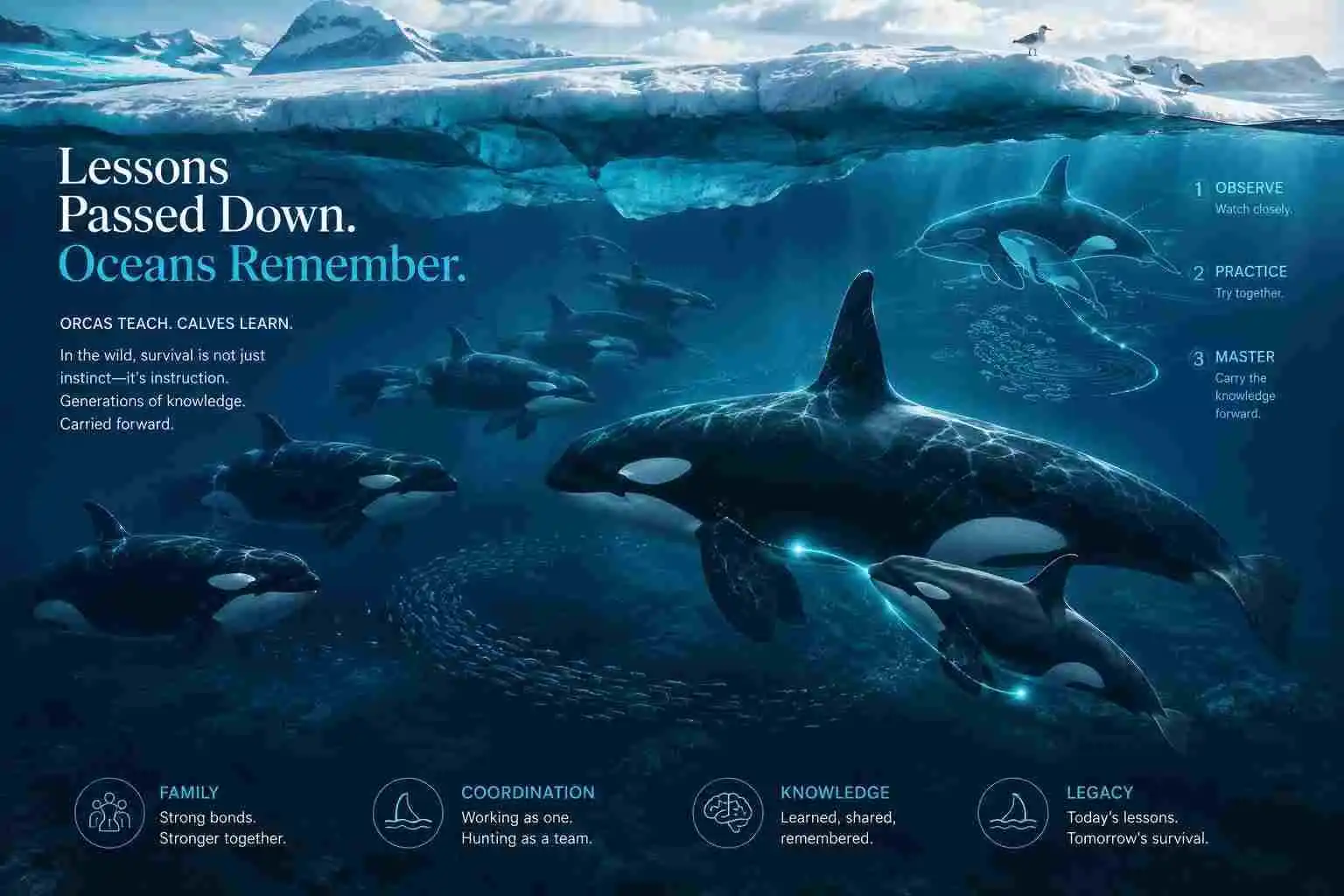
Orcas, also called killer whales, are already known as one of the ocean’s most capable apex predators, but what has increasingly fascinated researchers is not just what they hunt, it is how specific hunting techniques appear, spread, and persist within particular orca populations in ways that look remarkably similar to how human cultural knowledge spreads: learned through observation, refined through practice, and passed deliberately from one generation to the next rather than being innate, instinctive behavior every orca is simply born knowing.
This distinction matters enormously to researchers, since it reframes orca populations not as a single, behaviorally uniform species but as a collection of distinct groups, each carrying its own specialized hunting repertoire, developed and maintained through social learning specific to that population, a pattern strong enough that many marine biologists now comfortably use the word “culture” to describe it, a term traditionally reserved almost exclusively for human societies. What follows is a tour through some of the most striking documented examples, and what they reveal about how deeply social learning shapes life beneath the surface.
What Scientists Mean by “Culture” in Animals
In behavioral science, culture generally refers to behavior that is socially learned, shared within a group, and transmitted between individuals, particularly across generations, rather than genetically inherited or independently discovered by every individual through trial and error. This is a meaningfully different claim than simply saying orcas are intelligent; it specifically means that a hunting technique observed in one orca population, but absent in a genetically similar population elsewhere, likely reflects a locally invented and socially transmitted tradition rather than a hardwired instinct shared uniformly across the species.

Researchers distinguish cultural transmission from simple environmental adaptation by looking for behaviors that are population-specific despite similar environmental conditions and genetic backgrounds, evidence of active teaching or deliberate demonstration rather than incidental observation alone, and persistence of the specific technique across multiple generations within that population, all patterns that have been documented repeatedly across different orca populations around the world.
Wave-Washing: A Technique Passed Down for Generations
One of the most well-documented examples of orca cultural hunting behavior is wave-washing, observed specifically among a population of orcas in Antarctica’s Southern Ocean that hunts seals resting on ice floes. Rather than attempting to attack a seal directly on the ice, these orcas coordinate to swim in tight formation directly at the floe, generating a large wave that washes over the ice and knocks the seal into the water, where the pod can then capture it far more easily than on solid ice.
This technique requires precise coordination between multiple orcas, careful timing, and considerable practice to execute effectively, and researchers have observed adult orcas appearing to actively teach the technique to younger pod members, including instances interpreted as controlled practice attempts on smaller floes before calves participate in a full, coordinated hunt, a pattern that strongly resembles skill instruction rather than instinctive behavior every orca would perform correctly on a first attempt.
Intentional Stranding: A Hunting Style Passed From Mother to Calf
Off the coast of Argentina, a distinct population of orcas has developed an even more striking and risky hunting technique: intentionally beaching themselves partially on shore to catch sea lion pups resting near the water’s edge, then using their own momentum and tail movements to work their way back into deeper water afterward, a maneuver that carries genuine risk of the orca becoming fully stranded if executed incorrectly.
This technique is documented as being specifically taught by mother orcas to their calves over an extended learning period, with young orcas observed practicing partial strandings under close supervision before successfully executing the full hunting maneuver independently, and the behavior remains geographically confined to this specific population rather than appearing among genetically related orca populations elsewhere that do not have access to the same particular coastal seal-pup hunting opportunity.
A young orca practicing a partial stranding under its mother’s supervision looks less like instinct and more like an apprenticeship.
The Salmon Hat Fad That Baffled Researchers
Perhaps the most unusual documented example of orca cultural behavior involves what researchers informally called the “salmon hat” trend, first observed among a population of orcas in the Pacific Northwest in the 1980s, when several orcas began carrying dead salmon balanced on top of their heads, a behavior with no apparent hunting or survival function whatsoever. The behavior spread across the local population before disappearing entirely for several decades, only to reappear briefly in the same population years later.
Researchers generally interpret this episode as evidence of genuine social trend behavior among orcas, essentially a fad that spread through observation and imitation within the population independent of any practical survival benefit, a pattern that, while admittedly unusual as a specific example, is frequently cited in behavioral research precisely because it demonstrates social transmission of behavior clearly disconnected from direct evolutionary utility, strengthening the broader argument that orca populations transmit behavior socially rather than purely through instinct or environmental necessity.
The Boat-Ramming Behavior Making Headlines
In recent years, a population of orcas off the Iberian Peninsula has drawn significant international attention for a pattern of ramming and, in some documented cases, damaging or disabling sailboats, behavior that has occurred with enough frequency and consistency to prompt formal scientific investigation into its cause. Several competing explanations have been proposed, including a traumatic incident theory suggesting the behavior originated with a specific orca that had a negative encounter with a boat, and various theories framing the behavior as a form of play behavior that has spread socially through the local population.
Regardless of its precise origin, researchers studying the behavior generally agree it displays hallmarks of socially transmitted behavior consistent with orca cultural patterns documented elsewhere, spreading specifically within this particular population rather than appearing more broadly across the species, and evolving in apparent sophistication and consistency over time in a manner consistent with a learned, refined behavior rather than a one-off, isolated incident repeated by unrelated individuals independently.
Hunting Sharks: A Newer, More Dangerous Specialty
Off the coast of South Africa, researchers have documented a smaller number of orcas developing a highly specialized and genuinely startling hunting technique: targeting great white sharks specifically to extract and consume their liver, a nutrient-dense organ, with remarkable surgical precision, leaving the rest of the shark’s body largely intact. This behavior has been directly linked to observed declines in local great white shark presence in specific coastal areas following documented orca predation events.
The precision and specific targeting involved in this behavior, along with its emergence in a genetically identifiable subset of the local orca population rather than appearing uniformly across all orcas in the region, has led researchers to interpret it as another example of a specialized, socially transmitted hunting innovation rather than a universal capability every orca possesses, further reinforcing the broader pattern of population-specific cultural knowledge documented across the species globally.
Orca Ecotypes: Populations That Rarely Mix
Much of this cultural diversity is closely tied to the existence of distinct orca ecotypes, genetically and behaviorally distinguishable populations that specialize in different prey and hunting strategies despite often overlapping geographically. Resident orcas, for example, primarily hunt fish, particularly salmon, while transient orcas, sometimes called Bigg’s killer whales, specialize in hunting marine mammals like seals and sea lions, and offshore orcas pursue a still different diet including sharks and other deep-water prey.
These ecotypes maintain distinct social structures, vocal dialects, and hunting techniques, and remarkably, they generally do not interbreed or socially mix even when their ranges overlap significantly, behaving essentially as separate cultural groups within the same species, a pattern researchers increasingly compare to distinct human cultural or linguistic groups occupying overlapping geographic territory while maintaining separate social and behavioral traditions.
Dialects: The Vocal Side of Orca Culture
Hunting technique is not the only culturally transmitted trait documented among orca populations; distinct pods maintain their own specific vocal dialects, recognizable, consistent patterns of calls that differ measurably between pods even within the same broader ecotype and geographic region. These dialects are learned rather than innate, passed down within family groups, and researchers have used dialect analysis as a reliable tool for tracing social relationships and lineage between different orca pods.
The combination of distinct hunting techniques and distinct vocal dialects, both specific to particular family groups and transmitted socially across generations rather than being universally shared across the species, forms a significant part of the broader scientific case for describing orca social organization using the framework of culture rather than treating their behavioral diversity as simple environmental adaptation alone.
Why Matrilineal Structure Matters So Much
Orca social structure centers heavily on matrilineal family groups, with offspring, including adult male offspring who typically remain with their mother’s pod for life, staying closely associated with their mother and her extended family unit rather than dispersing to form entirely independent groups. This tight, long-term social structure creates an unusually stable environment for cultural knowledge to be reliably passed down across multiple generations within the same family lineage, since young orcas spend years in close proximity to experienced adults actively demonstrating and refining specialized hunting techniques.
Researchers specifically point to this matrilineal stability as a key structural factor explaining why orcas, more so than many other highly intelligent marine species, have developed such well-documented, population-specific cultural traditions, since the social conditions necessary for reliable, multi-generational knowledge transmission are consistently present within orca family groups in a way not necessarily replicated in species with looser or more transient social structures.
How Researchers Actually Document These Traditions
Establishing that a specific orca behavior qualifies as culturally transmitted, rather than simply a common environmental adaptation independently discovered by multiple individuals, requires years of patient, systematic observation. Researchers typically track known, individually identifiable orcas over extended periods, sometimes spanning decades, using photo-identification techniques based on the unique markings and dorsal fin shapes of individual animals, allowing scientists to document exactly which orcas perform a specific behavior, trace its apparent origin within a population, and observe how it spreads to other individuals over time.
This long-term, individual-based tracking approach is precisely what allowed researchers to document the salmon hat trend’s spread and eventual disappearance, the specific matrilineal teaching patterns behind intentional stranding in Argentina, and the gradual refinement of boat-interaction behavior off the Iberian coast, since establishing a genuine cultural pattern requires ruling out coincidence and independent discovery in favor of demonstrable, traceable social transmission between specific, identifiable individuals within a known population.
What This Reveals About Animal Intelligence More Broadly
Orca cultural behavior sits within a broader, growing body of research documenting socially transmitted behavior across various intelligent species, including chimpanzees’ tool-use traditions and certain bird species’ regionally distinct songs, but orcas stand out for the sheer diversity and sophistication of their documented cultural repertoire, spanning complex, multi-step hunting techniques, vocal dialects, and even behaviors with no clear survival function at all, like the salmon hat trend.
This breadth has led some researchers to argue that orcas represent one of the clearest non-human examples of a species whose behavioral diversity is better explained by cultural transmission than by genetics or direct environmental adaptation alone, a conclusion that continues to reshape how marine biologists study and interpret behavioral differences observed not just in orcas, but increasingly in other highly social, long-lived marine and terrestrial species as well.
Why This Matters for Conservation
Recognizing orca behavior as culturally transmitted rather than purely instinctive carries significant practical implications for conservation efforts. If a specific population loses enough members, whether from hunting, pollution, prey depletion, or other pressures, it risks losing not just individuals but an entire specialized cultural repertoire, hunting techniques and knowledge that a genetically similar population elsewhere may not possess and cannot simply reacquire quickly, since these behaviors depend on learned transmission rather than instinct that would automatically reappear given the same environmental pressures.
This has led conservation researchers to increasingly argue that orca populations should be managed and protected as distinct cultural units rather than treated as interchangeable members of a single homogeneous species, a shift in conservation framing that has already begun influencing how some regional orca protection policies are structured, recognizing that the loss of a specific population represents a loss of specialized knowledge and tradition, not simply a reduction in overall species population count. Protecting orcas, under this framework, means protecting not just a species, but the accumulated, irreplaceable knowledge specific family lines have spent generations refining.
Frequently Asked Questions
| Question | Answer |
| Do orcas actually have culture? | Many researchers argue yes, based on socially learned, population-specific behaviors passed across generations. |
| What is wave-washing? | It is a coordinated hunting technique where orcas create a wave to knock seals off ice floes. |
| Where is wave-washing observed? | It is primarily documented among orcas in Antarctica’s Southern Ocean. |
| What is intentional stranding in orcas? | It is a hunting technique where orcas beach themselves briefly to catch sea lion pups near shore. |
| Where do orcas practice intentional stranding? | This behavior is documented off the coast of Argentina. |
| What was the salmon hat trend? | It was a documented fad where orcas carried dead salmon on their heads with no clear survival purpose. |
| Why is the salmon hat trend scientifically significant? | It demonstrates social behavior transmission unrelated to direct survival benefit. |
| Why are orcas ramming boats off Iberia? | The cause is debated, though it shows hallmarks of socially transmitted, learned behavior. |
| Do orcas hunt sharks? | Yes, some orca populations specifically target great white sharks for their livers. |
| What is an orca ecotype? | It refers to genetically and behaviorally distinct orca populations specializing in different prey. |
| What do resident orcas eat? | Resident orcas primarily hunt fish, especially salmon. |
| What do transient orcas eat? | Transient, or Bigg’s, orcas primarily hunt marine mammals like seals and sea lions. |
| Do different orca ecotypes interbreed? | Generally no, even when their ranges overlap significantly. |
| Do orcas have distinct dialects? | Yes, different pods maintain distinct, learned vocal call patterns. |
| Are orca dialects genetic or learned? | They are learned and passed down socially within family groups. |
| What is matrilineal social structure? | It refers to family groups organized around and led by female lineage, common in orca pods. |
| Why do male orcas stay with their mothers? | Male orcas typically remain in their mother’s pod for life, supporting stable cultural transmission. |
| How do orcas teach hunting techniques to calves? | Adults demonstrate techniques and supervise calves practicing before full independent execution. |
| Is orca hunting behavior instinctive? | Some behaviors are innate, but many specialized techniques are learned rather than instinctive. |
| What defines culture in animal behavior science? | Socially learned behavior that is shared within a group and transmitted across generations. |
| Why does orca culture matter for conservation? | Losing a population risks losing unique, non-instinctive knowledge that cannot be easily replaced. |
| Are orcas considered apex predators? | Yes, orcas are apex predators with no natural predators of their own. |
| How long do orcas stay with their family groups? | Many individuals, especially males, remain with their mother’s group for their entire lives. |
| Can orca hunting techniques disappear if a population declines? | Yes, since these techniques are culturally transmitted rather than automatically reappearing instinctively. |
| Do all orcas hunt the same way? | No, hunting techniques vary significantly between different populations and ecotypes. |
| What evidence supports cultural transmission over instinct? | Population-specific behaviors despite similar environments and genetics support cultural transmission. |
| Are offshore orcas different from resident and transient orcas? | Yes, offshore orcas represent a third distinct ecotype with its own diet and behavior patterns. |
| How do researchers study orca social learning? | Through long-term behavioral observation, genetic analysis, and tracking specific pod behaviors over time. |
| Is orca culture unique among marine animals? | While other species show social learning, orca culture is unusually well-documented and diverse. |
| What is the biggest takeaway from orca culture research? | Orca populations should be understood and protected as distinct cultural groups, not a single uniform species. |
Disclaimer: The content on this blog is for informational purposes only. The author’s opinions are personal and not endorsed. Efforts are made to provide accurate information, but completeness, accuracy, or reliability are not guaranteed. The author is not liable for any loss or damage resulting from the use of this blog. It is recommended to use the information on this blog at your own discretion.
