
Table of Contents
Why Travelers Are Booking Flights Away From Summer Instead of Toward It
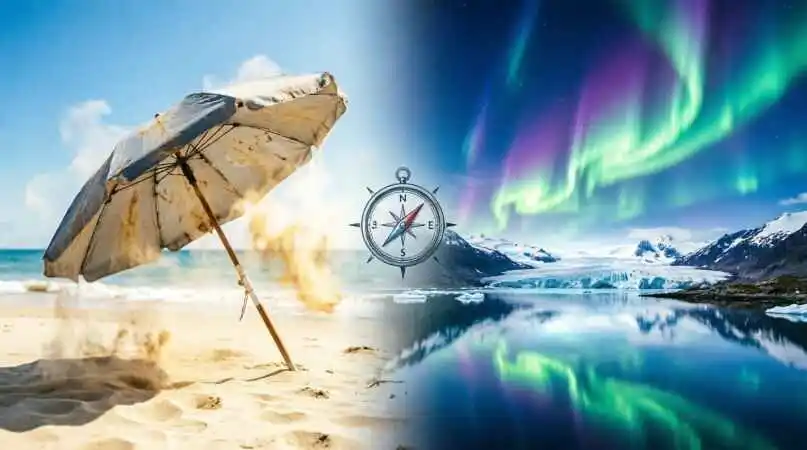
As Mediterranean heatwaves push past 40°C and iconic beach destinations turn into cautionary tales, a growing wave of travelers is deliberately chasing cold instead. Here is what is actually driving the “coolcation” boom, and where it is taking people.
A Vacation Built Around Running From Summer
For generations, the archetypal summer vacation meant chasing heat: a beach, a poolside lounger, a destination guaranteed to deliver sun. That default assumption is visibly cracking. Search interest in terms like “coolcation” has surged in recent years, travel booking data from multiple major platforms shows accelerating demand for Arctic and sub-Arctic destinations during peak summer months, and travel publications now regularly cover the trend as a genuine, measurable shift rather than a passing curiosity.
The driver behind this shift is not subtle. Repeated, increasingly severe summer heatwaves across traditionally popular destinations, southern Europe, the Mediterranean coast, parts of the American Southwest, have made the classic hot-weather vacation genuinely uncomfortable and, in some documented cases, actively dangerous, prompting a meaningful share of travelers to actively seek out cooler destinations instead of simply enduring the heat as an accepted cost of summer travel. What began as a niche preference among a small group of heat-averse travelers has, within just a few years, become significant enough to reshape national tourism marketing strategy across an entire region of the world.
What a Coolcation Actually Is
A coolcation refers to a vacation deliberately chosen for its cooler climate rather than despite it, typically involving destinations at higher latitudes or elevations that offer mild or genuinely cold temperatures during the traditional summer travel season. This distinguishes it from ordinary off-season travel or simple destination variety; the defining feature is that cooler weather is the primary draw itself, not an incidental feature of wherever else the trip happens to be headed.

The trend spans a range of destination types, from Nordic and Arctic Circle countries offering genuinely cold summer conditions, to mountainous regions offering cooler elevation-driven relief, to higher-latitude coastal destinations that simply avoid the most extreme heat without necessarily being cold in an absolute sense, meaning “coolcation” functions more as a relative, comparative category than a single fixed temperature threshold.
The Climate Data Behind the Shift
The pattern driving coolcations is grounded in well-documented climate trends rather than simple perception. Multiple recent summers have produced record-breaking heatwaves across southern Europe, with temperatures in parts of Spain, Italy, and Greece repeatedly exceeding 40 degrees Celsius, prompting heat health warnings, wildfire evacuations, and, in some documented cases, tourist deaths directly attributed to extreme heat exposure during outdoor sightseeing.
Climate scientists have specifically linked the increasing frequency and intensity of these heatwaves to broader global climate change trends, meaning the discomfort driving coolcation demand is not an isolated unusual summer but part of a well-documented, ongoing pattern that climate researchers expect to continue and likely intensify in coming years, giving the coolcation trend a genuinely structural rather than temporary basis.
Where Travelers Are Actually Going
Nordic and Arctic Circle destinations have emerged as the clearest beneficiaries of this shift. Norway, Iceland, Finland, and Sweden have all reported measurable increases in summer tourism specifically tied to travelers seeking cooler climates, with several national tourism boards explicitly incorporating “escape the heat” messaging into their summer marketing campaigns, a notable shift from historically leaning primarily on aurora borealis and winter-season appeal.
Beyond mainland Scandinavia, destinations including Greenland, the Faroe Islands, and Scotland’s more remote northern regions have seen growing interest from travelers specifically seeking a genuinely cool-weather summer alternative, while within North America, Alaska and Canada’s northern provinces have reported similar patterns among travelers looking to avoid increasingly hot conditions in the continental United States and southern Canada during peak summer months.
Tourism boards that spent decades marketing the northern lights are now selling something considerably simpler: the promise of not sweating through your vacation.
The Midnight Sun Factor
A significant part of these destinations’ summer appeal comes from a phenomenon unrelated to temperature alone: the midnight sun, in which locations sufficiently far north experience near-continuous daylight during summer months, allowing extended outdoor activity time genuinely impossible at lower latitudes. This extended daylight, combined with cooler temperatures, has proven particularly appealing for travelers interested in outdoor activities like hiking, wildlife viewing, and fjord exploration without the heat exhaustion risk that similar activities would carry in a traditionally hot summer destination.
Iceland, Norway’s northern regions, and parts of Finland and Sweden above or near the Arctic Circle offer some of the most pronounced midnight sun experiences, giving these destinations a genuinely distinctive selling point beyond simply “less hot” compared to a traditional beach alternative, an experiential draw travel marketers have increasingly emphasized alongside the more straightforward heat-avoidance messaging.
The Wellness and Sauna Culture Connection
Nordic countries’ deeply established sauna and cold-water immersion traditions have found a particularly receptive audience among coolcation travelers already drawn to cooler climates generally, with Finland specifically, home to an estimated three million saunas for a population of roughly 5.5 million people, leaning into this cultural fit as part of its tourism appeal. The broader wellness travel movement, already growing independently of the coolcation trend specifically, has found a natural overlap with destinations already marketing cold exposure, cold plunges, and sauna culture as core, authentic local experiences rather than imported wellness trends.
This convergence between the coolcation trend and the broader cold-exposure wellness movement discussed in health and lifestyle media has created a mutually reinforcing appeal for Nordic destinations specifically, positioning them simultaneously as a heat escape and a wellness-forward travel choice, a combination that has proven particularly effective in tourism marketing aimed at travelers motivated by both factors at once.
The Over tourism Angle
Coolcation growth has coincided with, and is partly reinforced by, a separate but related travel trend: growing traveler fatigue with over tourism at traditionally popular hot-weather destinations. Cities including Venice, Barcelona, and parts of the Greek islands have implemented tourist caps, entry fees, or public protests against over tourism in recent years, coverage that has made some travelers more receptive to considering genuinely different destinations rather than returning to increasingly crowded, expensive, and occasionally unwelcoming traditional hotspots.
This overlap means coolcation growth is not driven purely by heat avoidance in isolation, but by a broader reassessment of what makes a satisfying travel experience, with quieter, less crowded Arctic and Nordic destinations benefiting from travelers seeking both cooler weather and a less congested, more genuinely restorative travel experience than an overcrowded, sweltering traditional summer destination can currently offer.
The Economic Impact on Destination Countries
The tourism revenue increase associated with coolcation growth has been substantial enough for several Nordic countries to actively factor it into national tourism strategy, with hotel occupancy and booking data in Norway, Iceland, and Finland showing measurable summer season growth specifically attributed to this shift by national tourism authorities. This has created genuine economic benefit for these destinations, though it has also introduced new pressure on infrastructure, accommodation pricing, and local resources in regions that historically saw considerably lighter summer tourist volume than winter aurora-season visitors.
Some smaller Nordic and Arctic communities have specifically flagged concerns about infrastructure strain, accommodation price increases pricing out local residents, and environmental pressure on previously lightly visited natural areas, a set of concerns that closely mirrors overtourism complaints in more established hot-weather destinations, suggesting that unmanaged coolcation growth could eventually produce similar strain in these newly popular cooler destinations if visitor growth continues without corresponding infrastructure and management investment.
The Carbon Footprint Irony Worth Acknowledging
A significant tension underlies the coolcation trend that deserves honest acknowledgment: flying to a distant, cooler destination specifically to escape climate-change-driven heat contributes directly to the aviation emissions that scientists have identified as a meaningful contributor to the very climate change driving the extreme heat travelers are trying to avoid in the first place. This irony has not gone unnoticed by climate-focused travel commentators and sustainability researchers, who have specifically flagged the coolcation trend as an example of individual adaptation behavior that can inadvertently work against the broader climate mitigation effort.
This does not mean coolcation travel is uniquely worse than other forms of long-haul leisure travel from a carbon footprint standpoint, but it does mean travelers genuinely concerned about this tension have increasingly explored lower-carbon alternatives, including train travel to reach European Nordic destinations rather than flying, extending trip length to reduce the frequency of separate flights, and choosing closer, still-cooler regional alternatives over the most distant Arctic options when a shorter, lower-emission trip can still deliver much of the same heat-escape benefit.
How Coolcation Pricing Compares to Traditional Summer Travel
Nordic and Arctic destination pricing during peak summer coolcation season has risen alongside growing demand, in some cases narrowing what was previously a meaningful cost advantage over traditional Mediterranean summer destinations, though genuine price comparisons vary considerably depending on specific destination, accommodation type, and how far in advance travel is booked. Iceland and Norway in particular have seen notable summer accommodation price increases in recent years, tracking closely with reported visitor growth.
Travelers specifically motivated by cost savings alongside heat avoidance have increasingly looked toward less internationally marketed cooler destinations, including parts of the Scottish Highlands, the Baltic states, and northern parts of continental Europe that offer meaningfully cooler summer conditions than southern Europe without carrying the premium pricing that the most heavily marketed Nordic and Arctic destinations have increasingly commanded as demand has grown.
Practical Planning Considerations for a Coolcation
Travelers planning a coolcation for the first time should account for genuinely variable weather even in destinations marketed primarily for their cool summer climate, since Nordic and Arctic summer weather can still include periods of rain, wind, and temperature swings requiring proper layered clothing rather than assuming uniformly mild, pleasant conditions throughout an entire trip. Packing genuinely warm layers, waterproof outer clothing, and comfortable footwear suited to variable terrain remains essential regardless of how “summer” the specific travel dates technically are.
Booking accommodation and popular activities well in advance has become increasingly important as coolcation demand has grown, since previously lightly booked summer inventory in destinations like Iceland and Norway has tightened considerably compared to just a few years earlier, meaning the spontaneous, easily bookable summer trip these destinations once offered during their traditional off-peak season has become considerably less reliable as coolcation demand has continued to climb.
How Airlines and Tour Operators Have Responded
The travel industry has moved quickly to capitalize on this shift, with several airlines adding or expanding summer routes to Nordic and Arctic destinations specifically in response to documented demand growth, and tour operators increasingly marketing dedicated “coolcation” packages that explicitly frame cooler climate as the trip’s central selling point rather than a secondary feature buried within a broader Scandinavian itinerary. This kind of rapid commercial response mirrors how the travel industry has historically reacted to other emerging travel trends, treating growing search and booking data as a reliable signal worth building dedicated product offerings around rather than a passing curiosity.
Travel insurance providers and destination marketing organizations have also begun adjusting messaging and product offerings specifically around coolcation travel, including guidance addressing the genuinely variable weather conditions these destinations can present even during their marketed cool season, reflecting a broader industry recognition that this segment of demand has grown substantial enough to warrant dedicated attention rather than being treated as a niche subset of general Nordic tourism.
Is This a Lasting Shift or a Passing Trend?
Given that the coolcation trend is fundamentally grounded in well-documented, ongoing climate patterns rather than a passing cultural fad, most travel industry analysts and climate researchers expect the underlying driver, worsening summer heat in traditionally popular destinations, to persist and likely intensify rather than reverse in coming years, suggesting the coolcation trend reflects a genuine, structural shift in travel patterns rather than a temporary novelty likely to fade once the next travel trend emerges.
This does not mean traditional hot-weather summer travel will disappear entirely, since many travelers remain drawn to beach and warm-climate destinations regardless of rising temperatures, but it does suggest cooler destinations are likely to continue capturing a meaningfully larger, more durable share of summer travel demand going forward than they historically have, a shift Nordic and Arctic tourism boards appear to be actively planning around rather than treating as a temporary bump worth waiting out.
Frequently Asked Questions
| Question | Answer |
| What is a coolcation? | It is a vacation deliberately chosen for its cooler climate rather than a traditional hot-weather destination. |
| Why are coolcations becoming popular? | Worsening summer heatwaves in traditional destinations are driving travelers toward cooler alternatives. |
| What destinations are popular for coolcations? | Norway, Iceland, Finland, Sweden, Greenland, and parts of Scotland and Canada are common choices. |
| What is the midnight sun? | It is a phenomenon at high latitudes where daylight lasts nearly continuously during summer months. |
| Are coolcations linked to climate change? | Yes, increasing heatwave frequency and intensity are directly connected to broader climate trends. |
| Is coolcation travel more expensive than traditional summer travel? | Pricing has risen with demand, though it varies by destination and booking timing. |
| Why is Finland associated with coolcation travel? | Its strong sauna and cold-exposure culture aligns naturally with cooler-climate wellness travel. |
| What is the carbon footprint concern with coolcations? | Flying to distant cooler destinations contributes to emissions that worsen the climate change driving the trend. |
| Can train travel reduce the carbon impact of a coolcation? | Yes, train travel to European destinations is a lower-emission alternative to flying. |
| Is overtourism related to the coolcation trend? | Yes, traveler fatigue with crowded hot-weather destinations has reinforced interest in quieter alternatives. |
| Are Nordic countries experiencing more summer tourists? | Yes, several national tourism boards report measurable summer visitor growth tied to this trend. |
| What should I pack for a coolcation? | Layered clothing, waterproof outerwear, and sturdy footwear are recommended due to variable weather. |
| Is coolcation weather always cold? | Not always; conditions can be mild and variable rather than consistently extreme cold. |
| What is causing extreme summer heat in southern Europe? | Climate change has been linked to increasing frequency and severity of regional heatwaves. |
| Are Iceland and Norway becoming more crowded in summer? | Yes, accommodation booking and pricing data show notable summer demand increases. |
| What is a lower-cost alternative to major Nordic coolcation destinations? | The Scottish Highlands and Baltic states offer cooler climates at often lower price points. |
| Do coolcations only appeal to heat-avoidant travelers? | No, many are also drawn by wellness culture, outdoor activities, and reduced crowds. |
| Is the coolcation trend expected to continue? | Yes, most analysts expect it to persist given ongoing climate trends. |
| What role does social media play in coolcation growth? | Increased visibility and search interest have helped popularize the trend significantly. |
| Are coolcations only for summer travel? | The term primarily refers to summer travel, since it centers on escaping seasonal heat. |
| Can coolcation destinations still be affected by tourism strain? | Yes, some communities have reported infrastructure and pricing pressure from rising visitor numbers. |
| Is Greenland considered a coolcation destination? | Yes, it has seen growing interest among travelers seeking a cooler summer alternative. |
| Do coolcation destinations require advance booking? | Increasingly yes, as demand has grown and previously available inventory has tightened. |
| What is driving tourism board marketing changes in Nordic countries? | Growing coolcation demand has prompted new “escape the heat” messaging alongside traditional appeal. |
| Are coolcations considered a form of climate adaptation? | Yes, some researchers describe it as individual behavioral adaptation to worsening summer heat. |
| Is Alaska part of the coolcation trend? | Yes, it has seen similar interest from travelers avoiding hot conditions in the continental United States. |
| Do coolcations help address overtourism concerns? | Partially, by redistributing demand toward previously less visited cooler destinations. |
| What is the biggest criticism of the coolcation trend? | The carbon footprint of long-haul travel undermines some of its climate-driven motivation. |
| Are shorter regional trips a good coolcation alternative? | Yes, closer, cooler regional destinations can reduce emissions while still avoiding extreme heat. |
| What is the overall outlook for coolcation travel? | It is expected to remain a durable, growing segment of summer travel rather than a passing trend. |
Disclaimer: The content on this blog is for informational purposes only. The author’s opinions are personal and not endorsed. Efforts are made to provide accurate information, but completeness, accuracy, or reliability are not guaranteed. The author is not liable for any loss or damage resulting from the use of this blog. t is recommended to use the information on this blog at your own discretion.
