
Table of Contents
Khndzoresk Cave Village Near Goris, this is an ancient village of cave dwellings carved into a hillside. Until the 1950s, people lived here. A swinging bridge connects the two sides of the gorge. It is an eerie, fascinating place that feels like stepping back in time.
Karahunj (Armenian Stonehenge) Located near Sisian, is a prehistoric archaeological site consisting of hundreds of standing stones with holes drilled in them. It predates the British Stonehenge and is believed to have been an astronomical observatory.
Gyumri, Armenia’s second-largest city, has a distinct vibe. It is the capital of humor and crafts. The architecture is different from Yerevan, with more black tuff stone. It suffered greatly in the 1988 earthquake but is rebuilding. Visit the Black Fortress and the Yot Verq (Seven Wounds) church.
Practical Information
- Currency: Armenian Dram (AMD). Credit cards are widely accepted in Yerevan, but cash is king in rural areas.
- Language: Armenian is the official language. Russian is widely spoken, and English is becoming common among the younger generation in Yerevan.
- Visa: Many nationalities can obtain a visa on arrival or an e-visa.
- Sim Cards: Beeline, Ucom, and VivaCell-MTS offer cheap data plans and good coverage.
- Safety: Armenia is considered one of the safest countries in the world for tourists. Petty theft is rare, and locals are generally very helpful.
Conclusion
Armenia is a destination that defies expectations. It is neither the glitzy resort hub of some of its neighbors nor a backward relic of the past. It is a country of contrasts—ancient stone and modern tech, rugged mountains and delicate apricots, tragic history and boundless hospitality.

To travel here is to connect with a culture that has maintained its identity for three millennia. It is to stand on a cliff edge and look at a mountain that is both a home and a loss. It is to eat food that has been perfected over centuries. Armenia does not just show you sights; it tells you stories. And for the traveler willing to listen, those stories are unforgettable.
FAQ’s
- Why is Armenia called the “Land of Stones”?
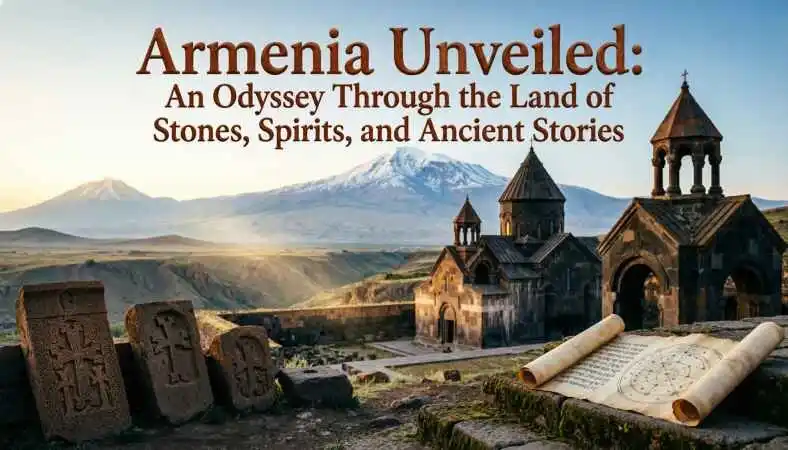
Armenia’s rugged topography is defined by volcanic highlands, basalt formations, and dramatic gorges that have shaped both the landscape and the architecture for millennia. The moniker also references the ancient tradition of stonework visible in prehistoric cyclopean fortresses, medieval monasteries carved into cliffs, and the iconic khachkars—intricately carved stone crosses that dot the countryside. This rocky terrain has forged a resilient culture that literally built its civilization from the mountains themselves.
- What spiritual traditions define Armenia?
As the first nation to adopt Christianity as its state religion in 301 AD, Armenia possesses a distinct Apostolic tradition centered around ancient monasteries like Etchmiadzin and Tatev. Yet beneath this Christian surface lies a living substratum of pagan heritage, from the polytheistic temple of Garni to rituals honoring Vahagn and Astghik that persist in folklore and festival. This creates a unique spiritual palimpsest where pre-Christian stones whisper beneath Christian crosses.
- When is the best time to explore Armenia?
Late spring (May-June) and early autumn (September-October) offer ideal conditions with mild temperatures, clear skies, and landscapes either blooming with wildflowers or golden with harvest. Summer brings intense heat to the lowlands but perfect weather for highland trekking, while winter transforms the country into a snowy wonderland ideal for ski resorts like Tsaghkadzor. Each season reveals different faces of the “Land of Stones,” from snow-capped monasteries to sun-baked ancient ruins.
- Is Armenia safe for solo travelers and families?
Armenia ranks among the safest countries in the region, with low crime rates and a culture of exceptional hospitality that often sees strangers inviting travelers home for coffee or homemade mulberry vodka. The capital, Yerevan, is particularly secure with a vibrant nightlife that feels safer than many Western European cities. However, travelers should exercise caution near the border with Azerbaijan due to ongoing territorial disputes and the presence of landmines in those specific regions.
- What are khachkars, and why do they matter?
Khachkars are elaborately carved stone steles bearing crosses, floral motifs, and biblical scenes that function as both religious art and spiritual talismans, unique to Armenian culture. Created since the 9th century, these outdoor stone “books” served as memorials, boundary markers, and expressions of faith, with over 50,000 surviving examples across the country. The art of khachkar carving is recognized by UNESCO as Intangible Cultural Heritage, representing Armenia’s ability to transform hard stone into flowing spiritual poetry.
- How ancient is Armenian wine culture?
Archaeological evidence from the Areni-1 cave complex proves that wine production in Armenia dates back over 6,000 years, making it one of the world’s oldest wine-making regions. The tradition continues today through the revival of indigenous grapes like Areni Noir and Voskehat, grown in high-altitude vineyards that survived the Soviet era. Visitors can explore wine routes through the Vayots Dzor region, tasting wines made in karas—clay vessels buried underground that predate modern barrels.
- Why is Mount Ararat significant to Armenians?
Though now located across the border in Turkey, Mount Ararat remains the national symbol of Armenia, featured on the coat of arms and visible from Yerevan on clear days as a haunting, snow-capped silhouette. According to biblical tradition, Noah’s Ark came to rest on its slopes after the flood, making it the genesis point of renewed humanity in Armenian mythology. The mountain represents both the spiritual foundation of the nation and the painful history of lost territories, serving as a daily reminder of Armenia’s complex geography.
- Do I need a visa to visit Armenia?
Citizens from the EU, USA, Canada, UK, and many other countries receive visa-free entry for up to 180 days, making Armenia one of the most accessible destinations in the Caucasus. For those requiring visas, the e-visa system provides a simple online application with quick turnaround times. This open policy reflects Armenia’s position as a cultural crossroads eager to share its ancient stories with modern travelers.
- What defines traditional Armenian cuisine?
Armenian food represents the pinnacle of Caucasian gastronomy, featuring lavash (thin clay-oven bread) inscribed on UNESCO’s intangible heritage list, succulent barbecue called khorovats, and dolma wrapped in grape leaves or cabbage. The cuisine balances robust mountain flavors—local cheeses, grilled meats, and aromatic herbs—with careful preparations like sweet sujukh (walnut strings in grape molasses). Every meal is accompanied by the ritual of tamada (toast-making) and often homemade oghi (fruit vodka), turning dining into a communal spiritual experience.
- How do travelers navigate between sites?
While Yerevan has a metro system, exploring monasteries and highland sites requires shared taxis (marshrutkas), private drivers, or rental cars with sturdy suspension for mountain roads. The scenic drives are part of the experience, winding through gorges painted with prehistoric petroglyphs and medieval bridges. For the ambitious, the Transcaucasian Trail offers hiking routes connecting remote villages where time seems measured in centuries rather than hours.
- How did Armenia become the first Christian nation?
In 301 AD, King Tiridates III converted to Christianity under the influence of Saint Gregory the Illuminator, establishing it as the state religion a decade before Rome’s Constantine and predating Ethiopia’s conversion. This early adoption created a distinct Christian identity that survived Zoroastrian, Arab, and Soviet domination through the creation of the Armenian alphabet (405 AD) to translate the Bible and a unique liturgical tradition. Today, over 95% of the population identifies with the Armenian Apostolic Church, whose ancient rites continue in stone churches built fifteen centuries ago.
- Are pagan traditions still practiced?
Despite Armenia’s Christian identity, ancient Zoroastrian and Indo-European traditions persist in festivals like Vardavar, where people douse each other with water in honor of Astghik, the goddess of love and water. The pagan Temple of Garni remains standing as the only Hellenistic colonnade in the former Soviet Union, while fire worship and nature veneration subtly color Christian celebrations. This syncretism creates a spiritual landscape where pagan stones and Christian crosses coexist in the same sacred spaces.
- Is English spoken widely in Armenia?
While the official language is Armenian—an Indo-European language with its own unique 38-letter alphabet created by Mesrop Mashtots—younger generations and those in tourism increasingly speak English, particularly in Yerevan. Russian remains widely understood among older generations due to the Soviet legacy. Learning a few phrases in Armenian, such as “Vonts es?” (How are you?) or “Shnorhakalutyun” (Thank you), earns warm smiles and opens doors to deeper cultural exchange.
- Which UNESCO sites should I prioritize?
The monasteries of Haghpat and Sanahin showcase a unique Armenian architectural fusion of Byzantine ecclesiastical and Caucasian stone-building traditions amidst Lori’s forested mountains. Geghard Monastery, partially carved into living rock, exemplifies medieval Armenian engineering, while the cathedral and churches of Echmiadzin—the Vatican of Armenian Christianity—contain the country’s most sacred relics. The prehistoric site of Zorats Karer (Armenian Stonehenge) and the Areni-1 cave complete the essential UNESCO itinerary spanning six millennia.
- How does the Soviet past shape contemporary Armenia?
Soviet brutalist architecture contrasts with 19th-century Russian imperial buildings in Yerevan, while massive monuments like the Cascade complex and the Genocide Memorial blend socialist grandeur with Armenian motifs. The legacy appears in everyday culture through chess education (mandatory in schools), widespread Russian language proficiency, and a continued appreciation for jazz and classical music that flourished despite ideological constraints. Yet Armenia distinctively preserved its Christian identity and national alphabet throughout the Soviet period, creating a unique synthesis of East and West.
- What should I know before entering monasteries?
Modest dress is required—shoulders and knees covered for all visitors, with head scarves necessary for women in active churches like Etchmiadzin or Khor Virap. Photography is generally permitted outside but often restricted during services or within sacred inner chambers containing relics. Visitors should respect the sanctity of these spaces, maintaining silence near worshippers and never turning one’s back to the altar when taking photos, as these stones have been holy ground for seventeen centuries.
- Is Armenia budget-friendly for tourists?
Armenia offers exceptional value compared to European or even Georgian destinations, with comfortable accommodation available for $30-60 nightly and superb meals costing $8-15 in local restaurants. Luxury experiences like private vineyard tours or five-star Yerevan hotels remain affordable by Western standards. However, imported goods can be expensive, so embracing local products—from dried fruits to handicrafts—ensures both savings and authentic cultural immersion.
- Why is Armenian brandy world-renowned?
Winston Churchill allegedly favored Armenian brandy over French cognac, specifically the Dvin label produced by Yerevan Brandy Company using traditional French methods adapted to local conditions. Distilled from indigenous grapes and aged in oak casks, Armenian brandy gained international acclaim at the 1900 Paris International Exhibition. Today, visitors can tour historic distilleries in Yerevan, tasting vintages aged 20 years or more while learning how this “spirit of the land” became a diplomatic tool and national treasure.
- How do I respectfully engage with Armenian Genocide history?
The Armenian Genocide Memorial Complex (Tsitsernakaberd) in Yerevan offers a profoundly moving, dignified introduction to the 1915 systematic deportation and massacre of 1.5 million Armenians by Ottoman Turkey—a subject central to national identity. Visitors should approach the eternal flame and museum with appropriate solemnity, recognizing that this remains living history for families who lost ancestors and continue to seek international recognition. Engaging with survivor testimonies and academic sources before visiting demonstrates respect for the “great crime” that continues to shape Armenia’s diaspora and foreign policy.
- What unique souvenirs embody Armenian culture?
Authentic khachkar replicas carved from local tuff stone, hand-knotted carpets featuring dragon motifs or Tree of Life patterns, and duduk (wooden flute) recordings capture the auditory and visual spirit of Armenia. Lavash bread warm from tonir ovens, homemade fruit lavash (fruit leather), and bottles of Areni wine or Ararat brandy offer edible memories. For literary travelers, books by William Saroyan or Paruyr Sevak in translation, or painted pomegranates—the national symbol of fertility and resilience—provide lasting connections to ancient stories.
- What natural wonders complement the cultural sites?
Beyond the monasteries, Armenia offers the pristine Lake Sevan—one of the world’s largest high-altitude lakes—where medieval Sevanavank monastery perches on a peninsula above azure waters. The Lastiver caves in Yenokavan and the basalt organ pipes of the Symphony of Stones in Garni Gorge showcase the country’s geological drama. For hikers, the Geghama Mountains reveal alpine lakes and wildflower meadows where shepherds maintain seasonal traditions unchanged since the Bronze Age.
- How does Armenia’s location affect its identity?
Situated at the intersection of Europe and Asia along the ancient Silk Road, Armenia has served as a cultural conduit and buffer zone between empires—Persian, Greek, Roman, Arab, Mongol, Russian—absorbing influences while maintaining distinct linguistic and religious traditions. This geographic crossroads created a cosmopolitan society that welcomed refugees (including genocide survivors and more recent Syrian Armenians) while fiercely guarding its alphabet and Apostolic faith. The result is a nation where ancient stones speak multiple historical languages, yet the spirit remains distinctly, stubbornly Armenian.
Disclaimer: The content on this blog is for informational purposes only. The author’s opinions are personal and not endorsed. Efforts are made to provide accurate information, but completeness, accuracy, or reliability are not guaranteed. The author is not liable for any loss or damage resulting from the use of this blog. It is recommended to use the information on this blog at your own discretion.
