
Table of Contents
Why Your Fingers Turn White in the Freezer Aisle — The Complete Guide to Raynaud’s Phenomenon
You’re in the supermarket. You grab a bag of frozen peas, and within thirty seconds, two of your fingers go bone-white and completely numb. By the time you reach the checkout, they’ve turned an alarming shade of purple. Twenty minutes later, wrapped around a warm mug at home, they throb an angry red while your partner asks if you’re okay.
You say yes. But privately, you’ve started to wonder.
Here’s the thing: what just happened to you has a name, a mechanism, and — in most cases — a very manageable future. It’s called Raynaud’s phenomenon, and roughly 3–5% of the population lives with it, most of them without ever knowing the name.
(Quick correction before we go further: it’s Raynaud’s — pronounced ray-NOZE — not “Reynolds.” Half the internet spells it wrong. It’s named after Maurice Raynaud, a French medical student who described the condition in his 1862 thesis. So if you’ve been Googling “Reynolds phenomenon” and getting nothing useful, now you know why.)

Whether you’ve just had your first white-finger scare or you’ve been hiding your cold hands for twenty years, this guide will walk you through what’s actually happening inside your fingers, the one distinction that changes everything about your outlook, the triggers nobody warns you about, and the exact steps to take when an attack strikes.
What Raynaud’s Phenomenon Actually Is (and Why Your Fingers Do the Traffic-Light Thing)
Picture the circulation in your hands as having a bodyguard. His job is to protect your core body temperature when things get cold — so he occasionally pulls blood away from your fingers and toes, because your heart, brain, and lungs matter more than your pinky.
That’s normal. Everyone has this system.
In Raynaud’s, the bodyguard is jumpy. Deeply, disproportionately jumpy. He doesn’t just reduce blood flow to your fingers when it’s cold — he slams the doors shut entirely. The tiny arteries in your fingers, called arterioles, go into vasospasm: the muscular walls of the vessels clamp down so hard that blood flow can drop by 90% or more. Often it’s not even cold that sets him off. Sometimes it’s just stress.
An attack then unfolds in three distinct stages, and understanding them takes the fear out of the colors:
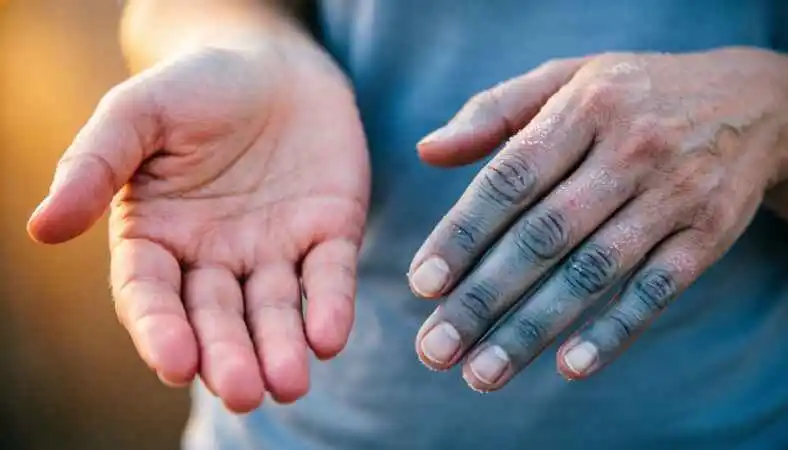
Stage 1: White (pallor)
Blood gets squeezed out of the finger entirely. The skin turns porcelain white, waxy, and weirdly stiff. This is when most people feel nothing at all — just deadness. No feeling, no movement, as if the finger doesn’t belong to you.
Stage 2: Blue (cyanosis)
The small amount of blood that remains trapped in the finger runs out of oxygen. Deoxygenated blood is dark, and through the skin it reads as a dusky blue or purple. This is the stage that makes people panic — and the stage that gets the most concerned stares at dinner parties.
Stage 3: Red (reperfusion)
When the attack releases, blood rushes back in — a lot of it, all at once. The finger turns red, swells slightly, and starts to throb, burn, and ache. That pain isn’t a bad sign. It’s the sound of the doors reopening.
Not everyone gets the full traffic light. Some people only go white; others skip straight to blue. The white stage is the signature — if your fingers reliably blanch to paper-white in response to cold or stress, you’re describing Raynaud’s.
Who gets it? Far more women than men — the ratio is steep, and primary cases typically start between the ages of 15 and 30. If you’re a young woman whose hands have always been “freezing,” this is probably not news to you.
On a biological level, researchers point to a few culprits: oversensitive receptors on the blood vessel walls that overreact to adrenaline, an imbalance between constricting and relaxing chemicals in the vessel lining, and sometimes simply vessels that are wired a little too eagerly. You don’t need the biochemistry to manage the condition — but it helps to know that the problem is in the vessel’s behavior, not in your blood or your heart.
Primary vs. Secondary Raynaud’s: The Distinction That Changes Everything
This is the most important section of this entire article, so read it twice.
Raynaud’s comes in two forms, and they have very different implications:
- Primary Raynaud’s (also called Raynaud’s disease) happens on its own, with no underlying condition. It’s the common form — the vast majority of cases — and it’s annoying rather than dangerous.
- Secondary Raynaud’s (also called Raynaud’s syndrome) is Raynaud’s that appears because of something else — usually an autoimmune disease, an occupational injury, or a medication. Here, the color changes are a messenger, not the message.
Here’s how they compare side by side:
| Feature | Primary (Disease) | Secondary (Syndrome) |
| Typical onset | Teens to 30s | After age 30–40 |
| Which hands | Both hands, symmetrical | Often one-sided or asymmetrical |
| Severity | Mild to moderate | Can be severe |
| Tissue damage | Essentially never | Possible — ulcers, pitted scars |
| Other symptoms | None | Joint pain, rashes, skin thickening, dry eyes |
| Underlying cause | None identified | Autoimmune disease, vibration injury, drugs |
| Outlook | Excellent | Depends on the underlying condition |
The red flags — when Raynaud’s deserves a closer look
If any of the following apply to you, book a doctor’s appointment specifically to discuss it:
- Your first attack came after age 30 (primary almost always announces itself early)
- Attacks affect one hand or one side significantly more than the other
- You’ve had sores or ulcers on your fingertips — even small ones that healed
- You notice pitted scars or tiny dents on your fingertips
- The skin on your fingers or hands is becoming thick, tight, or shiny
- You have joint pain, unexplained rashes, muscle weakness, dry eyes or mouth, or trouble swallowing
- Your symptoms appeared after years of using vibrating power tools
The autoimmune conditions most often linked to secondary Raynaud’s include scleroderma (systemic sclerosis — where Raynaud’s is present in over 90% of patients and often appears years before anything else), lupus, Sjögren’s syndrome, dermatomyositis, and mixed connective tissue disease.
And here’s the genuinely useful part: there’s a quick, painless test that helps separate the two forms. It’s called nailfold capillaroscopy — a doctor places a drop of oil at the base of your fingernail and looks at the tiny capillaries through a magnifying lens. Normal, evenly spaced loops suggest primary Raynaud’s. Dilated, distorted, or dropout capillaries raise a flag for connective tissue disease. It takes minutes, costs little, and can redirect your entire care pathway.
Bottom line: Primary Raynaud’s is a quirk of your plumbing. Secondary Raynaud’s is a smoke alarm. Your job is to figure out which one you have — and that’s exactly what a first appointment is for.
Raynaud’s Triggers: Cold Is Only the Headline
Ask anyone with Raynaud’s what triggers an attack and they’ll say cold. Correct — but incomplete. Attacks are triggered by anything that makes those jumpy vessels clamp down, and the list is longer and sneakier than most people realize.
The obvious ones:
- Cold weather and winter wind
- Cold water (washing dishes, swimming, rain)
- Touching frozen food, ice, or cold drinks straight from the fridge
- Cold air conditioning blowing directly on you
The ones nobody warns you about:
- A cold steering wheel on a mild morning
- Air-conditioned offices and supermarkets — many people have more attacks indoors in July than outdoors in January
- Emotional stress and anxiety — adrenaline constricts vessels exactly like cold does. Some people’s worst attacks happen during arguments, exams, or presentations, in perfectly warm rooms
- Holding an iced drink — the cold travels through the glass into your palm
- Cold metal keys, door handles, and shopping trolleys
The internal triggers — what’s in your bloodstream:
- Nicotine — smoking and vaping are powerful vasoconstrictors. If there’s one thing you do for your Raynaud’s, quit this.
- Decongestants (pseudoephedrine and similar) — they work by constricting blood vessels. That includes vessels in your fingers.
- Beta-blockers — commonly prescribed for blood pressure and migraines, and known to worsen Raynaud’s. Never stop one on your own, but definitely mention it.
- Some ADHD medications, migraine drugs, and certain chemotherapy agents — all worth flagging to your doctor.
- Too much caffeine — moderate amounts are fine for most people, but if you’re on your fifth espresso during a stressful deadline, that’s a cocktail.
The principle that explains almost everything: protect the core
Here’s the insight that changes how you manage cold, and it’s the single most practical thing in this article:
Your body doesn’t care about your fingers. It cares about your heart.
When your core temperature drops — even slightly — your body sacrifices the extremities to protect the vital organs. It’s why wearing the world’s best gloves still leaves your hands freezing if your torso is cold. Your body reads “cold core” and cuts supply to the hands no matter how warm the gloves are.
So the counterintuitive fix for cold hands is a warm torso. Proper jacket, warm socks, hat. Warm feet help warm hands. Every experienced Raynaud’s patient eventually discovers this, and the ones who do usually cut their attack frequency dramatically.
Practical habit: Keep an “attack diary” for a month — when it happened, what you were doing, how cold or stressed you were. Patterns will emerge fast, and your triggers are almost certainly not identical to anyone else’s.
The 5-Step Rescue Protocol for an Active Raynaud’s Attack
An attack is happening right now. Your fingers are white and dead. Here’s exactly what to do, in order:
Step 1: Remove the trigger and get somewhere warm
Put down the frozen peas. Step away from the AC vent. Get indoors, or at least into a warmed car. Speed matters — the less time the vessels stay clamped, the shorter and milder the whole episode.
Step 2: Rewarm with lukewarm water — never hot
Run your hands under lukewarm water, around body temperature or slightly above. Not hot.
This matters more than people realize: when your fingers are numb, they cannot report heat properly. Patients routinely burn themselves with hot water or radiators because “warm” felt like nothing. Numb skin + direct heat = burns that you didn’t feel happening.
Step 3: Use the arm-windmill trick
Stand up and swing your arms in big, full circles — like a windmill — for 20 to 30 seconds. Centrifugal force pushes blood out toward your hands, and it’s genuinely one of the most effective non-chemical ways to reopen the vessels. Follow it with gentle massage, working from the wrist down toward the fingertips.
Step 4: Warm the core while the fingers recover
Sip something warm. Add a layer. Wrap up. Remember the core principle — if your torso stays cold, your body will keep the finger doors shut no matter what you do to the fingers themselves.
Step 5: Let it happen
Full rewarming typically takes 15 to 30 minutes. The throbbing, burning stage is unpleasant but it’s the destination — it means blood is back. Don’t rush it and don’t panic during it.
What NOT to do:
- Don’t put hands directly on a radiator, heater, or fire
- Don’t use hot water
- Don’t rub your fingers together aggressively
- Don’t smoke or have caffeine mid-attack
- Don’t ignore fingers that stay white for hours or develop breaks in the skin — that’s a medical issue, not a bad day
Raynaud’s Treatment and Prevention: The Long Game
Once you know your triggers and have the rescue protocol down, the next layer is reducing how often attacks happen in the first place — and, if needed, bringing in medication.
The prevention checklist (non-drug layer)
- Mittens beat gloves. Fingers warm each other when they share space. Silk or merino liner gloves under mittens is the power combination for brutal days.
- Rechargeable hand warmers have quietly become the best value in Raynaud’s management. Keep them in every coat pocket and the car.
- Pre-warm everything. Start the car (and its heater) before you drive. Run your hands under warm water before going out into the cold. Ten minutes of pre-warming buys you significantly more time outside.
- Oven mitts for the freezer aisle. Yes, people will look at you. You will be the one without white fingers.
- Insulated cups for iced drinks, so the cold never reaches your palm.
- Exercise regularly. Aerobic fitness improves overall circulation and stress resilience — it attacks the problem from both directions.
- Manage the adrenaline. Biofeedback training, breathing exercises, and stress management aren’t soft science here — because stress is a legitimate physical trigger, calming the nervous system is legitimate physical treatment.
- Quit nicotine. Non-negotiable, and the improvement is usually noticeable within weeks.
- Review your medications with your doctor — not to stop anything yourself, but to see whether alternatives exist.
The medical ladder
When lifestyle measures aren’t enough, treatment follows a well-established sequence:
| Level | Treatment | What to know |
| First line | Calcium channel blockers (nifedipine, amlodipine) | The most prescribed Raynaud’s medication worldwide. Relaxes vessel walls, reducing attack frequency and severity |
| Second line | Topical nitrates (nitroglycerin cream/gel) | Applied to the fingers; improves local blood flow |
| Also used | PDE5 inhibitors (sildenafil, tadalafil) | Yes, that class of drug — it dilates blood vessels and has solid evidence in Raynaud’s |
| Alternatives | Losartan; certain antidepressants (fluoxetine) | Useful when calcium blockers cause side effects like swelling or headaches |
| Severe cases | IV prostacyclin (iloprost); botulinum toxin injections | Hospital-based, typically for secondary Raynaud’s with ulcers |
| Refractory | Digital sympathectomy (surgery) | Rare; reserved for severe, treatment-resistant cases |
Two honest notes about medication. First, nothing cures Raynaud’s — the drugs reduce the frequency and severity of attacks, which for most people is life-changing in itself. Second, treatment decisions differ sharply between primary and secondary disease, which is why getting properly classified (see the section above) comes before any prescription.
The photo trick every patient should know
Doctors almost never see an attack in real time — attacks happen in cold cars and supermarket aisles, not hospital rooms. So photograph your hands mid-attack. A phone picture of white and blue fingers is worth more diagnostically than an hour of description, and it makes your first appointment dramatically more productive.
Living Well With Raynaud’s: Workarounds That Actually Help
The medical stuff is only half the picture. The other half is the hundreds of small decisions that make up daily life with unpredictable hands.
At work: Fingerless gloves over a warm keyboard area, a small desk heater positioned away from your face but near your body, and warm drinks as an excuse to hold a mug. If your job involves vibrating tools — construction, forestry, mining, grounds maintenance — and your fingers have started going white, tell occupational health. Vibration-induced white finger is a recognized, compensable condition in many countries, and early intervention protects your hands for the long term.
In sport and outdoors: Cycling bar mitts and lobster-claw gloves exist precisely for this problem. For swimming, most Raynaud’s patients learn quickly that cold pools are a trigger — indoor heated pools and wetsuits are the workaround. Winter hikers: chemical toe warmers inside boots, and a “warm-up ritual” before heading into the cold.
In the car: Keep a winter kit — spare gloves, rechargeable warmers, a blanket. A cold steering wheel through thin gloves on a January morning can trigger an attack before you reach the end of your street.
The emotional side: This one gets ignored, and it shouldn’t. Raynaud’s is an invisible condition, which means everyone from coworkers to relatives will tell you to “just put gloves on” — as if you hadn’t thought of that in the fifteen years you’ve had this. The color changes can be embarrassing in social settings; the numbness can be genuinely frightening the first few times. If that’s you: this is a known condition, you’re not imagining it, and you’re not fragile. Roughly one in ten women will experience it at some point.
One more thing worth knowing: many women report their Raynaud’s improves during pregnancy, thanks to increased blood volume and circulation. A rare upside in an otherwise challenging nine months.
FAQs
The Basics
- Is it “Reynolds” or “Raynaud’s”?
It’s Raynaud’s, named after French physician Maurice Raynaud, who described the condition in 1862. “Reynolds phenomenon” is a common misspelling that leads people to the wrong search results.
- Is Raynaud’s dangerous?
Primary Raynaud’s is not dangerous — it’s uncomfortable and inconvenient, but it doesn’t damage tissue or shorten life. Secondary Raynaud’s can be serious, mainly because of the underlying condition and, in severe cases, fingertip ulcers.
- What’s the difference between Raynaud’s disease and Raynaud’s syndrome?
“Disease” refers to the primary form, which occurs alone. “Syndrome” or “phenomenon” refers to the secondary form, where the color changes result from another condition, an injury, or medication.
- How common is Raynaud’s?
It affects roughly 3–5% of the population, with significantly higher rates in women and in colder climates. Some estimates suggest up to 10% of women experience it.
- Can Raynaud’s be cured?
No, but it can be managed very effectively. Many people reduce attacks to near-zero through trigger avoidance and warmth strategies; medication further reduces frequency and severity where needed.
- Is Raynaud’s hereditary?
It often runs in families. If a parent has it, your risk is meaningfully higher, which supports a genetic component in the primary form.
- How is Raynaud’s diagnosed?
There’s no single blood test. Diagnosis is based on your history of color changes, an examination, nailfold capillaroscopy, and screening blood tests to rule out underlying autoimmune disease.
- What is nailfold capillaroscopy like?
Painless and quick. Oil is placed on the skin at your nail base and the tiny capillaries are viewed through a magnifying lens. Abnormal, enlarged, or missing capillaries suggest a connective tissue disease.
- Which blood tests might I need?
Typically an ANA (antinuclear antibody) as a screening test, plus inflammatory markers like ESR or CRP. If results are positive, more specific antibodies may follow.
- Can Raynaud’s affect areas other than fingers?
Yes. Toes are the second most common site, and attacks can also affect ears, nose, lips, and — less known — nipples, which can complicate breastfeeding for some mothers.
Symptoms and Look-Alikes
- Why do fingers go white, then blue, then red?
White means blood has been squeezed out; blue means the remaining blood has lost its oxygen; red means blood is rushing back in during rewarming. It’s ischemia, oxygen depletion, then reperfusion.
- Is Raynaud’s the same as “poor circulation”?
No. Most people with Raynaud’s have perfectly healthy circulation at rest. The problem is an exaggerated response to cold and stress, not a constant blockage or weak pump.
- How is it different from chilblains or frostbite?
Chilblains cause itchy, red, swollen patches after cold exposure without the three-color sequence. Frostbite is actual freezing of tissue — an injury, not a spasm — and is a medical emergency.
- Can stress alone trigger an attack?
Absolutely. Adrenaline constricts blood vessels just like cold does. Many patients have attacks during anxiety, conflict, or exams while sitting in warm rooms.
- Why does rewarming hurt so much?
When blood rushes back into oxygen-starved tissue, nerves fire intensely — throbbing, burning, and aching. It’s unpleasant but it’s the sign of reperfusion, which is exactly what you want.
Triggers
- Does caffeine make Raynaud’s worse?
Caffeine is a mild vasoconstrictor. Moderate intake is fine for most people, but large amounts — especially combined with stress or cold — can contribute to attacks.
- Should I quit smoking if I have Raynaud’s?
Yes, strongly. Nicotine is one of the most powerful vasoconstrictors and measurably worsens attack frequency and severity — including with vaping.
- Can my medications be triggering attacks?
Possibly. Beta-blockers, decongestants, some ADHD medications, and certain other drugs are known to worsen Raynaud’s. Never stop medication on your own — ask your prescriber about alternatives.
- Can air conditioning really trigger attacks in summer?
Yes, and it’s one of the most underappreciated triggers. Cold, dry, blowing air — especially in offices and supermarkets — triggers attacks in warm weather for many people.
- Why do I get attacks in summer?
Air conditioning, iced drinks, cold drinks cans, frozen food aisles, swimming, and summer rain all deliver localized cold. Plus, if your core gets chilled — say, evening breeze after sweating — the core-protection reflex kicks in regardless of season.
Management
- What are the best gloves for Raynaud’s?
Silk or merino liners worn under mittens outperform any single glove, because fingers share warmth. For dexterity needs, thin insulated gloves with windproof shells work best.
- Are chemical or rechargeable hand warmers better?
Rechargeable warmers are generally better — reusable, adjustable heat, longer duration. Chemical air-activated warmers remain a good backup in bags and cars.
- Does biofeedback actually work?
There’s reasonable evidence it helps, particularly in primary Raynaud’s. Learning to consciously warm your hands sounds improbable, but trained patients can measurably raise finger temperature and reduce attacks.
- What’s the first-line medication for Raynaud’s?
Calcium channel blockers — usually nifedipine or amlodipine. They relax the vessel walls and are the most widely prescribed and best-studied option.
- Do natural remedies like ginkgo biloba help?
Some small studies show modest benefit for ginkgo in primary Raynaud’s, and fish oil has mixed evidence. Talk to your doctor first — ginkgo interacts with blood thinners, and “natural” doesn’t mean risk-free.
- Can diet changes help Raynaud’s?
No specific diet treats Raynaud’s, but overall vascular health matters: stay hydrated, eat well, maintain healthy weight, and limit excess caffeine. Warm food and drinks during attacks are genuinely useful too.
Life Stages and Complications
- Can children get Raynaud’s?
Yes, though it’s less common. Primary Raynaud’s in children follows the same mild pattern as in adults, but any childhood case deserves medical evaluation to exclude underlying causes.
- Do men get Raynaud’s?
Yes. Women are affected far more often, especially in the primary form, but men get it too — and in men, there’s a somewhat higher index of suspicion for secondary causes and vibration injury.
- Does pregnancy affect Raynaud’s?
Many women improve during pregnancy due to increased blood volume and circulation, then symptoms return after delivery. Raynaud’s itself poses no barrier to a healthy pregnancy, though medication choices need review.
- When is Raynaud’s an emergency?
When fingertips develop open sores or ulcers, turn black, or an attack doesn’t resolve within a reasonable time despite rewarming. Tissue breakdown means critically reduced blood supply — that needs urgent medical attention, the same day.
Raynaud’s phenomenon has a strange reputation problem. It’s either dismissed as “just cold hands” by people who’ve never watched a finger turn the color of chalk in a warm room, or feared as something sinister by people who’ve just discovered it has a medical name.
The truth sits in a much more comfortable place: for the overwhelming majority, this is a manageable condition with an excellent outlook — a bodyguard who’s a little too enthusiastic, not a disease that’s coming for you. The small minority with secondary Raynaud’s need vigilance, and modern screening makes that vigilance straightforward.
What you do with this information matters more than the diagnosis itself. Learn your triggers. Protect your core, not just your fingers. Master the rescue protocol. Photograph your attacks. And if any red flag from this article sounded familiar — late onset, one-sided attacks, fingertip sores, or anything else that made you pause — let that pause become an appointment.
Your fingers have been trying to tell you something. Now you know how to listen.
If this article described your hands, do two things today: book a checkup to get properly classified, and send this to the friend whose fingers are always ice-cold — they’ve probably been wondering about this for years. Have questions or a Raynaud’s story of your own? Drop it in the comments below.
⚕️Medical Disclaimer:
The information provided on this website is for general educational and informational purposes only and is not intended as a substitute for professional medical advice, diagnosis, or treatment. Always seek the advice of your physician or other qualified health provider with any questions you may have regarding a medical condition. Never disregard professional medical advice or delay in seeking it because of something you have read on this website.
