
Table of Contents
The Delicate Balance: A Comprehensive Guide to Coagulation Disorders, Causes, Symptoms, and Holistic Management
Introduction: The River of Life
Blood is often romanticized as the “river of life,” a vital fluid that courses through our veins, delivering oxygen and nutrients to every cell. However, blood is also a complex, high-stakes suspension of cells and proteins designed with a singular, critical purpose: to maintain flow while being prepared to stop it instantly.
This ability to clot—coagulation—is a biological miracle. Without it, a simple paper cut could be fatal. However, when this intricate system breaks down, the consequences are dire. When blood clots too little, we face hemorrhaging; when it clots too much, we face strokes, heart attacks, and pulmonary embolisms.
Coagulation disorders represent a disruption in the body’s hemostatic balance. They affect millions of people worldwide, some born with genetic conditions and others who acquire them through lifestyle, disease, or medication. Understanding these disorders is not just a medical necessity; it is a crucial step toward taking control of one’s long-term health.
This guide explores the complex world of bleeding and clotting disorders, dissecting their causes, symptoms, medical treatments, and the natural remedies and lifestyle changes that can help manage them.

Understanding the Mechanism: How Clotting Works
To understand the disorder, one must first understand the mechanism. Hemostasis (the stopping of bleeding) is a three-step process:
- Vasoconstriction: When a blood vessel is injured, it constricts immediately to reduce blood flow.
- Primary Hemostasis (Platelet Plug): Platelets (tiny cell fragments) rush to the site. They stick to the exposed collagen of the vessel wall and to each other, forming a temporary “plug.”
- Secondary Hemostasis (Coagulation Cascade): This is where the proteins come in. A complex chain reaction involving clotting factors (Roman numerals I through XIII) occurs. This cascade transforms fibrinogen (Factor I) into fibrin. Fibrin strands weave through the platelet plug, creating a hard, stable net that traps blood cells and seals the wound.
A coagulation disorder occurs when any of these factors are missing, deficient, or malfunctioning.
1. Bleeding Disorders (Hypocoagulability)
Bleeding disorders occur when the blood does not clot properly, leading to prolonged or excessive bleeding.
Hemophilia
Perhaps the most famous coagulation disorder, Hemophilia, is a genetic disorder that primarily affects males. It is caused by a deficiency in specific clotting factors.
- Hemophilia A: Caused by a deficiency of Factor VIII. It is the most common type, affecting about 1 in 5,000 male births.
- Hemophilia B (Christmas Disease): Caused by a deficiency of Factor IX. It is less common, affecting about 1 in 25,000 male births.
Symptoms: Symptoms range from mild to severe depending on the level of clotting factor deficiency. Common signs include excessive bleeding from minor cuts, prolonged nosebleeds, unexplained bruising, and, most critically, bleeding into joints (hemarthrosis) and muscles. Joint bleeding can cause severe pain and permanent damage over time.
von Willebrand Disease (vWD)
This is the most common inherited bleeding disorder, affecting up to 1% of the population. It is caused by a deficiency or dysfunction of von Willebrand Factor (vWF), a protein that helps platelets stick to the vessel wall and protects Factor VIII from degradation. Unlike Hemophilia, vWD affects both men and women equally.
Symptoms: Symptoms are often milder than those of hemophilia and can include frequent nosebleeds, heavy menstrual bleeding (menorrhagia) in women, bleeding gums, and easy bruising.
Idiopathic Thrombocytopenic Purpura (ITP)
This is an autoimmune disorder where the immune system mistakenly attacks and destroys its own platelets. “Idiopathic” means the cause is unknown, though it often follows viral infections.
Symptoms: The hallmark symptom is purpura—purple or red bruises on the skin. Petechiae (tiny red dots under the skin caused by broken capillaries) are also common. Women may experience heavy menstrual flow.
2: Clotting Disorders (Hypercoagulability)
On the other end of the spectrum are disorders where the blood clots too easily, creating dangerous blockages in veins and arteries.
Deep Vein Thrombosis (DVT) and Pulmonary Embolism (PE)
DVT occurs when a blood clot forms in a deep vein, usually in the leg. If that clot breaks loose and travels to the lungs, it becomes a Pulmonary Embolism—a life-threatening emergency.
Symptoms (DVT): Swelling in one leg, pain or tenderness (often described as a cramp or soreness), red or discolored skin, and a feeling of warmth in the affected leg.
Symptoms (PE): Sudden shortness of breath, chest pain that worsens with breathing or coughing, rapid heart rate, and coughing up blood.
Factor V Leiden
This is the most common inherited form of thrombophilia. It is a mutation of Factor V that makes it resistant to the body’s natural anticoagulant protein (Protein C). This resistance causes the blood to clot more readily than normal.
Disseminated Intravascular Coagulation (DIC)
DIC is a complex, paradoxical disorder. It causes both widespread clotting and bleeding. Usually triggered by severe infection (sepsis), trauma, or cancer, it causes tiny clots to form throughout the body’s small blood vessels, depleting clotting factors and platelets. When these run out, massive internal bleeding begins.
3: Causes and Risk Factors
Coagulation disorders are generally classified as inherited or acquired.
Inherited Causes: These are passed down through families. Hemophilia and von Willebrand Disease are classic examples, caused by specific gene mutations on the X chromosome or autosomal chromosomes.
Acquired Causes: These develop later in life and can result from a variety of factors:
- Vitamin K Deficiency: Vitamin K is essential for the production of clotting factors II, VII, IX, and X. A deficiency, often due to malabsorption issues (like Celiac or Crohn’s disease) or long-term antibiotic use, can lead to bleeding.
- Liver Disease: The liver produces most clotting factors. Severe liver damage (cirrhosis, hepatitis) drastically reduces the production of these proteins, leading to a high risk of bleeding.
- Cancer: Certain cancers release substances that promote clotting. Pancreatic, lung, and gastric cancers are particularly associated with DVT.
- Medications: Anticoagulants (like Warfarin or Heparin) cause bleeding. Conversely, stopping these drugs suddenly can cause rebound clotting. Hormonal therapies, such as birth control pills or hormone replacement therapy (HRT), increase estrogen levels, which increases the risk of clots.
- Prolonged Immobility: Long flights, bed rest after surgery, or paralysis slow blood flow, allowing it to pool and clot.
- Autoimmune Diseases: Lupus and Antiphospholipid Syndrome (APS) cause the body to produce antibodies that attack clotting regulators.
4: Diagnosis
Diagnosing coagulation disorders requires a battery of blood tests designed to pinpoint exactly where in the cascade the breakdown is occurring.
- Complete Blood Count (CBC): Checks platelet levels.
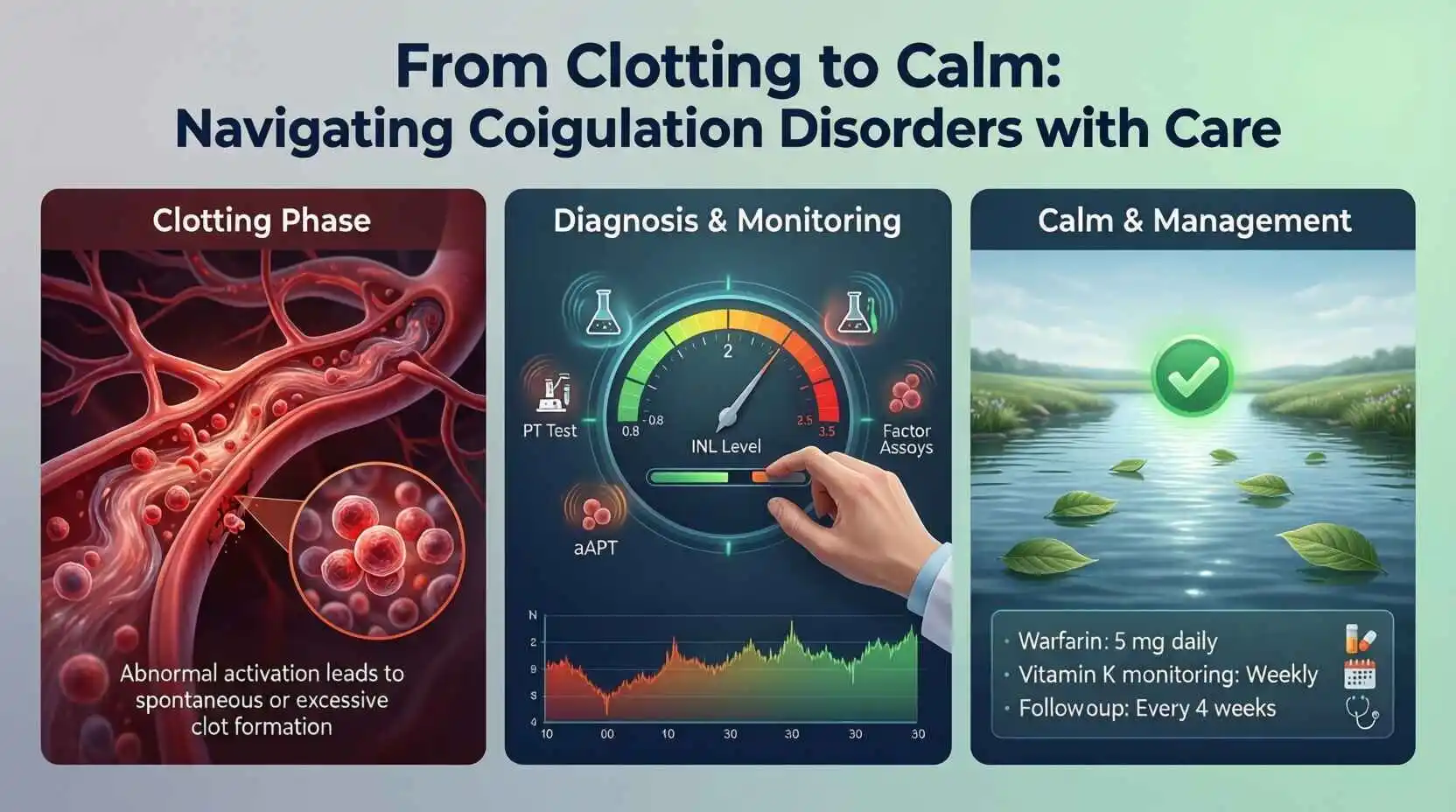
- PT/INR (Prothrombin Time/International Normalized Ratio): Measures how long it takes for blood to clot. It primarily checks the extrinsic pathway (Factor VII). It is used to monitor Warfarin therapy.
- aPTT (Activated Partial Thromboplastin Time): Measures the intrinsic pathway (Factors VIII, IX, XI, XII). It is used to monitor Heparin therapy and diagnose Hemophilia.
- Bleeding Time: A small cut is made on the forearm to see how long it takes to stop. This tests platelet function.
- Specific Factor Assays: Tests to measure the levels of specific factors like Factor VIII or IX.
- D-Dimer Test: Measures a protein fragment present when a blood clot dissolves. High levels indicate a clot might be present (used to rule out DVT).
5: Medical Treatments
Treatment depends entirely on whether the patient suffers from excessive bleeding or excessive clotting.
Treatments for Bleeding Disorders:
- Replacement Therapy: The mainstay of treatment for Hemophilia. Clotting factors (VIII or IX) derived from donated blood or lab-created (recombinant) are infused intravenously. Patients can do this at home (prophylaxis) to prevent bleeds or at the onset of a bleed.
- Desmopressin (DDAVP): A synthetic hormone that stimulates the release of stored von Willebrand Factor and Factor VIII. It is used for mild Hemophilia A and Type 1 vWD.
- Antifibrinolytics: Drugs like Tranexamic acid or Aminocaproic acid prevent clots from breaking down. They are often used for nosebleeds or heavy menstrual bleeding.
- Fibrin Sealants: A topical glue-like substance used during surgery to stop bleeding.
Treatments for Clotting Disorders:
- Anticoagulants (Blood Thinners): These do not “thin” the blood but rather block the clotting cascade.
- Warfarin (Coumadin): A vitamin K antagonist. Requires strict dietary monitoring and blood testing.
- DOACs (Direct Oral Anticoagulants): Newer drugs like Apixaban (Eliquis) and Rivaroxaban (Xarelto). They do not require routine monitoring, but can be difficult to reverse in emergency surgery.
- Antiplatelets: Drugs like Aspirin and Clopidogrel (Plavix) prevent platelets from clumping together. They are crucial for heart attack and stroke prevention.
- Thrombolytics: “Clot busters.” These are potent drugs (like tPA) injected in emergency settings (like during a massive stroke or heart attack) to rapidly dissolve a dangerous clot.
6: Natural Remedies and Dietary Support
Disclaimer: Natural remedies should never replace prescribed medication for serious coagulation disorders. Always consult a hematologist before starting supplements.
For those with mild disorders or as an adjunct therapy, nature offers powerful compounds.
For Clotting Disorders (Natural Blood Thinners):
- Ginger: Contains salicylates, the same chemical compound found in aspirin. It helps reduce inflammation and platelet clumping.
- Cayenne Pepper: High in salicylates and capsaicin, cayenne helps stimulate blood flow, reducing the risk of clots.
- Turmeric: Curcumin, the active ingredient in turmeric, has potent anticoagulant properties.
- Garlic: Regular garlic consumption has been shown to reduce platelet aggregation.
- Vitamin E: High doses of Vitamin E can thin the blood by inhibiting platelet aggregation.
For Bleeding Disorders (Promoting Clotting):
- Vitamin K: The ultimate clotting vitamin. Leafy greens (kale, spinach, swiss chard), broccoli, and brussels sprouts are high in K1.
- Cyanocobalamin (Vitamin B12): Essential for DNA synthesis and healthy red blood cells. A deficiency can lead to anemia and platelet issues. Found in meat, eggs, and dairy.
- Iron: While not a direct clotting agent, iron is vital for hemoglobin production. Those with chronic bleeding (like heavy periods) often suffer from iron-deficiency anemia, which compounds fatigue.
