
Table of Contents
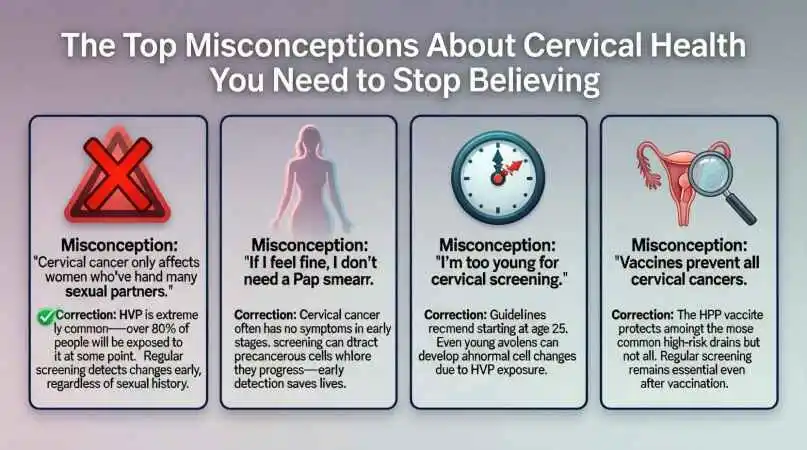
The Top Misconceptions About Cervical Health You Need to Stop Believing
Introduction: The Silent Gatekeeper
In the intricate architecture of the female reproductive system, the cervix plays a role that is both pivotal and profoundly misunderstood. Situated at the lower, narrow end of the uterus, connecting it to the vagina, this small, doughnut-shaped structure acts as the gatekeeper to the womb. It allows the passage of menstrual blood, facilitates the journey of sperm for fertilization, and, during childbirth, dilates to allow life to enter the world.
Despite its critical functions, the cervix is often shrouded in silence, confusion, and medical myth. For many women, cervical health is a topic relegated to a once-a-year anxiety-inducing appointment—a few uncomfortable minutes on an exam table followed by a nervous wait for results. Because of this sporadic engagement and the historical stigma surrounding women’s reproductive anatomy, misconceptions have flourished. These aren’t just harmless old wives’ tales; they are dangerous fallacies that can lead to missed diagnoses, unnecessary fear, and preventable diseases.
In this in-depth exploration, we are debunking the most pervasive myths surrounding cervical health. By separating fact from fiction, we aim to empower you with knowledge, enabling you to advocate for your body with confidence and clarity.
1: The HPV Paradox
Perhaps no single subject is more clouded by misunderstanding than the Human Papillomavirus (HPV). To understand cervical health, one must understand HPV, yet the stigma attached to this virus is profound.

Misconception #1: “HPV is rare and only happens to people who are promiscuous.”
This is perhaps the most damaging myth in existence. HPV is not a rare “scarlet letter” of sexual behavior; it is the common cold of the sexually active world. According to the Centers for Disease Control and Prevention (CDC), nearly all sexually active men and women will contract HPV at some point in their lives. There are over 150 strains of the virus, and it is so incredibly transmissible that skin-to-skin genital contact is enough to pass it on—intercourse is not strictly required. You can be monogamous for decades, have only one sexual partner in your entire life, and still contract HPV. It simply is what happens when humans are intimate. Framing it as a consequence of “promiscuity” prevents people from getting vaccinated and shames those who test positive, creating a barrier to treatment.
Misconception #2: “If I have HPV, I definitely have cervical cancer.”
Hearing that you have tested positive for HPV can send a chill down the spine, largely because of the conflation between the virus and the cancer it can cause. However, the vast majority of HPV infections are transient and harmless. The body’s immune system is remarkably adept at clearing the virus naturally within one to two years.
Only a small subset of HPV strains are “high-risk” (notably types 16 and 18), and even among those, infection does not guarantee cancer. Cervical cancer is a slow-growing disease that typically takes years, even decades, to develop. It is not an overnight event. An HPV diagnosis is a signal to monitor and manage, not a death sentence. It is a “watch and wait” scenario that often resolves itself without medical intervention beyond observation.
Misconception #3: “I don’t need the HPV vaccine because I’m already sexually active.”
There is a prevailing belief that the ship has sailed on vaccination once sexual activity has begun. While it is true that the vaccine is most effective when administered before exposure to the virus (hence the recommendation for ages 9-12), it is not useless for adults. The vaccine protects against the strains you haven’t encountered yet. Even if you have had one strain of HPV, the vaccine can still protect you against the other high-risk types that cause cancer and genital warts. The CDC now recommends the vaccine for everyone up to age 26, and for some adults up to age 45 based on shared clinical decision-making. It is a preventative tool against future risk, regardless of your past.
2: The Screening Maze
The Pap smear (or Pap test) and the HPV test are the cornerstones of cervical health maintenance, yet confusion surrounds when to get them, what they feel like, and what they actually detect.
Misconception #4: “A Pap smear tests for all STDs and infections.”
Many women walk into their annual exam believing that a Pap smear is a comprehensive sexual health checkup. It is not. A Pap smear specifically looks for precancerous changes in the cells of the cervix. While it might incidentally pick up on some issues, it does not test for Gonorrhea, Chlamydia, HIV, Syphilis, or Herpes. Those require separate swabs or blood tests. Assuming you are “clean” because your Pap was normal is a dangerous oversight. You must have a conversation with your provider about a full STI panel if you are sexually active, separate from your cervical cancer screening.
Misconception #5: “I don’t need a Pap smear if I feel fine.”
Cervical cancer is famously a silent killer in its early stages. In the precancerous phase, and even in the early stages of invasive cancer, there are often absolutely no symptoms. You might feel energetic, healthy, and have zero pain or discomfort. By the time symptoms appear—such as abnormal bleeding, pelvic pain, or discharge—the disease has often advanced to a much more difficult stage. The entire purpose of the Pap smear is to catch changes before you feel sick. Relying on how you “feel” is a gamble that no one should take with their health.
Misconception #6: “I don’t need a Pap smear if I’m post-menopausal.”
There is a dangerous assumption that cervical health stops mattering after the reproductive years. In reality, cervical cancer is most frequently diagnosed in women between the ages of 35 and 44, but the risk does not disappear as women age. In fact, post-menopausal women may neglect screening because they are no longer seeing a gynecologist for birth control or menstrual issues. Furthermore, after menopause, the vaginal walls and cervix can thin (atrophy), making them more susceptible to infections and lesions. Guidelines generally suggest that women over 65 can stop screening only if they have had adequate prior screening with normal results. If you have a history of abnormal results, screening must continue.
Misconception #7: “The Pap smear is painful.”
While discomfort is subjective, a properly performed Pap smear should not be excruciatingly painful. It may feel awkward, cold, or like a moment of pressure, but severe pain is not the norm. The myth of the “torturous” exam keeps many women away from the doctor’s office. If you experience pain during the exam, it is often due to tension (anxiety causes the pelvic muscles to tighten), a condition called vaginismus, or an infection. Communicating with your provider—using a smaller speculum, breathing exercises, or using lubrication—can make the process manageable. Don’t let the fear of momentary discomfort cost you your life.
3: Stigma, Hygiene, and Daily Habits
The intimate nature of cervical health makes it a breeding ground for myths regarding hygiene and morality.
Misconception #8: “Douching or using feminine hygiene products keeps the cervix healthy.”
The vagina is a self-cleaning ecosystem, and the cervix is the guardian of this delicate environment. It produces mucus that changes in consistency throughout the month to cleanse the vagina and block bacteria. Douching disrupts the natural pH balance and the beneficial bacteria (lactobacilli) that keep pathogens at bay.
Using scented soaps, sprays, or “feminine washes” inside the vagina can introduce irritants and chemicals that cause inflammation (cervicitis) or BV (Bacterial Vaginosis). When the balance is disturbed, it creates a pathway for infections to ascend to the cervix. The golden rule is simple: Less is more. Warm water and mild, unscented soap on the outside is all you need.
Misconception #9: “Abnormal bleeding is just irregular periods.”
Bleeding between periods, bleeding after sex, or bleeding after menopause are often brushed off as “stress,” “hormones,” or “just getting older.” This is a critical error. While hormonal fluctuations can cause spotting, the cervix is highly vascular. When cells on the surface of the cervix become irritated, inflamed, or cancerous, they bleed easily upon contact—such as during intercourse or a pelvic exam. Post-coital bleeding (bleeding after sex) is a “red flag” symptom that warrants immediate investigation. It is not something to be ignored or normalized.
Misconception #10: “I can’t get cervical cancer if I’ve had a hysterectomy.”
This myth depends entirely on what kind of hysterectomy was performed. A total hysterectomy removes the entire uterus and the cervix. If you have had a total hysterectomy and it was performed for non-cancerous reasons (like fibroids), then your risk of cervical cancer is effectively zero, and you can stop Pap screening.
However, if you had a partial or supracervical hysterectomy (where the uterus is removed but the cervix is left in place), you are still at risk and must continue screening. Furthermore, if the hysterectomy was performed because of cervical cancer or precancerous cell changes, screening must continue to monitor for recurrence. Many women assume “hysterectomy” equals “removal of everything female,” but the nuances are vital for continued health.
4: Fertility and Future Planning
Cervical health is inextricably linked to fertility, leading to anxiety among women trying to conceive.
Misconception #11: “An abnormal Pap smear means I’m infertile.”
Receiving an abnormal Pap smear result can be terrifying for a woman planning a family. However, an abnormal result merely means there are cellular changes; it is not a diagnosis of infertility. Even precancerous lesions (CIN 2 or CIN 3) do not prevent pregnancy.
The treatments for these abnormalities—such as LEEP (Loop Electrosurgical Excision Procedure) or cone biopsies—can slightly impact fertility or the ability to carry a pregnancy to term (specifically, there is a small increased risk of cervical insufficiency or second-trimester miscarriage). But these risks are managed, and most women who undergo treatment go on to have healthy pregnancies. The presence of HPV or dysplasia does not stop you from getting pregnant.
Misconception #12: “The HPV vaccine causes infertility.”
In the age of rampant misinformation, this myth has caused significant damage. Numerous studies from the CDC, WHO, and independent researchers have found absolutely no link between the HPV vaccine and infertility. In fact, by preventing cervical cancer and the need for surgeries (like hysterectomies or radical cervical procedures), the vaccine preserves fertility. The vaccine is safe, effective, and a crucial tool for reproductive health, not a threat to it.
