
Table of Contents
Scarlet Fever vs. Kawasaki Disease: A Parent’s Guide to Telling These Two Look-Alikes Apart
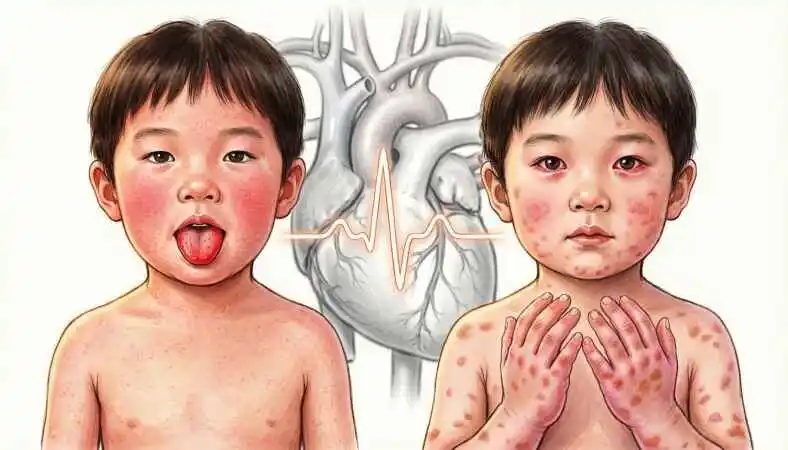
It’s 2 a.m., and you’re standing in your child’s bedroom, hand pressed to their forehead. The fever won’t budge. Their cheeks are flushed, their tongue looks oddly red and bumpy, and a rash is spreading across their chest. You’ve done the late-night Google spiral. Scarlet fever keeps popping up. But so does something you’ve never heard of: Kawasaki disease.
Your stomach drops. They look almost identical in the photos. How are you supposed to tell the difference?
You’re not alone in this panic. Scarlet fever vs. Kawasaki disease is one of the most genuinely confusing diagnostic puzzles in pediatrics. Both can start with a high fever, a rash, and that distinctive “strawberry tongue.” Both make kids miserable. But here’s what matters: they are caused by entirely different things, they require completely different treatments, and one of them can affect a child’s heart if it’s missed.
This isn’t about becoming a doctor overnight. It’s about walking into that clinic or ER armed with the right questions and a clear picture of what you’re seeing, so your child gets the right answer faster.

Let’s break this down in plain language.
What Is Scarlet Fever?
Scarlet fever is essentially strep throat with a rash. That’s the simplest way to understand it.
The culprit is Group A Streptococcus (GAS) — the same bacteria responsible for strep throat. Some strains of this bacteria produce toxins called streptococcal pyrogenic exotoxins. When those toxins enter the bloodstream, they trigger the widespread rash that turns a routine sore throat into scarlet fever.
Think of it this way: the bacteria is the fire, and the toxin is the smoke that spreads everywhere. The infection stays in the throat (or occasionally a skin infection), but the toxin causes symptoms throughout the body.
Who gets it? Scarlet fever most commonly affects school-aged children, typically between 4 and 8 years old. It’s rare in children under 2, partly because they still carry maternal antibodies that offer some protection.
How it spreads: Through respiratory droplets — coughing, sneezing, sharing cups. The incubation period is short, usually 1 to 4 days after exposure.
The classic symptoms to watch for:
- Fever, often above 38.5°C (101.3°F), appearing suddenly
- Sore throat with redness and sometimes white patches on the tonsils
- Sandpaper-like rash that feels rough to the touch, starting on the chest and abdomen before spreading
- Strawberry tongue — initially white-coated with red swollen papillae, then becoming bright red and bumpy as the coating sheds
- Circumoral pallor — a pale ring around the mouth despite flushed cheeks
- Pastia lines — deeper red lines in skin folds like the groin, armpits, and elbow creases
The rash usually appears 24 to 48 hours after the fever starts. It clears in about 4 to 5 days, often followed by peeling skin, especially on the fingertips and in the groin area.
The good news: Scarlet fever responds beautifully to antibiotics. Penicillin (or amoxicillin) is the first-line treatment, and children typically stop being contagious after just 24 hours on the medication. The full course lasts 10 days to prevent complications.
What Is Kawasaki Disease?
Kawasaki disease is a different beast entirely. It’s not an infection in the traditional sense. It’s a vasculitis — an inflammation of blood vessels throughout the body, with a particular fondness for the coronary arteries that supply blood to the heart.
The cause remains unknown. Researchers believe it’s likely an abnormal immune response to some environmental trigger — possibly an infection — in genetically susceptible children. It is not contagious.
Who gets it? Kawasaki disease predominantly affects children under 5 years old, with a peak incidence around 18 to 24 months. Boys are affected about 1.5 times as often as girls. It’s more common in children of Asian descent.
The five classic diagnostic criteria (you need fever plus at least four of these):
- Fever lasting 5 days or more, typically unresponsive to standard fever reducers
- Bilateral conjunctivitis — red, bloodshot eyes without pus or discharge
- Mucous membrane changes — red, cracked lips; strawberry tongue; diffuse redness inside the mouth
- Polymorphous rash — can look like many different things, often on the trunk and extremities
- Extremity changes — swelling and redness of the hands and feet, later followed by peeling skin
There’s also often a sixth sign: cervical lymph node swelling, usually on one side of the neck.
Why this matters so much: Without treatment, about 25% of children with Kawasaki disease develop coronary artery abnormalities, including aneurysms. That’s a quarter of untreated kids facing potential lifelong heart complications. Treatment with intravenous immunoglobulin (IVIG) within the first 10 days of illness drops that risk to around 5% or less.
The Side-by-Side Comparison: Where the Confusion Lives
Here’s where it gets tricky. Both conditions share several features:
| Feature | Scarlet Fever | Kawasaki Disease |
| Fever | High, usually resolves with antibiotics | Prolonged (5+ days), resistant to standard fever reducers |
| Rash | Sandpaper-like, blanching, starts on trunk | Polymorphous, varies widely, often involves extremities |
| Strawberry Tongue | Yes | Yes |
| Eyes | Normal | Bilateral conjunctivitis without discharge |
| Hands/Feet | Normal | Swelling, redness, later peeling |
| Lymph Nodes | Sometimes | Often enlarged |
| Sore Throat | Prominent | Sometimes |
| Cause | Group A Strep bacteria | Unknown (vasculitis) |
| Treatment | Antibiotics | IVIG + Aspirin |
| Heart Risk | None directly | Coronary artery complications |
The desquamation (peeling) is a key differentiator. In scarlet fever, the peeling tends to be diffuse and flaky. In Kawasaki disease, it’s sheet-like and typically begins around the fingernails and toenails — the periungual region.
The Critical Diagnostic Moment
A case report from Lithuanian University of Health Sciences illustrates exactly how this can play out. A 6-year-old boy came in with a 6-day fever, sore throat, and rash. He had a strawberry tongue and swollen lymph nodes. The initial diagnosis was scarlet fever, and treatment with penicillin was started. But after a few days, he remained irritable and symptomatic. Swollen, painful joints were noted in both knees. Then an echocardiogram revealed a coronary artery aneurysm in the right coronary artery. The diagnosis was corrected to Kawasaki disease with cardiac complications. Treatment was switched to IVIG and aspirin, and he recovered.
This story is a powerful reminder: when something doesn’t fit the scarlet fever picture — persistent fever despite antibiotics, joint pain, extreme irritability — it’s time to consider Kawasaki disease.
A crucial clinical pearl: Kawasaki disease is often associated with extreme irritability in infants and toddlers that seems out of proportion to their fever. Parents often describe it as “my child is just not themselves — they’re screaming and can’t be consoled.” That’s a red flag worth mentioning to your doctor.
How Doctors Tell Them Apart
Diagnosis relies on clinical criteria, but several tests help differentiate:
For Scarlet Fever:
- Rapid antigen detection test (RADT) or throat culture to confirm Group A Strep
- These tests are quick, reliable, and widely available
- A positive strep test plus the characteristic rash confirms scarlet fever
For Kawasaki Disease:
- No single test confirms it. Diagnosis is clinical.
- Inflammatory markers (ESR, CRP) are typically very elevated
- Echocardiography is essential to evaluate the coronary arteries
- Blood tests may show anemia, elevated white blood cell count, and elevated liver enzymes
- The 2024 AHA guidelines emphasize risk stratification, with a right coronary artery or left anterior descending artery Z-score ≥ 2.5 at diagnosis being a high-risk predictor for coronary artery abnormalities
The treatment gap is where the urgency lives. Scarlet fever can often wait a day or two for lab confirmation without increasing complication risk. Kawasaki disease cannot wait. Every day of delay increases the risk of coronary damage. IVIG is most effective when given within the first 7 to 10 days of fever onset.
Treatment: Two Very Different Paths
Scarlet Fever Treatment:
- Penicillin V or amoxicillin for 10 days (first-line)
- For penicillin-allergic children: cephalexin, clindamycin, or azithromycin
- Benzathine penicillin G injection is an option if adherence to oral medication is a concern
- Symptom relief: acetaminophen or ibuprofen, warm fluids, throat lozenges for older kids
- Children can return to school after 24 hours on antibiotics if they feel well
Kawasaki Disease Treatment:
- Intravenous immunoglobulin (IVIG) at 2 g/kg infused over 8 to 12 hours — the cornerstone of treatment
- Aspirin — high-dose during the acute phase, then reduced to low-dose for 6 to 8 weeks (or longer if coronary changes are present). This is one of the rare situations where aspirin is used in children; it’s specifically to protect the heart
- Corticosteroids may be added for high-risk patients or those who don’t respond to IVIG
- Some children need a second dose of IVIG or additional anti-inflammatory therapies
The response to IVIG is often dramatic. Fever typically resolves within 24 to 48 hours, and the child’s overall condition improves rapidly. But the heart monitoring continues long after the fever breaks.
Potential Complications: What’s at Stake
Scarlet Fever Complications:
- Suppurative complications (from spread of infection): peritonsillar abscess, otitis media, sinusitis
- Non-suppurative complications (immune-mediated): rheumatic fever (0.3-3% risk if untreated), post-streptococcal glomerulonephritis (kidney inflammation)
- Invasive Group A Strep (rare but serious): necrotizing fasciitis, streptococcal toxic shock syndrome, sepsis
The good news is that prompt antibiotic treatment dramatically reduces these risks.
Kawasaki Disease Complications:
- Coronary artery aneurysms — the most serious complication, affecting about 5% of treated children and up to 25% of untreated children
- Myocarditis (heart muscle inflammation) during the acute phase
- Myocardial infarction — risk is highest soon after onset
- Long-term cardiovascular risk — patients with a history of Kawasaki disease-associated coronary aneurysms require lifelong surveillance
A 2024 study from a U.S. center followed patients with giant coronary artery aneurysms after Kawasaki disease for up to 34 years. Major adverse cardiovascular events occurred in nearly 22% of patients over 30 years, with higher rates in those who had bilateral aneurysms or very large Z-scores (≥20). Even among those whose aneurysms regressed to normal diameter, ongoing surveillance was recommended.
The Long Game: What Happens After
For scarlet fever, recovery is typically straightforward. Once the antibiotic course is complete, children are back to normal with no lasting effects, assuming no complications developed. The peeling skin resolves on its own. Follow-up is minimal.
For Kawasaki disease, follow-up depends entirely on whether the coronary arteries were affected:
- No coronary involvement: Usually discharged from cardiology after 6 to 8 weeks with a normal echocardiogram
- Transient coronary dilation: Follow-up until dilation resolves, typically within 1 to 2 years
- Persistent coronary aneurysms: Long-term cardiology care, possibly lifelong, with regular imaging and stress testing
Recurrence of Kawasaki disease is rare — about 3 to 4% of children experience a second episode, usually within the first two years.
FAQs
- Can a child have both scarlet fever and Kawasaki disease at the same time?
It’s theoretically possible but extremely rare. They are distinct conditions with different causes. If a child has confirmed strep and doesn’t improve with antibiotics, Kawasaki disease should still be considered. - How quickly does scarlet fever rash appear after fever?
The rash typically appears 24 to 48 hours after the fever and sore throat begin, though it can sometimes appear simultaneously. - Is Kawasaki disease contagious?
No. Kawasaki disease is not contagious. It cannot be passed from child to child or from adults to children. - Can scarlet fever cause heart problems?
Not directly. However, untreated or inadequately treated scarlet fever can lead to rheumatic fever, which can cause heart valve damage. This is why completing the full antibiotic course is so important. - What does the Kawasaki disease rash look like?
It’s polymorphous, meaning it can take many forms — maculopapular, urticarial, scarlatiniform, or even targetoid. It’s often more prominent in the diaper area in infants and on the extremities. - How long does a child with scarlet fever need to stay home from school?
Until they’ve been on antibiotics for at least 24 hours and feel well enough to participate. The rash itself is not contagious. - Can Kawasaki disease be prevented?
No. Since the cause is unknown, there’s no known way to prevent it. - What’s the most important thing to watch for after scarlet fever treatment?
Persistent fever, joint pain, or new symptoms after completing antibiotics. These could indicate a complication or a misdiagnosis. - At what age is Kawasaki disease most common?
The peak incidence is between 18 and 24 months, though it can occur at any age, including in infants under 6 months and older children. - Does Kawasaki disease always affect the heart?
No. With prompt treatment, the majority of children — about 95% — have no coronary artery abnormalities. The risk is highest when treatment is delayed. - Can a child get scarlet fever more than once?
Yes. There are multiple strains of Group A Strep, and immunity to one strain doesn’t protect against others. Reinfection is possible. - What does the strawberry tongue look like in each condition?
In both conditions, the tongue has prominent red papillae. In scarlet fever, it often starts with a white coating that sheds to reveal the red, bumpy surface. In Kawasaki disease, the tongue is typically red from the start without the white-coated phase. - How is Kawasaki disease diagnosed if there’s no specific test?
Diagnosis is based on clinical criteria: fever for 5+ days plus 4 of 5 characteristic signs. Incomplete cases are diagnosed based on lab findings and echocardiogram results. - What happens if Kawasaki disease is not treated?
The risk of coronary artery aneurysms rises to about 25%. These can lead to blood clots, heart attacks, and lifelong cardiac complications. - Is scarlet fever serious?
With treatment, scarlet fever is usually not serious. Without treatment, the risk of rheumatic fever and kidney complications increases significantly. - Can adults get scarlet fever?
Yes, though it’s less common. Adults with strep throat can develop the rash if they’re infected with a toxin-producing strain. - How long does Kawasaki disease last?
The acute phase (fever and rash) typically lasts 1 to 2 weeks without treatment. With IVIG treatment, fever usually resolves within 24 to 48 hours. - What should I do if my child has a rash and fever that won’t go away?
Seek medical attention promptly. If the fever has lasted more than 5 days, specifically ask about Kawasaki disease — don’t assume it’s just a viral illness. - Is there a vaccine for scarlet fever?
No. There is no vaccine for scarlet fever or Group A Strep infections. - Can scarlet fever turn into Kawasaki disease?
No. They are completely separate conditions. Scarlet fever doesn’t “become” Kawasaki disease. - What blood tests help distinguish between the two?
A positive strep test points to scarlet fever. Kawasaki disease typically shows very high inflammatory markers (ESR, CRP) without evidence of bacterial infection. - Do children with Kawasaki disease need to avoid exercise?
During the acute phase and until cleared by a cardiologist, strenuous activity is usually restricted. Long-term restrictions depend on coronary artery status. - How often should a child with a history of Kawasaki disease see a cardiologist?
If no coronary changes: typically discharged after 6-8 weeks. If coronary changes occurred: follow-up schedules vary from every few months to annually, depending on severity. - Can antibiotics be used to treat Kawasaki disease?
No. Kawasaki disease is not a bacterial infection, so antibiotics are ineffective. Treatment focuses on reducing inflammation with IVIG and aspirin. - What’s the difference between the peeling in scarlet fever and Kawasaki disease?
Scarlet fever peeling is diffuse and flaky. Kawasaki disease peeling is sheet-like and starts around the fingernails and toenails. - Is the rash in scarlet fever itchy?
Typically not. The sandpaper rash is usually not itchy, which distinguishes it from many allergic rashes. - Can Kawasaki disease affect other organs besides the heart?
Yes. Inflammation can affect the upper respiratory tract, pancreas, biliary tract, kidneys, mucous membranes, and lymph nodes. - What’s the prognosis for a child with Kawasaki disease?
Excellent with prompt treatment. Most children recover fully with no lasting effects. The prognosis is more guarded if coronary artery complications develop. - How do I know if my child’s scarlet fever treatment is working?
Fever and sore throat typically improve within 24 to 48 hours of starting antibiotics. If symptoms persist beyond 48 hours, contact your doctor. - Should siblings of a child with scarlet fever be tested?
Only if they develop symptoms. Routine testing of asymptomatic household contacts is not generally recommended, though some clinicians may advise it in certain situations.
Final Thoughts: Trust Your Instincts
The fear of missing Kawasaki disease is real and justified. It’s the leading cause of acquired heart disease in children in developed countries, and the window for preventing coronary complications is narrow. But here’s the thing: you don’t need to diagnose your child yourself. You need to be the informed advocate who asks the right questions.
If your child has a fever that won’t quit, a rash that doesn’t fit the typical viral pattern, and they’re just not themselves — say so. Say the words “Could this be Kawasaki disease?” It’s not overreacting. It’s being a good parent.
And if it turns out to be scarlet fever? Great. A 10-day course of antibiotics and you’re done. But if it’s Kawasaki disease, that early recognition and treatment could protect your child’s heart for a lifetime.
Your call to action: If you’ve been through the diagnostic rollercoaster with scarlet fever or Kawasaki disease, share your story in the comments. Your experience could help another parent recognize the signs faster. And if this article helped you understand the difference, share it with a parent who needs it.
⚕️Medical Disclaimer:
The information provided on this website is for general educational and informational purposes only and is not intended as a substitute for professional medical advice, diagnosis, or treatment. Always seek the advice of your physician or other qualified health provider with any questions you may have regarding a medical condition. Never disregard professional medical advice or delay in seeking it because of something you have read on this website.
