
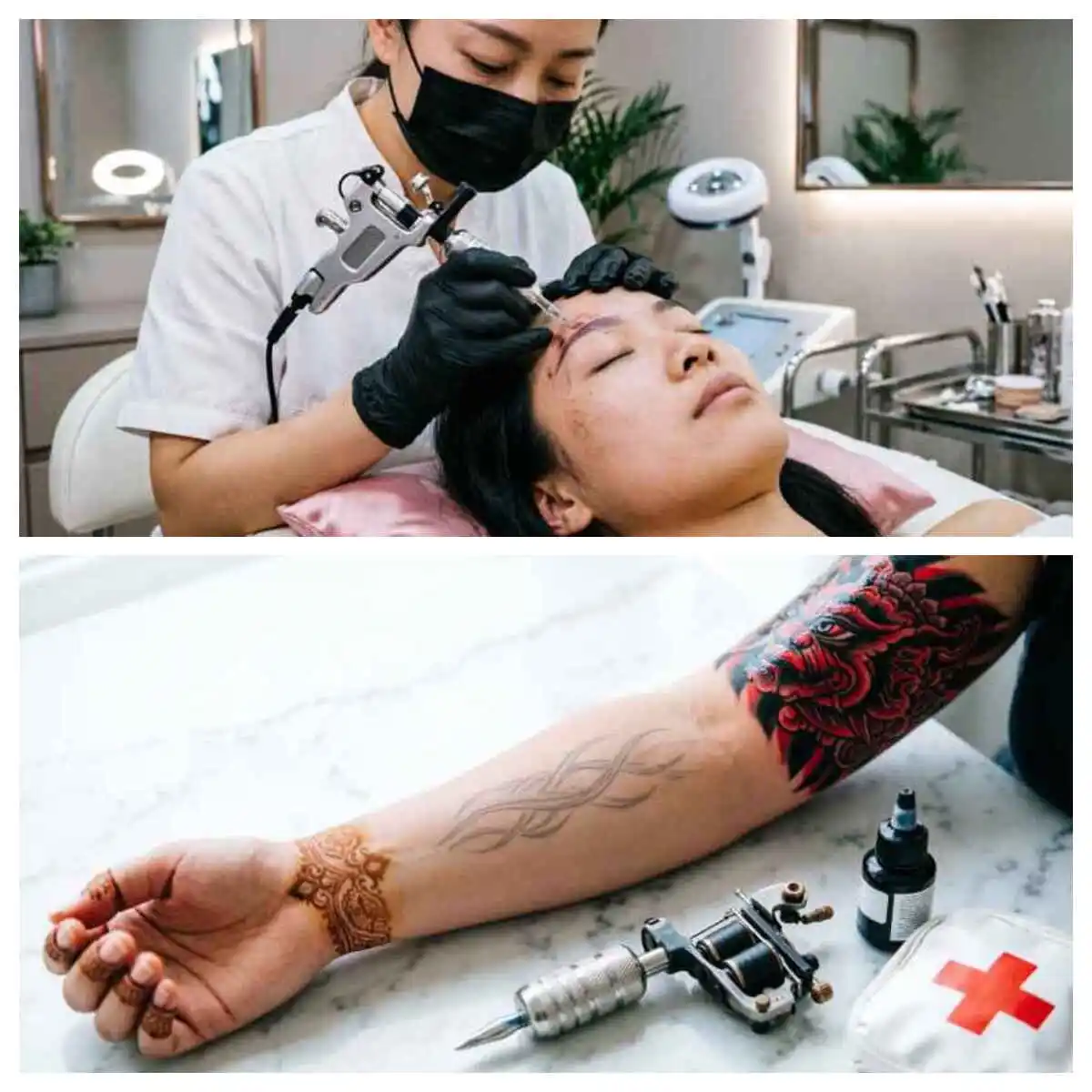
Table of Contents
Inked Intentions: A Deep Dive into Tattoo Styles, Health Risks and Safety
Introduction: The Canvas of the Self
The human body has always been a canvas for storytelling. From the ancient tribal markings signifying lineage and status to the modern intricate designs expressing individuality, the desire to decorate our skin is deeply woven into the human experience. Yet, in the modern era, the commitment to body art has become a complex decision. We live in a time of options—a spectrum of choices ranging from the fleeting whimsy of a sticker tattoo to the lifelong pledge of a permanent design, with a confusing middle ground of “semi-permanent” or “temporary permanent” options bridging the gap.
For decades, the choice was binary: you either got a real tattoo or you didn’t. Today, however, innovation in cosmetic chemistry has introduced concepts like “Ephemeral” tattoos—ink designed to fade over time—and semi-permanent makeup. This has blurred the lines, creating a new category of body modification that promises the look of a tattoo without the lifetime commitment.
But with these new technologies come new questions. Is “temporary permanent” ink safe? How does the skin react to pigments designed to vanish? Are the health risks of a semi-permanent procedure the same as those of a traditional one? And for the traditionalists, what are the modern realities of getting inked for life?
This comprehensive guide aims to take a stroll through the evolving landscape of body art. We will dissect the pros and cons of temporary, semi-permanent, and permanent tattoos, delve deep into the health implications of injecting dyes into the dermis, and provide the knowledge necessary to make an informed decision about your body art journey.

A Gallery of Styles – Understanding the Types of Tattoos
When discussing the pros and cons of tattoos, it is vital to understand that “tattoo” is an umbrella term. The experience, the level of pain, the health risks, and the longevity can vary drastically depending on the type and style of the tattoo chosen. Not all ink is created equal.
Artistic Styles and Their Implications
- Traditional (Old School)
- The Look: Bold, black outlines filled with a limited palette of primary colors (red, green, yellow, black). Iconic imagery includes anchors, swallows, roses, and hearts.
- Why it endures: This style is renowned for its longevity. The thick black outlines resist blurring over decades better than any other style.
- Health Note: Because this style uses solid blocks of color, it requires a significant amount of ink deposition. Reactions to red ink (common in this style) are historically more frequent.
- Realism (Portraiture)
- The Look: Tattoos that look like photographs or hyper-realistic drawings. Often used for portraits of loved ones or nature scenes.
- The Challenge: This requires immense skill. The artist uses shading and subtle gradients rather than outlines.
- Aging Factor: Realism tattoos are fragile. As the skin ages and the ink spreads slightly (blurring), the fine details can be lost, turning a crisp portrait into a “muddy” image faster than a traditional bold tattoo. Sunscreen is non-negotiable for this style.
- Watercolor
- The Look: Designed to look like a watercolor painting, featuring splashes of color with no (or very faint) black outline.
- The Aesthetic: Beautiful and modern, often blending colors seamlessly.
- The Risk: Without a “container” of black outline, the ink tends to migrate (blowout) more visibly as it fades. Some artists refuse to do pure watercolor because the design may lose its form within 5-10 years.
- Fine Line and Minimalist
- The Look: Delicate, thin lines, often single-needle work. Popular for small symbols, geometric shapes, or text.
- The Trend: Extremely popular on social media for its subtle appearance.
- The Health & Longevity Issue: Fine line tattoos are placed very shallowly in the skin. If placed too deep, the line blows out and looks thick. If placed too shallow, the body pushes the ink out during healing (fallout). They often require more frequent touch-ups than bold styles.
- Tribal and Blackwork
- The Look: Solid black areas of ink, often geometric or curvilinear patterns.
- The Context: While “Tribal” refers to cultural practices of indigenous peoples (Maori, Samoan, etc.), the term is also used in commercial shops for bold black designs.
- Removal Difficulty: Because of the high density of ink particles, blackwork is notoriously difficult and painful to remove with lasers. It requires many more sessions to break down the sheer volume of pigment.
- Neo-Traditional and New School
- The Look: An evolution of Old School. Neo-Traditional keeps the bold lines but uses a wider color palette and more depth. New School exaggerates features with graffiti or cartoon-like aesthetics.
- Health Note: These styles often use “white ink” for highlights. White ink is essentially a pigment (titanium dioxide) that the body breaks down very quickly. White highlights often disappear or turn yellow/brown within a year or two.
Functional and Medical Tattoos
Beyond aesthetics, tattoos serve functional purposes. These carry unique considerations.
- Cosmetic Tattoos (Permanent Makeup)
- Types: Microblading (eyebrows), eyeliner tattoos, and lip blush.
- The “Semi-Permanent” Reality: While called permanent makeup, the skin on the face is much thinner and has higher cell turnover than the rest of the body. These tattoos fade significantly faster (1-3 years) and often require annual color boosts.
- The Risk: The eye area is sensitive. Eyeliner tattoos carry a risk of corneal abrasion or damage to the eyelashes if not performed correctly.
- Medical Alert Tattoos
- The Concept: Instead of wearing a bracelet, a person gets their medical condition (e.g., “Diabetic,” “No MRI,” “Type 1”) tattooed, often on the wrist or chest.
- The Controversy: While convenient, emergency medical responders are trained to look for jewelry first. There is a risk that a tattoo might be overlooked in a trauma situation, or that the condition changes (e.g., a patient is no longer on a specific medication), but the tattoo remains.
- Scar Camouflage and Areola Restoration
- The Purpose: Using flesh-toned inks to cover scars (from surgery or accidents) or to recreate the appearance of a nipple/areola after mastectomy.
- The Skill: This is highly specialized. Artists must perfectly match skin tone, which changes with seasons (tanning). These inks are prone to color shifting—turning pink or orange over time as the body absorbs different pigment components.
- UV (Blacklight) Tattoos
- The Look: Invisible in normal daylight but glowing under UV/blacklight.
- The Safety Concern: Early UV inks were controversial because they contained phosphorus, a potentially carcinogenic substance. While safer UV inks now exist, the long-term health effects of having fluorescent dyes in the dermis are still under-researched. Many dermatologists advise caution with this type.
- White Ink Tattoos
- The Look: A ghostly, pale design that looks like a scar or branding.
- The Pitfall: White ink is the most volatile. It can fade completely, or worse, oxidize and turn a yellowish-brown color, looking like an old scar or a burn mark. It is the most likely type to result in dissatisfaction due to color change.
By understanding these types, a reader can better assess not just what they want their tattoo to look like today, but how it will interact with their body over the next decade.
The Spectrum of Permanence
To understand the pros and cons, we must first define the players. The market is no longer black and white; it is a gradient of fading timelines.
- Temporary Tattoos (Decals and Transfers)
These are the playground veterans. Applied with water and a damp cloth, they sit on the surface of the skin (the epidermis). They last a few days and wash off with soap and oil.
- The Appeal: Zero commitment, low cost, and pain-free.
- The Reality: They often look like plastic stickers, lacking the texture of real ink.
- Semi-Permanent Tattoos (The “Temporary Permanent”)
This is the trending category that confuses many consumers. It includes:
- Henna and Jagua: Natural plant-based dyes that stain the skin. They last 1–3 weeks.
- Cosmetic “Semi-Permanent” Makeup: Often used for eyebrows (microblading) or lips. This is technically a tattoo but uses pigments that are designed to fade significantly over 1–3 years, unlike traditional ink.
- Bio-absorbable Inks (e.g., Ephemeral Tattoos): A newer innovation using ink made of medical-grade, bio-absorbable polymers. Once injected into the skin, the body breaks down the polymer particles over time (roughly 9–15 months), causing the tattoo to fade away.
- Permanent Tattoos
The gold standard. A needle punctures the epidermis and deposits ink into the dermis—the second layer of skin. The dermis is stable, meaning the ink stays put for life. The only way to remove it is via laser surgery or surgical excision.
The “Temporary Permanent” Phenomenon
The concept of a tattoo that looks real but disappears on its own is the “holy grail” for the commitment-phobic. But is it too good to be true?
The Pros
- The “Try Before You Buy” Factor: For those contemplating a real tattoo, semi-permanent options allow a test run. You can live with a design on your forearm for a year to see how it fits your professional image or personal style. 2. Fade-ability: Life changes. A name of an ex-partner, a design from a phase you’ve outgrown, or a placement that no longer suits your aging skin becomes a non-issue if the ink is designed to vanish. 3. Less Trauma? Some bio-absorbable inks claim to be less traumatic to the skin than traditional heavy metal inks, potentially offering a safer alternative for sensitive skin types.
The Cons
- The Fading Process is Unpredictable: Unlike a decal that washes off cleanly, bio-absorbable tattoos fade as the body breaks down the particles. This can lead to patchy, uneven fading where parts of the design disappear while others linger, leaving a “ghost” of the image that looks messy. 2. Allergic Reactions: Because “temporary permanent” inks are often made of newer chemical compounds, the rate of allergic reaction is less documented than traditional inks. The body may react to the polymer breakdown products, leading to prolonged inflammation or scarring. 3. The Cost: Semi-permanent tattoos often cost as much as permanent ones because the application process (needles, equipment, skill) is identical. You are paying full price for a temporary result. 4. The “Sunblock” Effect: Paradoxically, some semi-permanent inks resist fading if exposed to certain skincare products or UV rays unevenly, leading to a design that refuses to leave when you want it to.
A Critical Note on Henna
When discussing semi-permanent options, Black Henna is a major safety red flag. Natural henna is reddish-brown. “Black henna” often contains PPD (paraphenylenediamine), a toxic hair dye chemical. PPD can cause severe blistering, chemical burns, and lifelong scars. It can also sensitize the skin permanently, meaning a person could have a severe allergic reaction to hair dye, antibiotics, or sunscreens years later. Always ensure semi-permanent body art is natural henna or jagua, never “black henna.”
The Permanent Mark – Pros and Cons
For centuries, permanent tattoos were the only option. They remain the most popular form of body art, but they carry the heaviest weight of responsibility.
The Pros
- Autonomy and Expression: A permanent tattoo is a declaration of identity. It allows for deep personal storytelling and the memorialization of loved ones or pivotal life moments. 2. Longevity: The design remains crisp and visible for decades. It does not require touch-ups every few years (unlike cosmetic tattoos) and does not wash off. 3. Artistic Integrity: Traditional ink allows for the finest details, shading, and gradients. It is the superior medium for complex art. Semi-permanent inks often cannot hold the same level of detail because of how they are designed to break down. 4. Cultural Connection: For many cultures (Maori, Samoan, Polynesian), permanent tattoos are sacred rites of passage that cannot be replicated with temporary measures.
The Cons
- Regret: The stigma around tattoos has lessened, but regret remains a significant issue. Estimates suggest that nearly 25% of people with tattoos eventually regret at least one of them. 2. Employment Barriers: While declining, discrimination against visible tattoos still exists in conservative industries like finance, law, and healthcare. 3. Aging of the Tattoo: Skin loses elasticity over time. A tattoo that looks crisp at 25 may look blurred and faded at 60. Sun exposure accelerates this degradation. 4. Removal Difficulty: Laser tattoo removal is expensive, painful, and rarely perfect. It works by breaking the ink particles into smaller pieces for the immune system to “eat.” This process can take years and leave behind “ghost images” or scarring.
Health Issues – The Anatomy of Ink
The most critical aspect of this discussion is health. Injecting any substance into the body carries risk. The skin is a barrier organ, designed to keep things out. Tattoos breach this barrier.
The Immune Response
When a needle deposits ink into the dermis, the immune system recognizes it as a foreign invader. White blood cells (macrophages) rush to the site to “eat” the ink particles. However, the particles are too large to be carried away. The macrophages stay put, holding the ink in place, creating the permanent image.
- The Risk: This constant low-grade immune response is why some people feel sluggish or “flu-ish” after a long tattoo session. The body is expending energy fighting a foreign substance.
Ink Composition and Heavy Metals
Traditional tattoo inks are not highly regulated in many parts of the world. They often contain heavy metals to create vibrant colors.
- Red inks often contain mercury sulfide (cinnabar) or iron oxide.
- Yellow and green inks may contain lead chromate or cobalt.
- Blue and black inks often contain carbon or iron oxides.
- The Danger: Heavy metals can be toxic in high doses. While the amount in a tattoo is small, the cumulative effect of heavy metals accumulating in the lymph nodes is a growing concern among researchers. Studies have found tattoo pigment particles in the lymph nodes of tattooed individuals, which can cause them to swell or harden.
Allergic Reactions
Allergies are one of the most common health issues.
- Symptoms: Itching, redness, bumps, or oozing at the tattoo site. This can happen immediately or years later.
- Red Ink: This is the most common allergen. It can cause granulomas (small bumps) or a severe eczema-like reaction. Because the ink is trapped deep in the skin, treating a tattoo allergy is difficult; topical creams often fail, and removal might be the only option.
Infections
A tattoo is an open wound.
- Bacterial Infections: Staphylococcus aureus is the most common culprit. It causes redness, swelling, pain, and pus. Poor aftercare or unsterile equipment is usually the cause.
- Bloodborne Pathogens: This is the nightmare scenario. If needles are reused or not sterilized properly, there is a risk of transmitting Hepatitis B, Hepatitis C, and HIV. This is why going to a licensed, reputable studio is non-negotiable.
MRI Complications
Rarely, people with tattoos (especially those with lower-quality inks containing metallic traces) experience swelling or burning during an MRI (Magnetic Resonance Imaging). The magnetic fields can theoretically interact with the metallic particles, though modern inks have largely reduced this risk.
Tattoo Removal – The Cost of Regret
If “temporary permanent” tattoos don’t fade fast enough, or if a permanent tattoo needs to go, removal enters the chat.
Laser Removal
The gold standard. High-intensity light beams break up the ink particles.
- Pros: Effective on most colors (though resistant to green, yellow, and fluorescent inks).
- Cons: It is often described as more painful than getting the tattoo itself (like a rubber band snapping against the skin repeatedly). It is expensive, requires multiple sessions (10-20 sessions for a large piece), and carries a risk of hypopigmentation (leaving white spots on the skin) or scarring.
Dermabrasion and Excision
Older methods that are rarely used today, but still exist for small tattoos.
- Dermabrasion: Sanding the skin down to remove the ink layers. Highly scarring.
- Excision: Cutting the tattoo out and stitching the skin back together. Only viable for very small tattoos.
The “Cover-Up”
Often, the best solution for regret is a cover-up. A skilled artist can redesign the old tattoo into something new. However, this requires a larger, darker design to hide the previous work, trading one commitment for a bigger one.
Safety Protocols – How to Protect Yourself
Whether you are getting a semi-permanent brow touch-up or a full sleeve, the safety protocols are largely the same.
- The Studio Checklist
- License: Check for state health department licensing.
- Autoclave: Ensure the studio has an autoclave for sterilizing non-disposable equipment.
- Single-Use Needles: Watch the artist open a fresh, sealed needle package.
- Gloves: The artist should change gloves if they touch anything non-sterile (like their phone or a trash can).
- The Ink Bottle
Ask to see the ink bottle. It should be poured into a small disposable cap. If the needle dips back into the main bottle, that is cross-contamination. For “semi-permanent” inks, ask for the brand and Material Safety Data Sheet (MSDS) to verify the ingredients.
- Aftercare
Healing takes 2–4 weeks.
- Keep it clean: Wash with unscented antibacterial soap.
- Moisturize: Use a thin layer of healing ointment (like Aquaphor) or specialized tattoo lotion.
- No picking: Scabbing is normal. Picking scabs pulls ink out and causes scarring.
- Sun avoidance: UV rays break down ink. Keep the healing tattoo out of the sun, and use sunscreen on healed tattoos to keep them bright.
The Psychological Aspect
Tattoos are not just physical; they are psychological.
Addiction?
Is “tattoo addiction” real? Biologically, the endorphin rush during the process and the satisfaction of the final product can be habit-forming. Psychologically, the “collector’s mentality”—wanting to finish a sleeve or theme—is common.
Mental Health and Tattoos
Many people use tattoos to reclaim their bodies after trauma or illness. Covering scars with art is a powerful therapeutic tool. However, getting tattooed while in a manic episode or during a period of severe depression can lead to impulsive decisions and regret. It is generally advised to wait 6 months after a major life event or mood shift before getting a permanent tattoo.
Conclusion: The Choice is Yours
The world of body art is no longer a simple path. The emergence of “temporary permanent” tattoos—semi-permanent inks and fading technologies—offers a middle ground for the indecisive, providing the aesthetic of ink without the weight of eternity. Yet, this technology is not without its own medical mysteries and aesthetic compromises.
Traditional permanent tattoos remain the benchmark for quality and meaning, demanding a respect for the craft and an understanding of the health risks involved, from heavy metals to infection.
Ultimately, whether you choose a sticker that washes off tomorrow, a bio-absorbable design that fades in a year, or a permanent mark to carry to the grave, the priority must be safety. Your skin is your largest organ; it deserves to be treated with care, pierced with sterilized needles, and stained with quality inks.
Ink is a powerful tool of expression. Use it wisely, research your artist, listen to your body, and embrace the art that tells your story—whether for a moment or a lifetime.
FAQs
General Concepts & Definitions
- What exactly is a “temporary permanent” tattoo?
This term usually refers to newer technologies like bio-absorbable inks (e.g., Ephemeral tattoos) designed to fade over 9–15 months, or semi-permanent cosmetic tattoos like microblading. They are applied like real tattoos but use ink formulated to break down in the body over time.
- How is a semi-permanent tattoo different from a sticker tattoo?
A sticker (decal) sits on the surface of the skin (epidermis) and washes off in days. A semi-permanent or bio-absorbable tattoo involves needles piercing the skin (dermis) to deposit ink, just like a permanent tattoo, but the ink is chemically designed to disappear eventually.
- Is “Black Henna” safe to use?
No. Natural henna is reddish-brown. “Black henna” often contains PPD (paraphenylenediamine), a toxic chemical that can cause severe blistering, permanent scarring, and lifelong chemical sensitivities.
- How long does a traditional permanent tattoo actually last?
A traditional tattoo lasts a lifetime. While the ink remains in the dermis, the design will blur and fade over decades due to sun exposure and the natural aging of the skin, but it will not vanish completely without intervention.
Health Risks & Safety
- Why does the body sometimes react to tattoo ink?
The immune system views tattoo ink as a foreign invader. White blood cells attempt to attack the ink particles. While they usually can’t remove them (which is why tattoos stay), this chronic immune response can sometimes lead to inflammation or allergic reactions years later.
- What heavy metals are found in tattoo ink?
Traditional inks can contain heavy metals for pigmentation. Red may contain mercury, while yellows and greens may contain lead or cadmium. These metals are a concern for potential long-term toxicity.
- Which tattoo color is most likely to cause an allergic reaction?
Red ink is historically the most common allergen, often causing itchy bumps or granulomas at the tattoo site.
- Can getting a tattoo make me sick?
Yes, it is possible to feel “flu-ish” after a long session. This is due to the stress on the body and the immune system working hard to handle the trauma and foreign substances in the skin.
- Is there a risk of getting HIV or Hepatitis from a tattoo?
Yes, if strict hygiene standards aren’t followed, reused needles or unsterile equipment can transmit bloodborne pathogens like HIV and Hepatitis B or C. This is why professional, licensed studios are essential.
- Can I get an MRI if I have tattoos?
Generally, yes. However, tattoos with high metallic content (common in older or lower-quality inks) can cause swelling or burning during an MRI due to the magnetic fields. This is rare with modern inks.
Tattoo Styles & Aesthetics
- Which tattoo style ages the best?
Traditional (Old School) tattoos with bold black outlines and solid colors tend to age the best. The thick lines resist blurring better than delicate fine lines.
- Why do realism tattoos require more maintenance?
Realism relies on subtle shading and fine details. As skin ages and ink spreads, these details blur faster than bold lines, meaning the image can look “muddy” sooner without proper sun protection.
- What is a “blowout” in tattooing?
A blowout occurs when the needle goes too deep into the skin, causing the ink to spread into the subcutaneous fat layer. It creates a blurred, streaky look around the lines.
- Do white ink tattoos stay white?
Not usually. White ink is unstable and often oxidizes, turning yellowish or brown over time. It is also the most likely color to fade away completely.
- What is the difference between Tribal and Blackwork?
“Tribal” refers to specific cultural designs (like Maori or Polynesian) but is often used commercially to describe bold geometric black patterns. Blackwork is a broad style term for tattoos using only black ink in large, solid areas.
- Are UV (blacklight) tattoos safe?
The safety is debated. Early UV inks contained phosphorus, which was carcinogenic. While newer formulas claim to be safer, the long-term health effects of fluorescent dyes in the dermis are not fully known.
Semi-Permanent & Cosmetic Tattoos
- Does a semi-permanent tattoo fade evenly?
Not always. Bio-absorbable inks fade as the body breaks them down, which can result in patchy or uneven fading, leaving a “ghost” of the design that looks messy.
- Why is cosmetic tattooing (like eyebrows) called “semi-permanent”?
The skin on the face is thinner and has faster cell turnover than the rest of the body. Additionally, the pigments used are designed to fade, usually lasting 1–3 years before a touch-up is needed.
- Can I use a semi-permanent tattoo as a “test run”?
Yes. Many people use semi-permanent options to “try on” a design or placement for a year before committing to a permanent version.
- Is the pain level the same for semi-permanent tattoos?
Yes. Since needles are still penetrating the skin to deposit the ink, the pain level is generally comparable to a permanent tattoo.
Removal & Aftercare
- How does laser tattoo removal work?
Laser energy breaks the large ink particles into tiny fragments. The body’s immune system then flushes these fragments out through the lymphatic system.
- Is tattoo removal more painful than getting a tattoo?
Most patients report that laser removal is more painful than the tattooing process itself, often described as a rubber band snapping intensely against the skin.
- Can all tattoos be removed completely?
No. Some colors (like greens and yellows) are very resistant to lasers. Additionally, removal can leave behind “ghost images” or hypopigmentation (white spots) where the skin loses its color.
- What is the most important rule for tattoo aftercare?
Keeping the tattoo clean and moisturized is key. You should wash it with unscented antibacterial soap and avoid picking at scabs, which can pull ink out and cause scarring.
- Why do tattoos blur when you get older?
The skin loses elasticity and collagen as it ages. The fibroblasts in the dermis that hold the ink loosen up, causing the ink particles to drift slightly, blurring sharp edges.
Psychology & Decision Making
- What percentage of people regret their tattoos?
Studies suggest that nearly 25% of people with tattoos eventually regret at least one of them, often due to a change in personal taste or the name of a former partner.
- Is “tattoo addiction” a real medical condition?
While not a formal medical diagnosis, the endorphin rush during the process and the desire to collect art can create a psychological habit often called “tattoo addiction.”
- Can tattoos help with mental health?
Yes. Many people use tattoos to reclaim their bodies after trauma or illness, or to memorialize loved ones. It can be a therapeutic tool for processing grief or asserting control.
- Why should I wait 6 months before getting a tattoo during a life change?
Impulsive decisions made during manic episodes, severe depression, or major life stress often lead to regret. Waiting ensures the decision is stable and meaningful.
- Do employers still discriminate against tattoos?
While stigma is decreasing, visible tattoos can still be a barrier in conservative industries like finance, law, and certain healthcare roles, though this is rapidly changing.
Disclaimer: This blog post is for informational purposes only and does not constitute medical advice. Always consult with a dermatologist or medical professional regarding skin concerns or reactions to body art.
