
Table of Contents
Sanctuary or Spectacle? Inside the World’s Animal Refuges Rewriting the Rules of Rescue
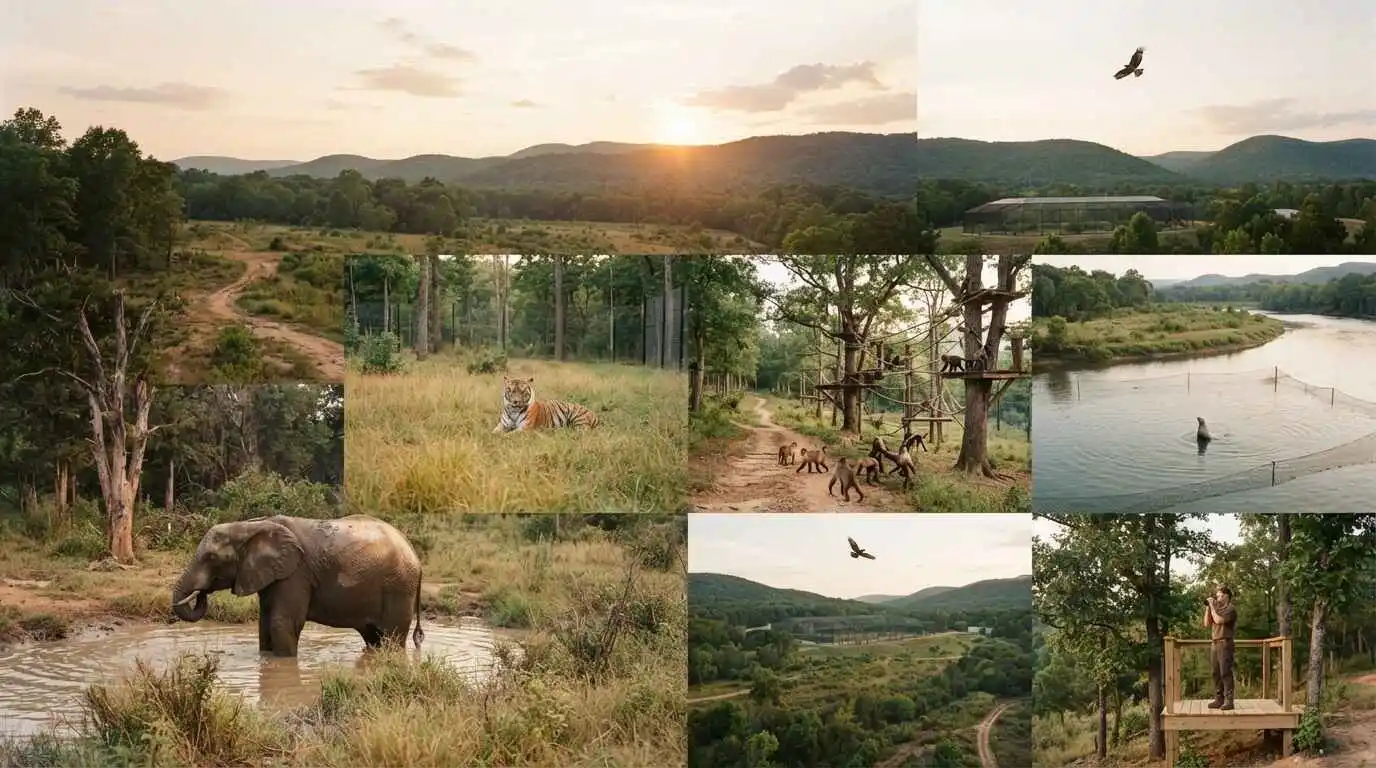
A rescued elephant named Mae Sri stands alone in a field in northern Thailand at dusk, unhurried, unbothered, unwatched except from a wooden platform forty meters away. No one is feeding her by hand. No one is asking her to pose. This, according to the people who run the sanctuary where she lives, is the entire point. It is also, they will tell you, surprisingly rare. Across the world, thousands of facilities call themselves animal sanctuaries. A meaningful fraction of them are not.
The animal sanctuary sector has quietly become one of the more contested spaces in conservation. On one side sits a genuine, expanding movement of accredited facilities doing serious rehabilitative and rewilding work, often in partnership with governments, wildlife authorities, and veterinary science. On the other sits a marketing category, unregulated and freely adopted, that lets roadside zoos, breeding operations, and tourist attractions borrow the word’s warm connotations without adopting any of its obligations. Understanding the difference is no longer a niche concern for conservationists. It’s a basic requirement for anyone who wants their travel dollars, donations, or attention to do what they think it’s doing.
The Word Nobody Regulates
Here is the uncomfortable starting point: in most countries, ‘sanctuary’ is not a protected legal term. Unlike ‘organic’ food labeling or ‘fair trade’ certification, there is no government body that inspects a facility and grants it the right to use the word. A private breeding operation that sells cub-petting experiences can call itself a sanctuary with the same legal freedom as a fully accredited, non-breeding rescue facility that has cared for the same tiger for eleven years without ever letting a paying guest touch it.
This gap is precisely why independent accreditation has become the sector’s de facto regulatory backbone. The Global Federation of Animal Sanctuaries, known as GFAS, is the most widely recognized of these bodies internationally, alongside regional counterparts and species-specific verification programs. Accreditation is not a rubber stamp. Inspectors evaluate enclosure size relative to natural range, veterinary protocols, staff-to-animal ratios, funding stability, euthanasia policy, and — critically — whether the facility breeds animals or permits direct physical contact with paying visitors. Facilities that fail on the latter two points are almost never accredited, regardless of how well they otherwise care for their residents.

The result is a strange asymmetry visible to anyone who looks closely: the sanctuaries doing the most rigorous, least performative work are often the least visually dramatic to visit. There are no elephant rides, no cub selfies, no dolphin high-fives. Visitors watch from a distance. Some facilities have leaned into this as a selling point; others have quietly lost tourist revenue to competitors willing to blur the line.
Elephants and the Industry’s Long Reckoning
No species illustrates this tension more starkly than the elephant, and nowhere more than in Southeast Asia, where an entire tourism economy built around elephant riding and bathing experiences has been undergoing a slow, uneven correction for roughly a decade. The pressure did not originate primarily from animal welfare organizations, though they applied consistent pressure. It came substantially from a shift in traveler expectations, as documentaries and investigative journalism exposed the training methods historically used to make wild elephants tractable enough for tourism — methods that typically involve early-life separation from the mother and physically coercive techniques designed to break resistance.
In response, a wave of facilities rebranded as sanctuaries, and some of that rebranding was genuine. The more credible operations ended riding programs entirely, phased out bathing-with-tourists activities, and shifted their business model toward observation-only visits: watching elephants forage, socialize, and bathe on their own terms from a respectful distance. Others simply renamed the same riding platform a ‘sanctuary experience’ and continued largely unchanged. Distinguishing between the two from a hotel brochure or a search engine listing is nearly impossible; distinguishing between them by asking a direct question about physical contact policy is usually straightforward, because the honest ones answer plainly and the evasive ones change the subject.
The deeper complication is what happens to elephants who cannot go back to the wild. Decades of captivity, logging-industry labor, or tourism work leave many elephants with joint damage, behavioral conditioning, or simply no surviving wild herd to rejoin. For these animals, a well-run sanctuary is not a stepping stone back to nature. It is the rest of their life. That reality reframes the entire sector’s purpose: not every rescue ends in release, and pretending otherwise sets an unrealistic bar that punishes honest facilities for admitting the limits of what rescue can achieve.
The sanctuaries doing the most rigorous work are often the least dramatic to visit — no rides, no selfies, no performances. Just distance, and time.
Big Cats and the Sanctuary-Zoo Blur
If elephants represent the sector’s most visible reform story, big cats represent its most persistent scandal. The proliferation of privately owned tigers, lions, and hybrid cats in facilities calling themselves sanctuaries or rescues has drawn sustained scrutiny from wildlife regulators in multiple countries, driven largely by a simple, damning pattern: breeding cubs specifically to generate a continuous supply of young animals for paid photo and petting experiences, then discreetly disposing of the adults once they became too large and dangerous to handle.
Legitimate big cat sanctuaries operate on the opposite model entirely. They do not breed. Every resident arrives from somewhere else — a confiscation by wildlife authorities, a private owner who could no longer manage a full-grown tiger, a circus or entertainment operation shutting down. Because these facilities never breed, their population is finite and aging, which means funding models built around perpetual cub encounters are structurally incompatible with genuine sanctuary ethics. This is one of the clearest litmus tests available to the public: any facility advertising ongoing access to baby big cats is, definitionally, running a breeding operation, whatever language it uses to describe itself.
Large carnivore sanctuaries also face a rehabilitation reality that is harder than it looks from the outside. Reintroducing a tiger or lion raised in captivity back into wild territory is exceptionally rare, not for lack of will but because territorial competition, lost hunting skills, and the near-certainty of human-wildlife conflict make it close to impossible in most circumstances. The honest framing that credible sanctuaries use with visitors and donors is that they are providing permanent, dignified retirement, not staging a return to the wild that the biology of the situation rarely allows.
Primates: Rethinking What Solitary Care Costs
Primate sanctuaries have undergone one of the more scientifically driven shifts in the sector, largely as a consequence of research into social deprivation. For decades, primates confiscated from the exotic pet trade or retired from biomedical research were often housed individually, partly out of caution about compatibility and partly out of institutional habit. Behavioral research over the past twenty years has made the cost of that approach much harder to ignore: primates are intensely social animals, and isolation produces measurable psychological distress, including self-directed behaviors, depression-like withdrawal, and stereotyped movement patterns rarely seen in socially housed individuals.
The operational consequence has been a shift toward what caretakers describe as slow, deliberate group integration — carefully matching individuals by temperament, species, age, and prior trauma history before attempting to house them together. This process can take months and sometimes fails, requiring re-separation and a new attempt. It is slower and more resource-intensive than simply maintaining separate enclosures, but it has become the accepted best practice among accredited facilities, reflecting a broader trend across the sector: welfare science increasingly drives operational decisions, even when the more convenient option would be cheaper.
Primate sanctuaries are also disproportionately likely to receive animals directly from law enforcement, since exotic primate ownership remains illegal in many jurisdictions yet persists through black-market pet trade and internet-driven demand for ‘cute’ viral content involving baby monkeys. This creates a steady, somewhat unpredictable intake pipeline that sanctuaries must budget and plan space for well in advance, often without knowing exactly when the next confiscation will arrive.
Marine Mammals and the Sea Pen Experiment
Marine mammal sanctuaries are the newest and most technically ambitious frontier in the sector. For decades, retired performing whales and dolphins had essentially one alternative to continued tank life: nothing. The concept of a coastal sea pen sanctuary — a large, netted-off section of natural ocean water, as opposed to a concrete performance tank — has emerged over roughly the last ten years as a serious, if still rare, alternative.
The most closely watched project in this space has involved beluga whales relocated from aquarium and entertainment facilities to open-water bay sanctuaries, where the animals have considerably more space, natural water conditions, and tidal variation than any tank could replicate. Full reintroduction to the open ocean, however, remains a different and much harder proposition, since animals raised or held in captivity for years typically lack the foraging skills, social pod structures, and predator-avoidance instincts needed to survive unsupported in the wild. Most marine mammal sanctuary projects are honest about this limitation, framing their goal as substantially improved welfare rather than a pathway back to full wild independence.
The economics of marine sanctuaries are also uniquely punishing. A sea pen large enough to meaningfully improve a whale’s quality of life requires coastal real estate, specialized net engineering capable of withstanding storms, and continuous water-quality monitoring — costs that dwarf what a terrestrial sanctuary of comparable ambition would spend. This has slowed the model’s expansion considerably, even as demand for alternatives to marine entertainment parks continues to grow.
Rewilding: The Hardest Kind of Success to Measure
Rewilding, the structured process of returning a rehabilitated or captive-raised animal to a wild or semi-wild habitat, is often treated by the public as the sanctuary sector’s ultimate success story. In practice, it is the outcome least often achieved, and the one hardest to verify from the outside. A genuine rewilding program typically involves a phased reduction in human contact, skill-building exercises for foraging or hunting, and extended observation periods in semi-wild enclosures before any release attempt, followed by post-release monitoring, often via tracking collars, to confirm the animal is actually surviving rather than simply having been set free and forgotten.
This is resource-intensive work, and it disproportionately succeeds with species that retain strong instinctual behaviors even after time in captivity — many birds of prey, for instance, respond well to flight-conditioning and often achieve meaningful release rates, particularly when injury rather than long-term captivity was the reason for their arrival. Species that require complex, learned social or hunting behaviors, including many large carnivores and some primates, see release rates that are far lower, and honest sanctuaries increasingly say so publicly rather than overstating their release statistics for marketing purposes.
The sector’s growing comfort with saying ‘this animal will live here permanently’ rather than manufacturing a rewilding narrative for every resident is, somewhat counterintuitively, one of the more encouraging signs of the field maturing. It suggests an industry becoming more willing to be judged on the quality of the care it actually provides, rather than a rescue-to-release story that sounds better in a donation appeal than it holds up in practice.
A World Map of Sanctuary Models
The word ‘sanctuary’ means something noticeably different depending on which continent you’re standing on, and the variation is not just cultural preference — it tracks the specific wildlife crises each region is actually managing. In sub-Saharan Africa, sanctuary work is dominated by great ape rehabilitation, chimpanzee and gorilla orphanages built to absorb infants whose mothers were killed by poachers or habitat loss, often working in direct partnership with national park authorities on eventual soft-release into protected forest reserves. These facilities tend to operate on multi-decade timelines, since a rescued chimpanzee may need ten or more years of gradual socialization and forest skill-building before any release attempt is even considered.
Australia’s sanctuary landscape looks almost nothing like that. Shaped by recurring bushfire seasons and a uniquely fragile marsupial ecology, Australian wildlife sanctuaries skew toward high-volume, short-stay rehabilitation: koalas with burn injuries, orphaned kangaroo joeys, and flying foxes displaced by habitat destruction, with an emphasis on rapid triage, medical stabilization, and, wherever survival odds allow, return to the wild within months rather than years. The country’s fenced predator-free sanctuary model, used to protect small native mammals from introduced cats and foxes, is also a distinct innovation rarely seen elsewhere, essentially recreating a predator-free island on the mainland.
Latin America’s sanctuary sector, by contrast, has grown up around the exotic pet and wildlife trafficking trade, particularly for sloths, small primates, parrots, and big cats confiscated at borders or seized from private homes. Because so many of these animals were taken from the wild as infants and imprinted on humans, release rates are often lower than facilities would prefer, which has pushed several Latin American sanctuaries toward large semi-wild forest enclosures as a middle path between full captivity and a release attempt unlikely to succeed. North American and European sanctuaries, meanwhile, absorb a disproportionate share of the world’s retired entertainment and exotic-pet-trade animals — circus lions, roadside-zoo tigers, backyard primates surrendered after owners realize what a fully grown chimpanzee actually requires — giving those regions a sanctuary population that skews older and more permanently resident than the infant-heavy intake seen in Africa or Latin America.
Farm Animal Sanctuaries: The Overlooked Category
Ask most people to picture a sanctuary and they will describe an elephant, a tiger, or a chimpanzee. Farm animal sanctuaries rarely make that mental list, despite representing one of the fastest-growing segments of the sector over the past fifteen years. These facilities exist specifically for pigs, cows, goats, and poultry rescued from industrial agriculture, abandonment, or, increasingly, backyard livestock operations that failed. Unlike wildlife sanctuaries, there is no release component at all; the animals in question are domesticated breeds with no wild habitat to return to, so the entire mission is centered on lifetime care and, frequently, public education about the realities of animal agriculture.
The welfare science underlying farm sanctuary work differs from wildlife rehabilitation in a specific, important way: many resident animals were selectively bred for rapid growth or high production yields, which creates chronic health problems, joint strain from unnatural body weight, or cardiac issues that persist regardless of care quality. Caretakers at these facilities often describe their job as managing genetically engineered health limitations for an animal’s entire natural lifespan, rather than treating an injury and eventually stepping back. It is a quieter, less photogenic corner of the sanctuary world, but it has developed its own accreditation standards, its own veterinary specialties, and its own donor base, largely built around visitors who leave a visit rethinking where their food comes from.
The Economics Behind the Fence
Running a genuine sanctuary is expensive in ways that are not obvious from the outside, and the funding model has significant downstream effects on how a facility treats its animals and its visitors. Intake alone can be costly: a confiscated or surrendered exotic animal frequently arrives with untreated medical conditions, malnutrition, or injuries from prior captivity, and veterinary stabilization before an animal is even settled into permanent housing can run into substantial figures for larger species.
Ongoing costs then compound. Large carnivores and elephants require enormous daily food volumes; primates need enrichment programs and, increasingly, expensive group-integration efforts; marine mammals require specialized water systems. Sanctuaries typically fund this through a blend of visitor admission fees, individual animal sponsorship or adoption programs aimed at recurring small donors, grant funding from conservation foundations, and — for the larger, more established institutions — corporate partnerships. This mixed funding model creates a persistent tension: facilities that rely heavily on visitor admission revenue face real financial pressure to make visits more entertaining, which is exactly the pressure that pushes some operators toward the physical-contact experiences that welfare science and accreditation bodies discourage.
The most financially resilient sanctuaries have generally solved this by diversifying away from ticket-price dependency, building sponsorship bases large enough that the facility does not need to compromise on animal contact policy to stay solvent. This is one reason accreditation bodies increasingly evaluate funding structure as part of the welfare assessment, not as a separate financial question — the two are, in practice, inseparable.
What a Responsible Visit Actually Looks Like
For a traveler trying to make a good decision, the practical filters are narrower and more useful than they might initially seem. First, check for independent accreditation rather than relying on a facility’s self-description; GFAS and comparable regional bodies publish member lists that are simple to search before booking. Second, look specifically at the facility’s stated policy on physical contact — riding, bathing, petting, or photo sessions with wild animals are close to universally discouraged by welfare-focused accreditation standards, so their presence is a reliable warning sign rather than a neutral feature. Third, ask, even briefly, where the animals came from; a facility that can answer clearly and specifically, naming rescues, confiscations, or surrenders, is behaving very differently from one that gives a vague answer or changes the subject.
It is also worth holding some intellectual honesty about the limits of any single visit’s insight. A well-run facility on a good day and a poorly run facility on a good day can look similar to an untrained visitor over the course of an hour-long tour. This is precisely why the sector has moved toward institutional accreditation rather than word-of-mouth reputation as the more dependable signal, even though it requires slightly more research before a trip than simply picking the highest-rated option on a travel app.
None of this resolves the deeper philosophical debate that continues to run through conservation circles: whether any facility holding wild animals in bounded space, however humane and well-funded, can truly meet needs that evolved for open, unmanaged habitat. Reasonable people in the field disagree, and that disagreement is unlikely to be settled soon. What has become clearer, in the meantime, is the difference between sanctuaries built around an animal’s needs and sanctuaries built around a visitor’s expectations. The industry’s better instincts, however unevenly applied, increasingly point toward the former.
Mae Sri will likely spend the rest of her life in that field in northern Thailand, unridden, unbothered, and largely unseen up close by the people who fund her care. Measured against the louder, more photogenic version of what a sanctuary is supposed to look like, that might seem like an underwhelming outcome. Measured against what she actually needs, it may be closer to the point the entire sector is still learning to make.
Frequently Asked Questions
| Question | Answer |
| 1. What legally separates an animal sanctuary from a zoo? | A sanctuary’s stated purpose is lifetime care and, where possible, release of rescued or displaced animals rather than public exhibition or breeding for display, though enforcement of that distinction varies by country and accreditation body. |
| 2. What is GFAS accreditation and why does it matter? | The Global Federation of Animal Sanctuaries is an independent body that verifies a facility meets welfare, ethics, and operational standards; its seal is one of the few reliable third-party checks a visitor can look for. |
| 3. Can I tell a real sanctuary from a ‘sanctuary-washed’ tourist attraction? | Warning signs include direct physical contact with wild animals, paid photo ops, performances or tricks, and breeding programs, since genuine sanctuaries generally minimize human contact and never breed animals for entertainment. |
| 4. Why do so many facilities call themselves sanctuaries without qualifying? | The word ‘sanctuary’ is not a protected or regulated term in most jurisdictions, so any facility can adopt it regardless of practices, which is why independent accreditation matters more than the name on the gate. |
| 5. Are elephant sanctuaries in Southeast Asia actually cruelty-free? | Standards vary widely; the most credible ones ended riding and bathing-with-tourists programs, since even ‘gentle’ handling for tourism often still requires early-life training methods that involve physical coercion. |
| 6. What happens to animals that cannot be released back into the wild? | Many rescued animals have permanent injuries, were captive-bred, or have lost survival skills, so they live out their lives at the sanctuary under managed care rather than returning to a wild habitat. |
| 7. How are big cat sanctuaries funded? | Most rely on a mix of visitor admission fees, adoption or sponsorship programs for individual animals, grants, and private donations, since intake and veterinary costs for large carnivores are substantial. |
| 8. What is a rewilding program, specifically? | Rewilding refers to a structured process of reintroducing captive-raised or rehabilitated animals to a wild or semi-wild habitat, often involving a phased reduction in human contact and skill-building for foraging or hunting. |
| 9. Why do primate sanctuaries emphasize social groups over solitary housing? | Primates are highly social species, and isolation from conspecifics is now understood to cause measurable psychological distress, so contemporary sanctuaries prioritize compatible group housing wherever possible. |
| 10. Do marine mammal sanctuaries exist, and how do they differ from aquariums? | Coastal sea pen sanctuaries have emerged for retired performing whales and dolphins, offering large enclosed ocean water areas instead of concrete tanks, though full reintroduction to open ocean remains rare and heavily debated. |
| 11. Is it ethical to visit any facility that keeps wild animals? | Opinion is divided; some conservationists argue well-run sanctuaries serve an educational and rehabilitative purpose, while others contend that any captivity, however humane, cannot fully replicate a wild animal’s needs. |
| 12. What should a first-time visitor look for before booking a visit? | Checking for third-party accreditation, reading the facility’s policy on physical contact, and looking for transparency about where animals came from are the three most reliable filters. |
| 13. How do sanctuaries handle animals confiscated from illegal wildlife trade? | Confiscated animals typically arrive through partnerships with wildlife authorities and customs agencies, and sanctuaries assess health, socialization needs, and release feasibility before assigning long-term housing. |
| 14. What role do sanctuaries play in species conservation beyond individual animal care? | Some participate in studbook-managed breeding for genuinely endangered species, genetic diversity tracking, and field conservation partnerships, extending their mission beyond rescue into population-level recovery. |
| 15. Are volunteer or ‘voluntourism’ placements at sanctuaries worthwhile? | Quality varies enormously; reputable programs limit unskilled volunteers’ direct animal contact and instead assign habitat maintenance or administrative tasks, while less scrupulous operations may prioritize fees over animal welfare. |
| 16. How much does it typically cost to sponsor a rescued animal? | Sponsorship programs commonly range from modest monthly contributions to larger annual packages, with funds typically allocated to feeding, veterinary care, and habitat maintenance for a specific named animal. |
| 17. What happens to sanctuary animals during natural disasters? | Facilities in disaster-prone regions maintain emergency evacuation and shelter-in-place protocols, though logistics for large or dangerous species can make evacuation extremely difficult, sometimes leaving shelter-in-place as the only option. |
| 18. Do sanctuaries work with local communities near their sites? | Many invest in community education, offer local employment, and run conflict-mitigation programs, since sustained coexistence with nearby human populations is often essential to a sanctuary’s long-term viability. |
| 19. What is the biggest misconception people have about sanctuaries? | A common misconception is that any hands-on interaction, like bottle-feeding or petting, indicates good welfare practice, when in fact minimal human interference is typically the higher ethical standard. |
| 20. How do sanctuaries decide which animals to accept? | Intake decisions weigh species compatibility with existing residents, available habitat space, medical needs, and funding capacity, meaning even well-resourced sanctuaries must sometimes decline new arrivals. |
| 21. Can sanctuaries reintroduce large carnivores like tigers or lions to the wild? | Reintroduction of large carnivores is exceptionally rare and complex due to territorial needs, prey-hunting skill loss, and human-wildlife conflict risk, so most such rescues remain lifetime sanctuary residents. |
| 22. What is the difference between a rescue center and a long-term sanctuary? | Rescue centers are often geared toward short-term stabilization, treatment, and rehoming or release, while sanctuaries are generally structured for indefinite or lifetime residency. |
| 23. How do bird sanctuaries differ operationally from mammal-focused ones? | Bird sanctuaries often emphasize flight-conditioning aviaries, injury rehabilitation for wing and migratory issues, and in many cases higher release rates than large-mammal facilities. |
| 24. Are there sanctuaries dedicated to farm animals rather than wildlife? | Farm animal sanctuaries exist specifically for animals rescued from agricultural industries or abandonment, focusing on lifetime care for species like pigs, cows, and poultry rather than wild rehabilitation or release. |
| 25. What training do sanctuary caretakers typically need? | Caretaker backgrounds commonly include veterinary technology, wildlife biology, or zoology, supplemented by species-specific handling training required by accrediting bodies. |
| 26. How transparent are sanctuaries expected to be about animal deaths? | Reputable sanctuaries typically disclose mortality information to accrediting bodies and, in many cases, to the public, viewing transparency as part of earning donor and visitor trust. |
| 27. Do sanctuaries participate in scientific research on their resident animals? | Some permit non-invasive behavioral or health research, particularly studies that inform welfare improvements, while invasive or stress-inducing research is generally prohibited under sanctuary ethics codes. |
| 28. What is ‘enrichment’ in a sanctuary context? | Enrichment refers to structured environmental or behavioral activities, like scent trails, puzzle feeders, or varied terrain, designed to stimulate natural behaviors and reduce captivity-related stress. |
| 29. How do sanctuaries handle overcrowding or funding shortfalls? | Options include waitlisting new intakes, expanding fundraising and grant applications, or in some cases transferring animals to partner facilities with available capacity. |
| 30. What long-term trend is reshaping the sanctuary model globally? | There is a growing shift toward larger, semi-wild enclosures and reduced human-animal contact protocols, reflecting an industry-wide move away from the more exhibition-oriented sanctuary models of past decades. |
Disclaimer: The content on this blog is for informational purposes only. The author’s opinions are personal and not endorsed. Efforts are made to provide accurate information, but completeness, accuracy, or reliability are not guaranteed. The author is not liable for any loss or damage resulting from the use of this blog. It is recommended to use the information on this blog at your own discretion.
