
Table of Contents
The Gentle Giant That Isn’t: What the Moose Doesn’t Want You to Know
Inside the biology, behavior, and quiet danger of the largest deer on Earth
From a distance, a moose looks almost comical. The legs are too long, the nose droops like it was borrowed from another animal entirely, and the whole silhouette seems assembled from spare parts rather than designed. That impression lasts right up until the moment a full-grown bull, standing taller at the shoulder than most doorframes, turns to look directly at you, and the comedy evaporates. The moose is the largest member of the deer family on the planet, an animal capable of moving through dense boreal forest in near silence and capable, when provoked, of causing more human injuries in parts of North America each year than bears do.
This is an animal defined by contradictions. It is a herbivore with no interest in predation, yet it is responsible for a surprising number of serious encounters with people, mostly not through aggression but through sheer size, unpredictability, and the simple fact that a startled thousand-pound animal in the wrong place at the wrong time is dangerous almost by accident. It thrives in some of the coldest, harshest landscapes on the continent, wading through frozen lakes and deep snow that would stop most other large mammals cold, while also being acutely vulnerable to heat, ticks, and a warming climate in ways that are only becoming fully understood.
This guide moves through what a moose actually is biologically, where it lives and why, what it eats and how that diet shapes its entire body, the extraordinary story of its antlers, its social and mating behavior, the real risks of a close encounter and how to handle one safely, the predators and threats it faces, how calves are raised, and where moose populations stand today across their range. The goal is a complete, practical picture of an animal that most people recognize instantly but understand only in outline.

What Exactly Is a Moose
The moose, known scientifically as Alces alces, belongs to the deer family, Cervidae, making it a close relative of elk, deer, and caribou despite looking dramatically different from all of them. It holds the title of largest living species in that family by a wide margin. Adult bulls commonly stand between five and a half and six and a half feet tall at the shoulder and can weigh anywhere from around eight hundred to well over fifteen hundred pounds depending on subspecies, age, and region, with the largest individuals recorded in Alaska and eastern Russia.
Several physical traits set the moose apart immediately. The long, drooping snout houses a highly flexible upper lip that the animal uses almost like a limited hand, wrapping it around twigs and aquatic vegetation to pull food toward the mouth. A flap of skin called a dewlap, sometimes called a bell, hangs beneath the throat, and its exact function remains a subject of ongoing debate among biologists, with theories ranging from scent dispersal during the mating season to visual signaling of health and size to potential mates or rivals. Long legs, disproportionate to the rest of the body at first glance, are in fact a precise adaptation, allowing the moose to wade through deep snow, marshland, and water with far less effort than a shorter-legged animal of similar bulk.
Moose are generally solitary animals outside of the mating season, a trait that distinguishes them from many other deer species that gather in herds. This solitary nature, combined with excellent camouflage in dense brush despite their size, means moose can be remarkably difficult to spot even in areas where they are common, right up until an observer is far closer than expected.
Where Moose Live and Why
Moose inhabit the boreal and mixed deciduous forests of the Northern Hemisphere, with populations spanning North America, Scandinavia, and Russia. In North America, their range covers most of Canada and Alaska, extending south into the northern United States, including New England, the Great Lakes region, the Rocky Mountains, and parts of the Pacific Northwest, wherever cold winters and appropriate forest and wetland habitat coincide.
The defining feature of good moose habitat is not simply forest, but a specific mix of dense cover for shelter and open, wet areas, ponds, marshes, and slow rivers, that support the aquatic and shrub vegetation moose depend on for food. Young, regenerating forest following fire or logging is often prime moose habitat, since it produces the dense growth of saplings and shrubs that mature, closed-canopy forest does not. This is one of the more counterintuitive facts about moose ecology: they frequently benefit from disturbance, whether natural or human-caused, rather than requiring untouched old-growth wilderness.
Temperature plays an outsized role in where moose thrive. Moose are extremely well insulated, with a dense double coat of hollow guard hairs over soft underfur that traps heat with remarkable efficiency, an adaptation built for surviving deep winter cold. That same insulation becomes a serious liability in warm weather. Moose begin experiencing heat stress at temperatures many other mammals would find entirely comfortable, generally in the range of the mid-fifties Fahrenheit in winter coat and somewhat higher in summer coat, and sustained heat stress forces them to reduce feeding and movement, which has real consequences for body condition and reproduction, one of several reasons climate change is reshaping moose range at the southern edges of their distribution.
“A moose can run at roughly thirty-five miles per hour and, unlike a bear, the right response to a charge is almost always simple retreat behind a solid obstacle.”
Diet, Digestion, and a Body Built for Browsing
Moose are herbivores and dedicated browsers, meaning they feed primarily on the leaves, bark, and twigs of woody plants rather than grazing on grasses the way deer or elk often do. A typical adult moose eats an enormous volume of vegetation daily during the warmer months, sometimes exceeding fifty or sixty pounds, reflecting both their large body size and the relatively low nutritional density of much of their diet.
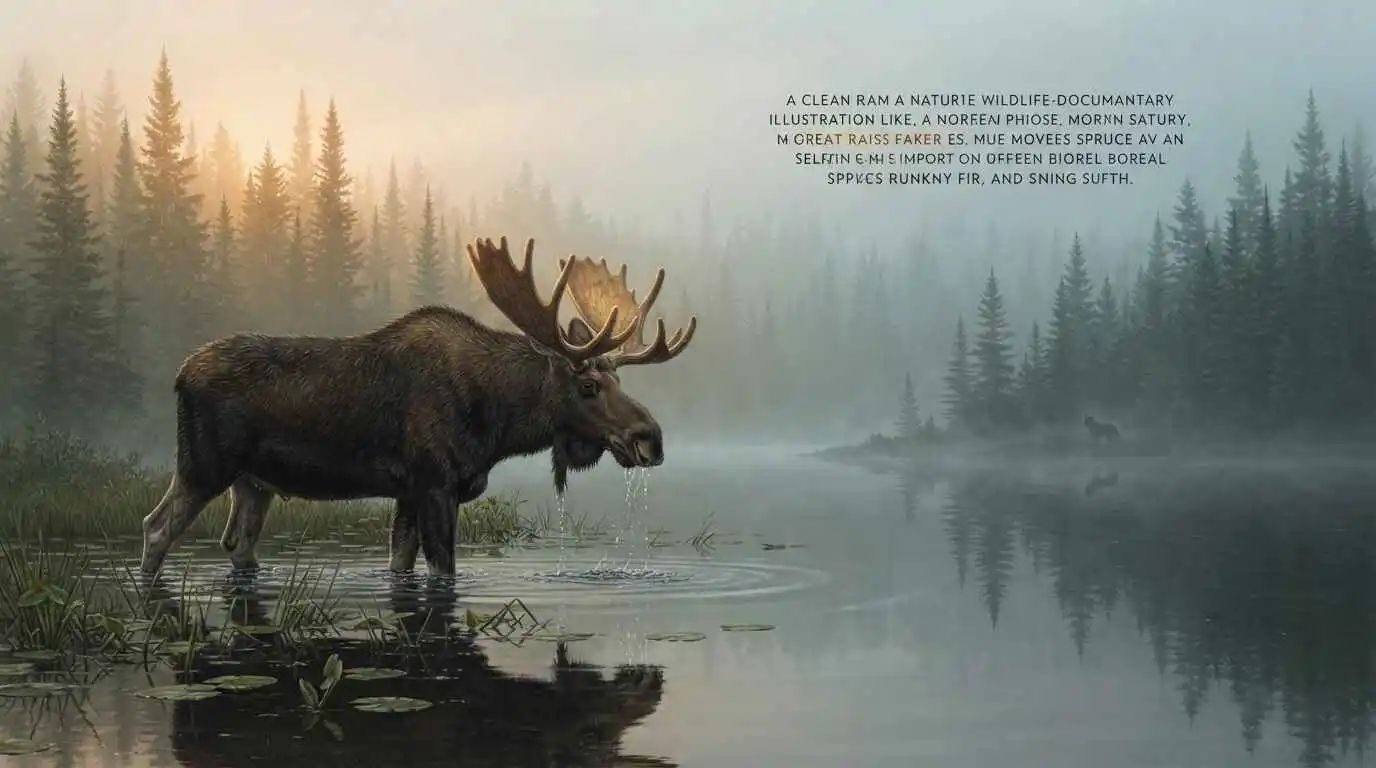
Willow, birch, aspen, and balsam fir rank among their preferred browse species, and moose show a strong seasonal shift in feeding strategy. In summer, they turn heavily to aquatic plants, wading into ponds and slow-moving water to feed on pondweed, water lilies, and other submerged vegetation. This is not incidental; aquatic plants are unusually rich in sodium, a mineral scarce in the moose’s typical terrestrial diet, and moose have been observed diving completely underwater, staying submerged for close to a minute, specifically to reach these plants, an unusual behavior among large land mammals.
As a ruminant, the moose possesses a four-chambered stomach that allows it to digest tough, fibrous plant material through microbial fermentation, regurgitating and re-chewing cud much like cattle. This digestive strategy is essential given how much lower-quality woody browse makes up their diet, particularly through the long winter months when moose survive largely on twigs and bark, a diet that provides enough energy to persist but is rarely enough to support significant weight gain, which is why moose enter winter as heavy as possible and typically emerge from it visibly leaner.
This seasonal feast-and-fast pattern shapes nearly every other aspect of moose biology, from the timing of the antler cycle to the scheduling of the rut and birth of calves, all synchronized to make the greatest possible use of the short window when high-quality forage is abundant. A moose that enters winter underweight, whether due to drought, poor summer forage, or a heavy parasite load, faces a measurably higher risk of not surviving to spring, which is one of the reasons wildlife biologists treat late-summer body condition as one of the more reliable predictors of regional population health.
Antlers: Growth, Purpose, and the Annual Cycle
Perhaps no feature captures public fascination with moose more than the antlers of a mature bull, which can span up to six feet across and weigh as much as forty pounds, among the largest antlers of any living animal. Unlike horns, which are permanent, antlers are shed and regrown entirely every single year, an extraordinary feat of biological growth that ranks among the fastest tissue growth known in mammals.
The annual cycle begins in spring, when new antlers emerge from the skull as soft, blood-vessel-rich tissue covered in a fuzzy skin called velvet, which supplies the nutrients and oxygen needed for rapid growth. Through summer, antlers can grow at a startling pace, sometimes close to an inch per day at peak growth, fueled by the bull’s summer diet of energy-rich vegetation. By late summer, growth stops, the velvet dries and is rubbed off against trees and shrubs, revealing the hardened bone antler underneath, typically timed just ahead of the autumn breeding season.
Antlers serve two main purposes: visual signaling of size, health, and genetic quality to potential mates and rivals, and physical weaponry during competition among bulls for access to females during the rut. After the breeding season ends and hormone levels drop, the connective tissue at the base of the antler weakens and the antlers are shed, usually in early to mid-winter, leaving the bull antlerless until the cycle begins again in spring. Interestingly, female moose, unlike some other deer species, do not typically grow antlers at all, a distinction from species like caribou where females commonly do.
The Rut and Social Behavior
Outside of breeding season, moose are largely solitary and somewhat territorial in a loose sense, tolerating overlapping ranges with other moose but generally avoiding close, sustained contact. That changes dramatically each autumn during the rut, the breeding season, typically running from September into October depending on latitude, when bulls become far more active, vocal, and aggressive.
During the rut, bulls compete for access to receptive females through a combination of vocalizations, scent marking, and, when necessary, direct physical combat using their antlers. Bulls create wallows, shallow depressions in the ground soaked with urine, and roll in them, spreading a strong scent believed to signal reproductive status to females in the area. Cow moose in estrus produce distinctive calls, and bulls respond with grunting vocalizations of their own, an auditory exchange that experienced hunters and wildlife observers use to locate animals during this period.
Physical clashes between competing bulls, while less common than posturing and vocal displays, do occur and can be serious, with antlers locking together and contests of strength deciding access to a female. This is also the period of the year when bulls are at their most unpredictable and potentially dangerous to humans, since elevated testosterone and single-minded focus on competition and mating lower their tolerance for perceived threats or interference, a critical fact for anyone hiking or camping in moose country during early autumn.
Moose and Humans: An Underestimated Danger
Moose are not predators and have no interest in hunting people, yet they are involved in a disproportionately high number of dangerous wildlife encounters in regions where their range overlaps with human activity, notably in parts of Alaska and Scandinavia. The reason has less to do with aggression in the way people imagine it from a predator and more to do with size, speed, and a very different threshold for feeling threatened.
A moose that feels cornered, surprised at close range, or accompanied by a calf, in the case of a cow, can charge with startling speed, capable of running at roughly thirty-five miles per hour over short distances despite its bulk. Unlike a bear encounter, where standing your ground or playing dead are sometimes appropriate depending on species and circumstance, the correct response to an aggressive moose is almost always to retreat immediately, ideally putting a solid object like a tree, vehicle, or building between yourself and the animal, since moose generally will not pursue past an obstacle once the immediate threat feels resolved.
Warning signs of an agitated moose include raised hackles along the back of the neck, ears pinned back, lip smacking, and a lowered head, all of which should be treated as a clear signal to leave the area calmly and without running directly toward the animal or making sudden movements. Dogs are a particularly common trigger for moose aggression, since moose appear to instinctively associate dogs with wolves, their natural predator, and off-leash dogs approaching a moose have caused a significant share of serious moose-related injuries. The safest general practice in moose country is simple: keep a wide distance, never approach a calf even if it appears alone, since the mother is very likely nearby and highly protective, and treat any moose showing agitation as a reason to retreat rather than observe more closely.
Predators, Threats, and Survival Challenges
Adult moose have few natural predators capable of reliably taking them down given their size and power, but wolves and, in parts of their range, brown bears represent the primary threat, typically targeting calves, injured animals, or those weakened by poor nutrition, disease, or deep snow that limits mobility. Wolf packs in particular have been extensively studied hunting moose, and the dynamic between wolf and moose populations in places like Isle Royale National Park has become one of the most closely observed predator-prey relationships in wildlife ecology.
Beyond direct predation, moose face a growing list of pressures tied to environmental change. Winter ticks have emerged as one of the most serious threats to moose populations in parts of their southern range, particularly in New England. A single moose can carry tens of thousands of these parasites through a single winter, causing severe blood loss, hair loss from excessive rubbing and grooming, and in extreme cases, death from anemia and exposure, a condition sometimes visually striking enough that affected animals are informally described as ghost moose due to the pale, patchy coat left behind after hair loss.
Winter tick outbreaks have been directly linked to warming trends that shorten the winter window during which ticks would normally die off, allowing populations to explode. Combined with the heat stress moose experience even in moderately warm weather, changing precipitation patterns, and shifts in forest composition, climate change is increasingly recognized as one of the central long-term challenges facing moose populations at the southern edge of their range, even in areas where hunting pressure and habitat loss remain relatively well managed.
Calves and Reproduction
Following a gestation period of roughly eight months, cow moose typically give birth in late spring, usually May or early June, timed to coincide with the emergence of abundant fresh vegetation needed to support milk production. First-time mothers usually give birth to a single calf, while experienced, well-nourished cows frequently produce twins, and in rare cases with exceptional body condition, even triplets.
Moose calves are born with remarkably long legs relative to their body, mirroring the adult form, and are capable of standing and walking within hours of birth, a critical adaptation given the presence of predators in most moose habitat. Cows are famously protective of their calves during this early period, and this maternal aggression accounts for a significant portion of dangerous human-moose encounters each spring and early summer, making it one of the most important seasonal safety considerations for anyone spending time in moose habitat.
Calves nurse for several months and begin sampling vegetation within their first few weeks, gradually transitioning to a fully independent diet by autumn, though they typically remain close to their mother through their first year. Young moose are driven off by the cow shortly before she gives birth again the following spring, at which point they must establish their own range, a vulnerable transitional period when young moose face elevated risk from predators and unfamiliar terrain.
Population Status and Conservation Outlook
Globally, the moose is not considered endangered, and healthy, well-managed populations exist across much of Scandinavia, Russia, Canada, and Alaska, where regulated hunting, habitat management, and relatively intact boreal forest support stable or even locally abundant numbers. Regional pictures vary considerably, however, and several areas at the southern edge of the species’ range have seen concerning declines over the past two decades.
Minnesota and New Hampshire, among other northeastern and upper midwestern states, have documented substantial population drops attributed to a combination of winter tick infestations, brainworm, a parasite carried by white-tailed deer that is generally harmless to deer but often fatal to moose, and the broader effects of a warming climate on habitat suitability and animal condition. Wildlife agencies in affected regions have responded with adjusted hunting quotas, expanded research into tick and disease dynamics, and habitat management aimed at supporting healthier, more resilient populations.
Conservation efforts increasingly focus on landscape-level thinking, maintaining the mix of young, regenerating forest and mature cover moose need, monitoring disease and parasite loads, and, in some regions, exploring how forest management and even prescribed fire can support moose habitat resilience under a changing climate. The overall trajectory for moose as a species remains stable at the global level, but the pattern emerging at the southern margins of their range serves as a closely watched indicator of how climate-sensitive large mammals are responding to a warming world, and it has made the moose something of an unofficial barometer species for boreal forest health more broadly.
The Takeaway
The moose occupies an unusual place among large wild animals: instantly recognizable, broadly beloved as a symbol of the northern wilderness, and yet genuinely misunderstood in ways that matter, both for appreciating the animal and for staying safe around it. It is neither the docile forest icon of postcards nor a predator to fear in the way a bear or wolf might be feared, but a powerful, specialized herbivore whose size and unpredictability demand real respect, particularly during the rut and calving season. Understanding how it feeds, why its antlers grow the way they do, how it responds to perceived threats, and the mounting environmental pressures it faces at the edges of its range turns a roadside curiosity into what it actually is: one of the more remarkable large mammals left on the continent, and one whose future is more closely tied to a changing climate than most people realize.
| Frequently Asked Questions |
| Q1. What is the scientific name for a moose?
The moose is scientifically classified as Alces alces, a member of the deer family, Cervidae. |
| Q2. Is a moose the largest member of the deer family?
Yes, the moose is the largest living species in the deer family, with bulls in some regions weighing over fifteen hundred pounds. |
| Q3. How tall is an adult moose?
Adult bulls typically stand between five and a half and six and a half feet tall at the shoulder, depending on subspecies and region. |
| Q4. What is the flap of skin under a moose’s throat called?
It is called a dewlap or bell, and its precise function is still debated among biologists, with theories involving scent dispersal and visual signaling. |
| Q5. Do both male and female moose grow antlers?
No, typically only bulls grow antlers, while cows do not, which distinguishes moose from some other deer species like caribou. |
| Q6. How fast do moose antlers grow?
Antlers can grow at a remarkable pace during peak summer growth, sometimes close to an inch per day, making them among the fastest-growing tissue in mammals. |
| Q7. Why do moose shed their antlers every year?
Antlers are shed annually after the breeding season as hormone levels drop, and new antlers regrow from scratch each spring. |
| Q8. What do moose eat?
Moose are herbivorous browsers that feed on leaves, bark, and twigs of woody plants, along with aquatic vegetation rich in sodium during summer. |
| Q9. Can moose swim and dive underwater?
Yes, moose are strong swimmers and can dive completely underwater, sometimes for close to a minute, to reach submerged aquatic plants. |
| Q10. Where do moose live?
Moose inhabit boreal and mixed forests across North America, Scandinavia, and Russia, typically where dense cover and wetland vegetation coexist. |
| Q11. Do moose prefer cold or warm climates?
Moose are highly adapted to cold climates and begin experiencing heat stress at surprisingly moderate temperatures, making them vulnerable to warming trends. |
| Q12. What time of year is the moose rut?
The rut, or breeding season, generally occurs from September into October, varying somewhat by latitude. |
| Q13. Are moose dangerous to humans?
Yes, moose can be dangerous, not through predatory aggression but due to their size, speed, and tendency to charge when startled, cornered, or protecting a calf. |
| Q14. How fast can a moose run?
A moose can run at roughly thirty-five miles per hour over short distances despite its large size. |
| Q15. What should you do if a moose charges you?
Retreat immediately and put a solid obstacle, such as a tree or vehicle, between yourself and the animal, since moose generally will not pursue past an obstacle. |
| Q16. What are the warning signs of an agitated moose?
Raised hackles, pinned-back ears, lip smacking, and a lowered head are common signs that a moose feels threatened and may charge. |
| Q17. Why are dogs a particular risk around moose?
Moose appear to instinctively associate dogs with wolves, their natural predator, which can trigger defensive aggression, especially from off-leash dogs. |
| Q18. Do moose have natural predators?
Wolves and, in parts of their range, brown bears are the primary predators, typically targeting calves, injured, or weakened moose. |
| Q19. What are winter ticks and why are they dangerous to moose?
Winter ticks are parasites that can infest a single moose by the tens of thousands, causing severe blood loss, hair loss, and sometimes death from anemia. |
| Q20. What is a ghost moose?
It is an informal term for a moose with a pale, patchy coat caused by excessive hair loss from rubbing off severe winter tick infestations. |
| Q21. How is climate change affecting moose populations?
Warmer winters allow winter tick populations to explode, and moose also experience heat stress at moderate temperatures, both of which harm population health at the southern edge of their range. |
| Q22. How long is a moose’s gestation period?
Gestation lasts roughly eight months, with calves typically born in late spring. |
| Q23. Do moose usually have one calf or more?
First-time mothers typically have a single calf, while experienced, well-nourished cows often produce twins and occasionally triplets. |
| Q24. How soon can a moose calf walk after birth?
Moose calves can stand and walk within hours of birth, an important adaptation given the presence of predators in their habitat. |
| Q25. Are moose solitary or social animals?
Moose are generally solitary outside of the breeding season, unlike many other deer species that form herds. |
| Q26. What is brainworm and how does it affect moose?
Brainworm is a parasite carried by white-tailed deer that is usually harmless to them but often fatal to moose, contributing to population declines in some regions. |
| Q27. Is the moose considered an endangered species?
No, moose are not globally endangered, though some regional populations, particularly in the northeastern United States, have declined significantly. |
| Q28. Why do moose wade into ponds and lakes?
They wade and dive to feed on aquatic plants like pondweed and water lilies, which provide sodium that is scarce in their typical woody diet. |
| Q29. What is a moose wallow?
A wallow is a urine-soaked depression in the ground that bulls create and roll in during the rut to spread scent believed to signal reproductive status. |
| Q30. Should you approach a moose calf that appears alone?
No, the mother is very likely nearby and highly protective, and approaching a calf significantly increases the risk of a dangerous encounter. |
Disclaimer: The content on this blog is for informational purposes only. The author’s opinions are personal and not endorsed. Efforts are made to provide accurate information, but completeness, accuracy, or reliability are not guaranteed. The author is not liable for any loss or damage resulting from the use of this blog. It is recommended to use the information on this blog at your own discretion.
