
Table of Contents
Bahrain Triumphs in Thrilling Gulf Cup Final | A Historic Victory Sparks Nationwide Celebrations
Bahrain Wins the Gulf Cup:
Bahrain has emerged victorious in the 26th Arabian Gulf Cup, defeating Oman 2-1 in a thrilling final held at the Jaber Al-Ahmad International Stadium in Kuwait City. The match saw Bahrain come from behind after Oman took an early lead with a goal from Abdulrahman Al-Mushaifri in the 17th minute. However, Bahrain equalized in the 79th minute with a penalty converted by Mohamed Marhoon, followed by a second goal just two minutes later, which was an own goal by Oman’s Mohamed Al-Musalami.
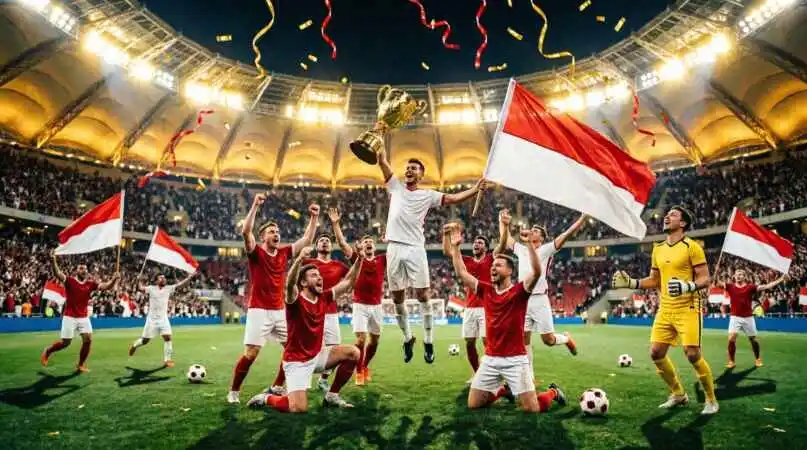
Celebrations and National Pride: The victory sparked widespread celebrations among Bahraini fans, with nearly 60,000 supporters present at the stadium. The Bahraini government declared a public holiday on January 5 to allow fans to celebrate and attend the match without work-related concerns. Social media buzzed with excitement as fans organized various support activities leading up to the final.
Regional Recognition: Following Bahrain’s win, leaders from across the Gulf region congratulated the nation. UAE President Sheikh Mohamed bin Zayed Al Nahyan praised both teams for their performances and commended the successful organization of the tournament by Kuwait.
Future of the Tournament: The tournament has been deemed a success, attracting over 450,000 fans throughout its duration. The next edition of the Arabian Gulf Cup is set to take place in Saudi Arabia in September 2026.
The Turning point

The turning point in the Gulf Cup final occurred in the 76th minute when Bahrain was awarded a penalty after Mohammed Marhoon was fouled by Jameel Al-Yahmadi. Marhoon successfully converted the penalty, leveling the score at 1-1. This moment shifted the momentum in favor of Bahrain, as they quickly capitalized on their newfound energy. Just two minutes later, in the 78th minute, a cross from Marhoon deflected off Omani defender Mohamed Al-Musalami into the net, giving Bahrain a dramatic 2-1 lead. This quick succession of events not only turned the tide of the match but also secured Bahrain’s victory in the final.
Tactical Masterclass: How Bahrain’s Strategic Nuances Dismantled Oman in the Gulf Cup Final
The Gulf Cup final is traditionally a high-stakes, emotionally charged affair, where regional pride and footballing philosophy collide. In the recent championship match, Bahrain secured a hard-fought 2-1 victory over Oman. While the final scoreline suggests a closely contested affair, a deeper tactical analysis reveals that the match was ultimately decided by a stark divergence in strategic approaches. Bahrain’s pragmatic, adaptable, and highly disciplined game plan systematically neutralized Oman’s expansive, possession-based ambitions.
Here is a detailed breakdown of the four key strategic differences that dictated the outcome of the final.
- Defensive Resilience vs. Offensive Pressure: A Clash of Philosophies
From the opening whistle, the contrasting tactical identities of the two nations were evident. Oman entered the final with a clear mandate: to dominate possession, dictate the tempo, and suffocate Bahrain through sustained offensive pressure. They utilized a high defensive line and committed numbers forward, successfully probing Bahrain’s flanks and eventually reaping the rewards with an early goal. This initial success validated their game plan, but it also planted the seeds of their eventual downfall.
Conversely, Bahrain adopted a highly disciplined, resilient defensive posture. Recognizing Oman’s attacking intent, Bahrain’s coaching staff set up a compact mid-to-low block. The defensive and midfield lines remained tightly spaced, denying Oman the central passing lanes required to break them down. Rather than chasing the ball fruitlessly, Bahrain focused on structural integrity, forcing Oman into wide, low-percentage crosses that were easily dealt with by Bahrain’s organized center-backs.
Crucially, Bahrain’s defense was not purely reactive; it was the foundation of their attack. By absorbing Oman’s early pressure, Bahrain invited the opposition to overcommit. This created vast spaces behind Oman’s advanced fullbacks, which Bahrain’s pacey wingers were primed to exploit on the counter-attack. While Oman’s offensive pressure yielded an early goal, it left them perpetually vulnerable to the transitional speed that Bahrain weaponized throughout the 90 minutes.
- The Art of Set-Piece Utilization: Preparation Meets Execution
In tightly contested finals, open-play goals are often scarce, making set pieces a critical strategic weapon. Bahrain demonstrated a superior level of preparation and clinical execution in these dead-ball situations, which proved to be a decisive factor in the match.
The turning point of the game arrived via a penalty kick. While winning a penalty often involves an element of chaos or individual error from the opposition, converting it in a high-pressure final requires immense psychological fortitude. Bahrain’s designated taker displayed remarkable composure, transforming a fleeting opportunity into a crucial equalizer. This moment highlighted Bahrain’s broader focus on maximizing every available advantage, no matter how small.
Oman, despite their dominance in possession, failed to translate their territorial advantage into set-piece threats. Whether from corners or dangerous free-kick positions just outside the box, Oman lacked the specific, rehearsed routines required to disrupt Bahrain’s zonal marking system. In a match decided by a single goal, Bahrain’s ability to capitalize on a set-piece opportunity, contrasted with Oman’s inability to generate danger from similar situations, underscored a vital gap in tactical preparation.
- Adaptability and the Crucial Momentum Shift
Football is a game of psychological momentum as much as physical execution, and Bahrain showcased a masterful ability to adapt to the game’s evolving dynamics. Conceding an early goal could have easily fractured a lesser team’s resolve, leading to panicked, desperate attacking. Instead, Bahrain remained tactically disciplined. They trusted their system, knowing that Oman’s high-risk approach would eventually yield mistakes.
When the penalty equalizer arrived, it did more than just level the scoreline; it completely inverted the psychological and tactical geometry of the match. Oman, who had been comfortably managing the game with a lead, suddenly faced the pressure of having to chase the result. This forced them out of their preferred, controlled possession style and into a more frantic, direct approach.
Bahrain, meanwhile, grew visibly in confidence. Having weathered the storm, they began to dictate the tempo. They intelligently slowed the game down when in possession to frustrate Oman, and accelerated the play with rapid vertical passes when spaces opened up. Oman’s subsequent defensive lapses were a direct symptom of this momentum shift; their players appeared fatigued and mentally fatigued, struggling to regain their composure and structural shape against a Bahrain side that had seized total control of the match’s rhythm.
- Substitutions and Tactical Evolution: The Impact of the Bench
As the match entered its final third, physical fatigue inevitably set in, making managerial decisions from the touchline paramount. Here, too, Bahrain held a distinct strategic advantage.
Bahrain’s coaching staff made proactive, highly effective substitutions that were clearly designed to address specific phases of the game. By introducing fresh, energetic players into the midfield, Bahrain maintained their defensive intensity and ball-winning capabilities without dropping their physical standards. Furthermore, bringing on attackers with fresh legs allowed them to continually stretch Oman’s tiring defense, ensuring that the threat of the counter-attack remained potent until the final whistle. These changes were not merely like-for-like swaps; they were calculated tactical adjustments designed to exploit Oman’s growing vulnerabilities.
In stark contrast, Oman’s substitutions appeared reactive rather than proactive. Brought on in an attempt to salvage the game or inject urgency, Oman’s replacements failed to make a meaningful impact. The changes did not solve the structural issues Bahrain was exploiting, nor did they provide the creative spark needed to break down Bahrain’s resolute defense. As a result, Oman was unable to counter Bahrain’s tactical adjustments, leaving them strategically outmaneuvered in the crucial final 20 minutes of the match.
Bahrain’s 2-1 victory in the Gulf Cup final was not a fortunate anomaly; it was the mathematical result of superior tactical execution. While Oman played an attractive, possession-heavy brand of football, their strategic rigidity and inability to adapt cost them dearly. Bahrain, on the other hand, delivered a masterclass in pragmatic football. By combining a resilient defensive structure, clinical set-piece execution, psychological adaptability, and astute managerial substitutions, they successfully neutralized Oman’s strengths and ruthlessly exploited their weaknesses. In the unforgiving arena of international finals, Bahrain proved that tactical intelligence and disciplined execution will always triumph over unrefined offensive ambition.
Individual Brilliance on the Grand Stage: The Standout Performers of the Gulf Cup Final
While tactical frameworks and managerial strategies dictate the overall flow of a match, it is often individual brilliance that ultimately decides the outcome of high-stakes finals. In the Gulf Cup championship, the clash between Bahrain and Oman was defined not just by contrasting team philosophies, but by the standout performances of key individuals who rose to the occasion. These players transcended their tactical roles, delivering moments of magic, resilience, and creativity that shaped the narrative of a thrilling 2-1 victory for Bahrain.
Here is a detailed look at the four players who left an indelible mark on the final.
- Mohammed Marhoon (Bahrain): The Catalyst and Ultimate Match-Winner
If Bahrain’s victory was a carefully constructed puzzle, Mohammed Marhoon was the piece that made the entire picture complete. Operating as the creative and offensive fulcrum for his nation, Marhoon delivered a performance of immense psychological fortitude when it mattered most.
The defining sequence of the match occurred in the 78th minute. With Bahrain trailing and the clock ticking down, Marhoon stepped up to take a crucial penalty. In the suffocating atmosphere of a regional final, converting a spot-kick requires nerves of steel, and Marhoon delivered with ice-cold composure, leveling the score and instantly shifting the momentum. Remarkably, his impact did not end there. Just two minutes later, Marhoon delivered a pinpoint cross into the box that ultimately forced an own goal, completing a dramatic turnaround in a span of 120 seconds.
These clutch contributions were not isolated incidents; they were the culmination of a dominant tournament. Marhoon’s relentless drive, vision, and clinical finishing earned him both the Top Scorer and Best Player of the Tournament awards, cementing his legacy as the undisputed architect of Bahrain’s Gulf Cup triumph.
- Abdulrahman Al-Mushaifri (Oman): The Aerial Threat and Early Architect
For Oman, Abdulrahman Al-Mushaifri was the embodiment of their early-game dominance and their strategic reliance on set-piece precision. In the 17th minute, he provided a masterclass in striker movement, timing his run perfectly to meet a delivered corner kick.
Al-Mushaifri’s opening goal was a testament to his elite aerial ability and spatial awareness. By out-positioning his marker and generating immense power in his header, he gave Bahrain’s goalkeeper no chance, silencing the opposition and sending the Omani fans into a frenzy. Throughout the match, he remained a constant, nagging threat. Even as Bahrain tightened their defensive block, Al-Mushaifri continued to make intelligent runs, stretching the defense and occupying the center-backs. His physical presence and relentless attacking work rate ensured that Oman remained dangerous for the majority of the contest, making him the focal point of their offensive efforts.
- Ebrahim Lutfalla (Bahrain): The Last Line of Resilience
In any match where a team is asked to absorb sustained pressure, the goalkeeper becomes the most critical player on the pitch. For Bahrain, Ebrahim Lutfalla was nothing short of a revelation, serving as the bedrock of his team’s defensive stability.
After Oman took the early lead, the pressure on Bahrain’s backline was immense. It was Lutfalla who ensured that this deficit did not grow into an insurmountable mountain. He made a series of vital, reflex-driven saves, denying Oman’s attackers from close range and confidently commanding his penalty area during dangerous crosses. Beyond his shot-stopping, Lutfalla’s calm distribution and vocal leadership helped organize the defensive line, preventing panic from setting in. His heroic performance kept Bahrain within striking distance, providing the outfield players with the belief that a comeback was not only possible but inevitable.
- Ali Al-Busaidi (Oman): The Creative Spark from the Flank
While Al-Mushaifri provided the finishing touch, it was Ali Al-Busaidi who supplied the creative spark for Oman’s most dangerous moments. Operating on the flank, Al-Busaidi was instrumental in Oman’s buildup play, consistently linking the midfield to the attack with sharp, progressive passing.
His most significant contribution came on the 17th-minute corner kick that resulted in Al-Mushaifri’s opening goal. The delivery was flawless—curled with the perfect weight and trajectory to bypass the first line of defense and find his teammate in the danger zone. Throughout the match, Al-Busaidi’s ability to generate chances from set pieces and his tireless overlapping runs kept Bahrain’s defense honest. Even as the momentum shifted in the second half, Al-Busaidi continued to battle tirelessly, trying to reignite Oman’s attacking engine, though his efforts were ultimately neutralized by Bahrain’s tactical adjustments and Lutfalla’s heroics.
Conclusion
The Gulf Cup final was a captivating showcase of individual talent intertwined with team strategy. Abdulrahman Al-Mushaifri’s early brilliance and Ali Al-Busaidi’s creative delivery gave Oman a deserved and commanding start. However, Ebrahim Lutfalla’s steadfast goalkeeping kept Bahrain’s hopes alive, setting the stage for Mohammed Marhoon’s legendary late-game heroics. In the end, it was Marhoon’s ability to deliver under extreme pressure that tipped the scales, proving that in the unforgiving theater of international football, individual moments of greatness are what ultimately etch a team’s name into the history books.
Disclaimer: The content on this blog is for informational purposes only. Author’s opinions are personal and not endorsed. Efforts are made to provide accurate information, but completeness, accuracy, or reliability are not guaranteed. Author is not liable for any loss or damage resulting from the use of this blog. It is recommended to use information on this blog at your own terms.
